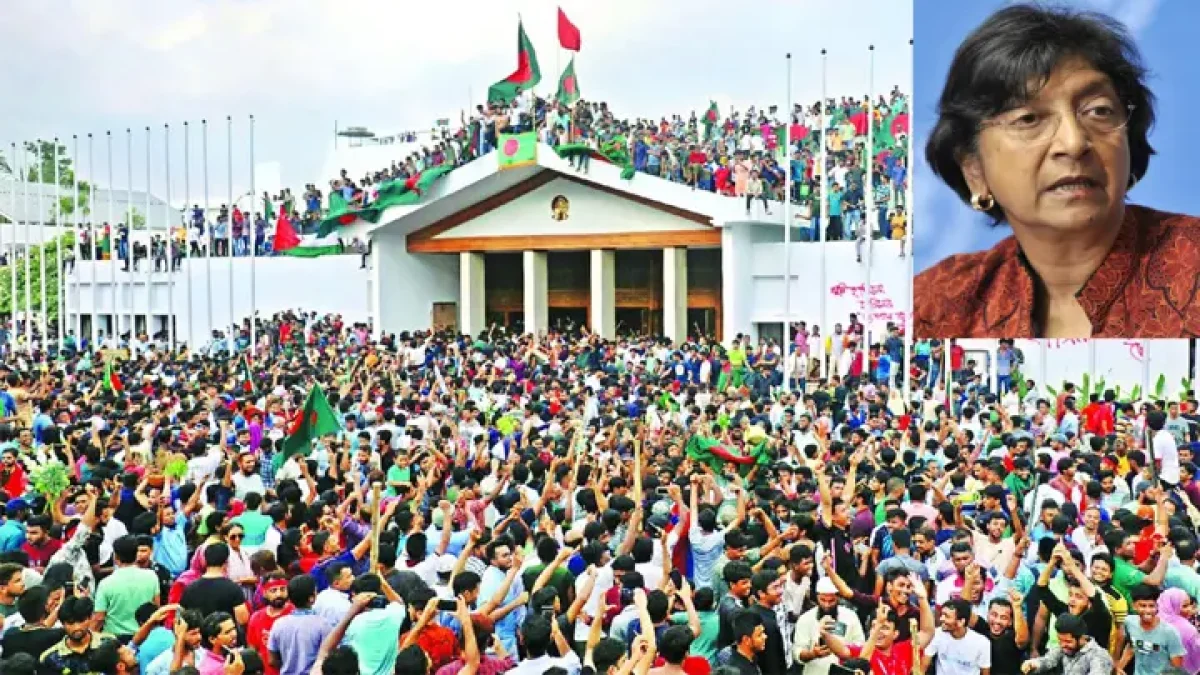
Human rights advocate Navi Pillay has won the Nobel peace prize. The Norwegian Nobel Committee awarded her the prestigious prize for her important role in securing justice for war crimes, crimes against humanity and genocide. The South African human rights lawyer and judge was the United Nations High Commissioner for Human Rights from 2008 to 2014.
In 2013 she expressed concern about the trials for the crimes against humanity of 1971 and the legal proceedings that followed the 2009 BDR mutiny, both conducted under the government of Bangladesh’s then prime minister, Sheikh Hasina. At the centre of her statements on Bangladesh’s judicial process and human rights situation was this: that trying the atrocities of 1971 and ending impunity was essential, and that the trials must equally meet international human rights standards and ensure justice and the rights of the accused.
Concern over the International Crimes Tribunal
The International Crimes Tribunal was set up to try genocide, crimes against humanity and other serious crimes committed during Bangladesh’s Liberation War of 1971. The Awami League government led by Sheikh Hasina took the process forward after coming to power in 2009. It was deeply bound up with Bangladesh’s history, the memory of the Liberation War and the long-standing question of impunity.
In a statement on 6 November 2013 as UN High Commissioner for Human Rights, Navi Pillay said the International Crimes Tribunal could play an important role in tackling impunity for the mass atrocities of 1971 and in providing redress to victims who had long waited for justice. But to establish the rule of law and strengthen the fight against impunity in the wider region, she said, the highest standards had to be maintained in the proceedings.
An important part of her concern was the death penalty. Given the questions raised about the fairness of the tribunal’s proceedings, she called on the government not to carry out death sentences in its cases. Her statement reflected both concern about the fairness of the trials and the UN’s position of principle against the death penalty.
Sharp criticism of the mass trial in the Pilkhana case
Navi Pillay expressed deep concern after 152 people were sentenced to death over the 2009 BDR mutiny at Pilkhana. Her statement of 6 November 2013 said the mass trial had fallen far short of international human rights standards.
In the mutiny and killings at the BDR headquarters at Pilkhana in Dhaka on 25 and 26 February 2009, 74 people were killed, 57 of them army officers. Expressing sympathy for the families affected, Pillay said true justice could not be achieved by trying hundreds of people together, amid allegations of torture in custody, and by imposing death sentences without meeting basic standards of fair trial.
On 5 November 2013 a special sessions court in Dhaka sentenced 152 people to death, 161 to life imprisonment and 256 to prison terms of various lengths in the case. A further 277 were acquitted. Because so many accused were tried in a single judgment, questions were raised internationally about each defendant’s individual responsibility, the opportunity to mount a defence and the transparency of the proceedings.
Pillay’s statement noted in particular that there were allegations of procedural irregularities in the trial of a total of 847 suspects in the case. In her view the accused were not given adequate and timely access to lawyers. Her objection was not merely to the pace of the court’s work or the size of the case; the question was whether the charges against each accused had been properly examined, and whether effective legal assistance and the right to a fair defence had been ensured.
Allegations of torture and deaths in custody
The gravest part of Pillay’s statement concerned allegations of torture and deaths in the custody of the security forces. It said there had been reports that several people detained on suspicion of involvement in the mutiny had died in custody, and allegations of widespread torture of detainees. There were also reports that evidence obtained through torture had been admitted in court in proceedings involving hundreds of defendants.
Pillay called for an independent and thorough investigation of the allegations of torture and deaths in custody. She called for the findings to be made public and for those responsible for torture or other human rights violations to be held to account. Her statement also referred to Bangladesh’s international obligations under the UN Convention against Torture.
She also stated clearly that evidence gathered through torture should not be used in court. Confessions or testimony extracted by torture raise questions of reliability and violate the basic rights of the accused, and sentences based on such evidence can damage the credibility of the judicial process.
Call for each sentence to be reviewed separately
Another of Pillay’s main demands was that the conviction and sentence of each accused be reviewed individually. Her position was that, in place of trying hundreds of people together, the charges, the evidence and the nature of the responsibility of each must be properly assessed, and that no evidence obtained through torture should be admitted in court.
Pillay reminded the government of Bangladesh that while the perpetrators needed to be held to account, this had to be done in accordance with Bangladesh’s law and its international obligations. She referred in particular to the fair trial standards of the International Covenant on Civil and Political Rights (ICCPR), which Bangladesh ratified in 2000.
International law and Bangladesh’s obligations
To understand the legal basis of Navi Pillay’s statement, Bangladesh’s obligations under international treaties have to be considered. Article 14 of the ICCPR recognises the right to a fair and public hearing, an independent and impartial court and the right of the accused to a defence. Article 7 of the same covenant prohibits torture and cruel, inhuman or degrading treatment.
Under the UN Convention against Torture there is also an obligation to investigate allegations of torture and, with specific exceptions, not to use statements obtained through torture as evidence. In her statement Pillay set out the need to review Bangladesh’s judicial process in the light of these obligations.
What the statement means for assessing the Hasina years
Navi Pillay’s 2013 statement is an important early document of international concern about the justice system and the human rights situation under Sheikh Hasina’s government. It raised questions about two separate sets of proceedings: the standard of fairness in the trials for the crimes of 1971, and the trial of a very large number of accused in the 2009 BDR mutiny case, with its allegations of torture and deaths in custody.
At least three points of significance emerge from it.
First, the political or historical need to try serious crimes does not cancel the obligation to ensure a fair trial. The trials for the crimes of 1971 may be an important means of giving justice to victims, but ensuring the transparency and acceptability of the proceedings is equally important.
Second, the basic rights of the accused must be upheld even in trials conducted in the interest of state security, discipline and the suppression of crime. While acknowledging the horror of the Pilkhana killings, Pillay questioned the torture, the inadequate legal assistance and the method of a mass trial. Her position was that the perpetrators must be held to account, but in a manner consistent with the rule of law.
Third, international human rights monitoring is not a final verdict on a government’s rule as a whole. From this particular statement, Pillay’s concerns about judicial process, the death penalty, torture in custody and the right to justice during Sheikh Hasina’s time in office may be treated as relevant evidence in assessing that government’s human rights record.
The central meaning of Navi Pillay’s statement of 6 November 2013 is that justice is not only a matter of ensuring that crimes are punished. How a trial is conducted, whether the rights of the accused are protected and whether allegations of human rights violations are impartially investigated are also inseparable parts of justice.
বাংলায় মূল প্রতিবেদন পড়ুন · Read the original Bengali report