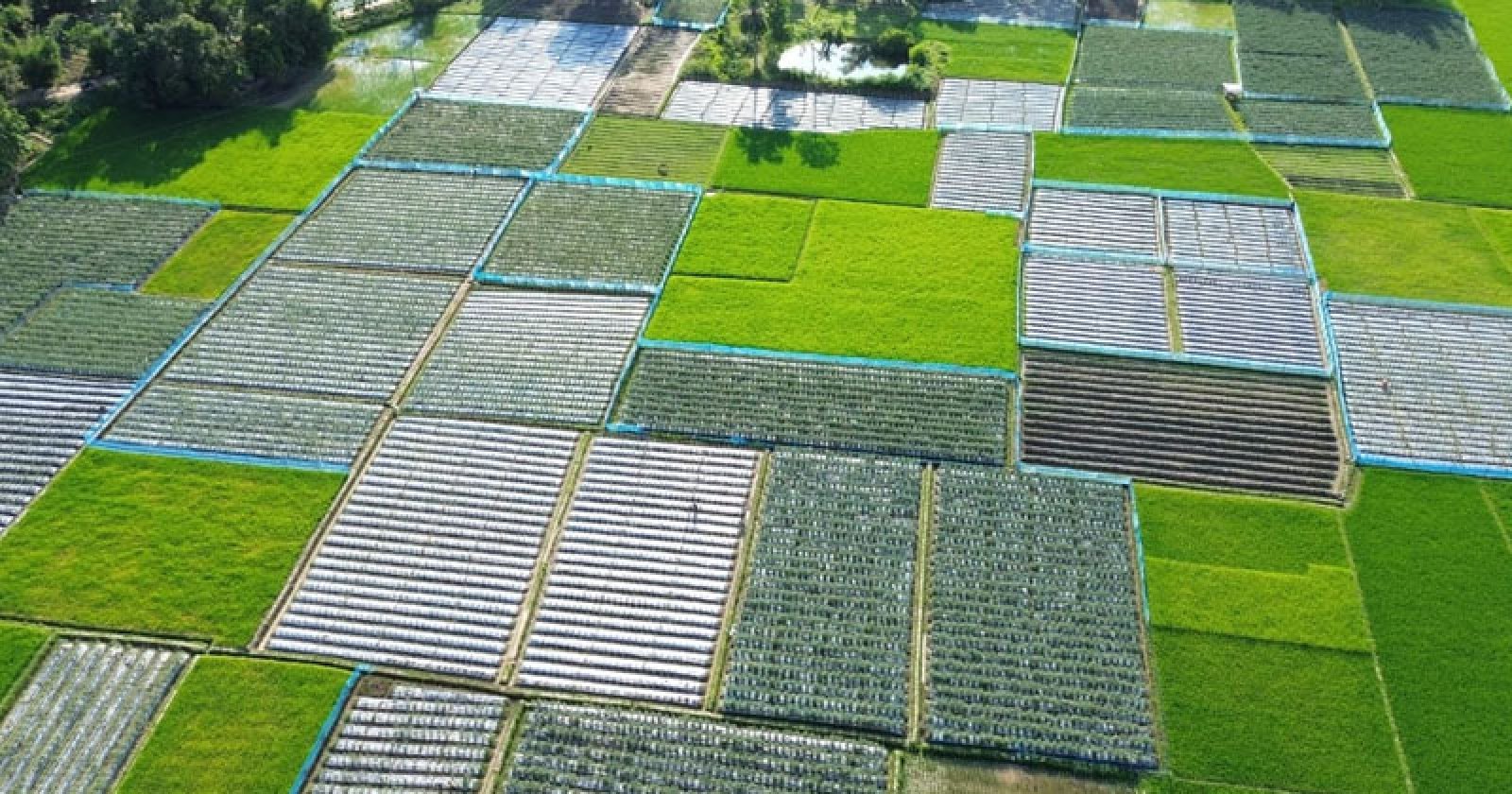
Special grafted seedlings are being made by joining the stems of improved tomato varieties to the tough roots of wild brinjal. Produced with precise cuts of a blade, these seedlings are changing the farm economy of Kamalganj upazila in Moulvibazar. Demand for Kamalganj’s disease-resistant, high-yielding tomato seedlings has spread to at least 10 districts, from Cumilla to Cox’s Bazar and from Mymensingh to Patuakhali.
According to the upazila agriculture department, Kamalganj produces 6.5 to 7 million grafted seedlings each season, generating local transactions of about 5 to 6 crore taka within just a few months.
Visits to Adampur, Jalalpur, Bongaon, Kandigaon, Moddhogaon, Najatkona and other parts of Kamalganj found the nurseries busy. Sitting beside rows of seedlings, workers cut the stems of wild brinjal with blades and join tomato stems to them. Growers said the wild brinjal seedbed takes about 35 days and the tomato seedlings 25 days. The two are then cut at set points, joined and tied with polythene. Within three to six days the two parts fuse, and after another 10 to 12 days in an intensive care room the seedlings are ready for sale. Each grafted seedling now sells for 12 to 15 taka.
Ordinary tomato plants are at risk of collapsing in even light rain or dying of root rot, the growers say, but because wild brinjal has very strong roots, grafted tomato plants have far fewer such problems. Local farmer and successful seedling producer MA Karim said wild brinjal is a wild variety related to tomato. “When tomato seedlings are grafted onto it, the plants do not die easily and yield more,” he said. An ordinary plant produces 5 to 10kg of tomatoes, while a grafted plant can yield 20 to 25kg, he said. Demand is so high that advance orders come in before the season from 8 to 10 districts, including Sylhet, Cumilla, Cox’s Bazar, Mymensingh and Patuakhali.
Grafted seedling production has also created new jobs in Kamalganj’s rural economy. A skilled worker can graft 1,000 to 1,200 seedlings a day and earns well from it. Locals say the technique is not only raising yields in farmers’ fields but gradually becoming a significant economic activity, with work in the nurseries for hundreds of women and men.
“This season, at least 480 farmers are growing summer tomatoes on about 60 hectares in the upazila,” said Kamalganj upazila agriculture officer Md Rakibul Islam. “The 6.5 to 7 million grafted seedlings produced by Kamalganj’s growers are going to different parts of the country. The sector generates an average of 5 to 6 crore taka in a season, a big achievement for local agriculture.”
“Grafted seedlings have opened new possibilities for Kamalganj’s farm economy,” local entrepreneurs said. “If government support, quality seed and technical facilities can be increased, farmers’ income and employment from this sector could rise several times over.”
বাংলায় মূল প্রতিবেদন পড়ুন · Read the original Bengali report