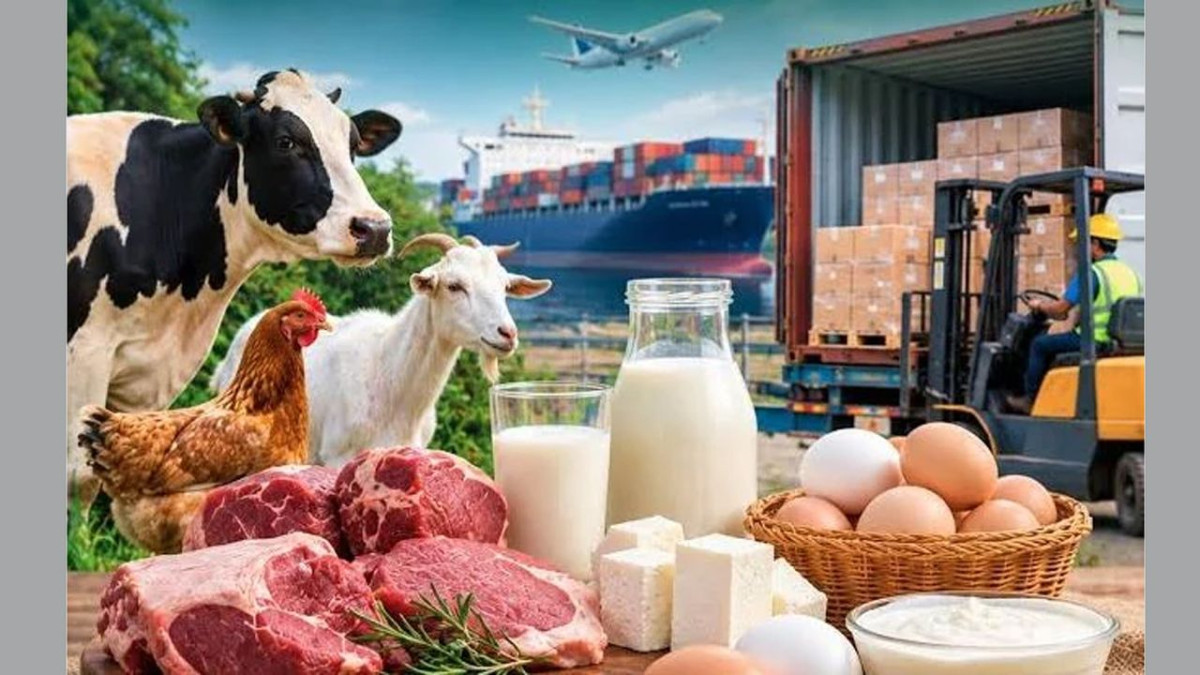
Bangladesh’s exports of livestock products rose 217 percent to $10.464 million in the six months from March to August this year. In the previous six months, from September 2025 to February 2026, these exports stood at $3.299 million.
According to the Department of Livestock Services (DLS), the country’s production of meat and eggs has exceeded national demand. As a result, per capita supply is now above the minimum nutritional requirement.
The country currently produces about 9.07 million tonnes of meat and 25.0941 billion eggs a year, against an estimated annual demand of 7.814 million tonnes of meat and 18.5536 billion eggs.
Milk production, however, still falls short of demand, according to the latest DLS statistics.
With higher output, meat availability is now 139.29 grams per person per day, above the minimum requirement of 120 grams. Annual per capita meat availability is 50.84 kg, against a minimum requirement of 43.8 kg.
According to the latest Household Income and Expenditure Survey of the Bangladesh Bureau of Statistics (BBS), however, annual per capita meat consumption is only 14 kg.
Similarly, annual per capita egg availability has passed 140, against a requirement of about 104.
Over the decade from fiscal year 2016-17 to 2025-26, meat and egg production rose by 26.78 percent and 68.04 percent respectively.
About 40 percent of meat production comes from broiler chickens, which can now meet national demand. Egg production has also reached the level of meeting national demand.
Milk production rose 69.71 percent over the past decade to about 15.753 million tonnes, but that is still below the annual demand of 16.279 million tonnes. Daily per capita milk availability is about 241 millilitres, against an estimated requirement of 250 millilitres.
In fiscal year 2025-26, meat production rose by 0.116 million tonnes, from 8.954 million tonnes the previous year to 9.07 million tonnes. Egg production rose 2.83 percent, from 24.4065 billion to 25.0941 billion.
Speaking to reporters, DLS Director General Md Shahjaman Khan named the government’s policy support, the creation of entrepreneurs and the improvement of cattle and poultry breeds as the main reasons for the rise in production.
Efforts to ensure antibiotic-free production at every stage of the supply chain have also contributed to the sector’s progress, he said.
On exports, Shahjaman said livestock product exports earned $15.447 million, or Tk 193.08 crore, in the first three months (July-September) of fiscal year 2026-27. Earnings for the whole of fiscal year 2025-26 were $8.206 million, or Tk 102.57 crore.
He said the DLS is working to ensure product quality and food safety. The agency is also working to meet international sanitary and phytosanitary (SPS) requirements, improve cold storage facilities and make export prices competitive. Work is also under way to find new export markets to keep the trend going.
On the sector’s potential, Dr Shakila Faruque, director general of the Bangladesh Livestock Research Institute (BLRI), said the country’s livestock production needs to rise to at least three times its current level. People in Bangladesh eat about 140 eggs a year on average, she said, while in developed countries the figure is about 400. Chicken consumption in Bangladesh is also far lower than in developed countries.
Noted economist Dr Jahangir Alam stressed the use of modern technology and higher production capacity to bring livestock products within ordinary people’s reach.
Meat, milk and eggs cost more in Bangladesh than in neighbouring India, mainly because of inefficient production, he said.
He urged the government to support grassroots entrepreneurs and to act so that corporate groups cannot control the market or manipulate prices.
He also called for wide distribution of modern equipment among livestock, dairy and poultry farmers, including milking machines, grass cutters, tractors, straw cutters, milk cans, cream separators and pasteurisation plants.
With the number of farm workers falling, mechanisation has become essential, Dr Alam said. Every farm should be developed as a modern production unit.
Former BLRI director general Dr Shahidul Haque called on the government to give livestock farmers incentives, as it does for crop farmers.
He stressed introducing an animal identification and record-keeping system, strengthening livestock policy and law, and providing insurance to protect marginal farmers.
He also advised improving livestock breeds through research and by bringing in high-yielding and crossbred varieties, including suitable breeds from abroad.
The government should introduce a price-setting system and curb the dominance of middlemen so that both farmers and consumers get fair prices, Dr Haque said.
To tackle marketing challenges and ensure fair prices for farmers’ products, he proposed setting up a livestock marketing wing under the DLS.
He noted that although about one percent of farmland is lost to non-farm use every year, there is still ample room to expand livestock production in Bangladesh.
Rural households can help the sector grow by raising broilers, layers, cattle, goats and sheep, he said, which would encourage new farms for meat, milk and egg exports and create jobs.
In fiscal year 2025-26, the livestock sector contributed 1.81 percent of the country’s GDP and 16.56 percent of agricultural GDP. About 43.64 percent of households in the country are involved in raising cattle and poultry.
About 20 percent of the country’s population depends directly on the sector and about 50 percent indirectly.
A combined Tk 43,355 crore, or 0.63 percent of GDP, has been allocated for the agriculture, food, fisheries and livestock sectors in fiscal year 2026-27. (BSS)
বাংলায় মূল প্রতিবেদন পড়ুন · Read the original Bengali report