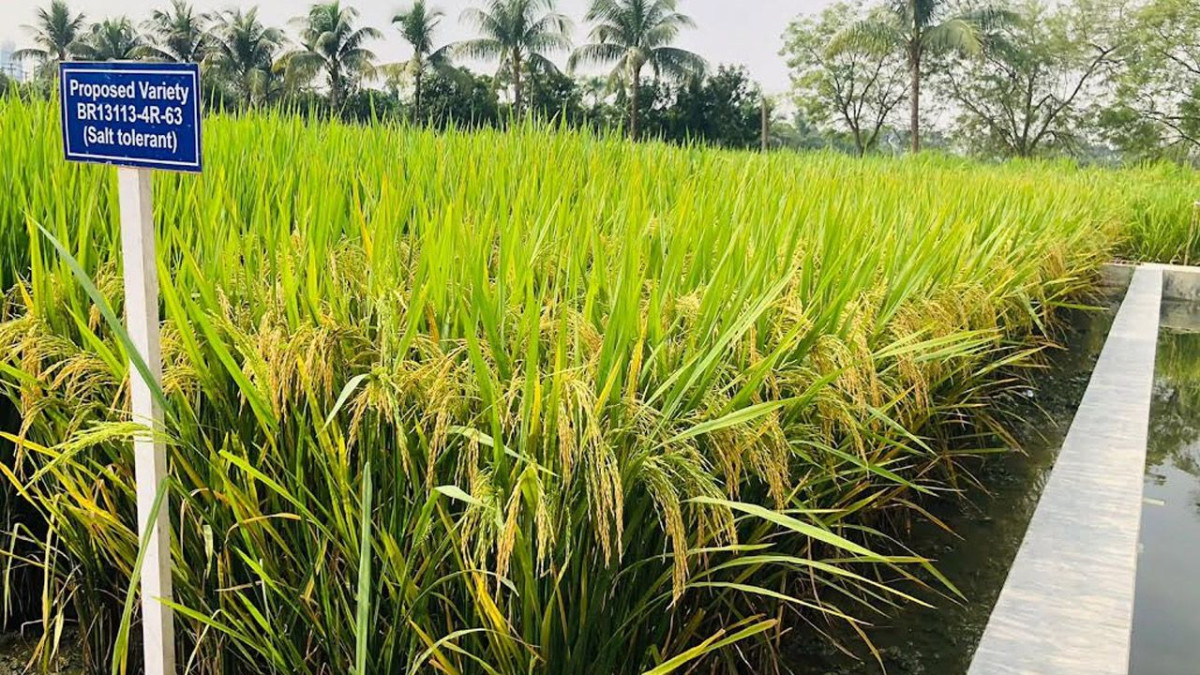
A new rice variety developed by the Bangladesh Rice Research Institute (BRRI), BRRI dhan119, opens up new ground for growing rice in the country’s salt-prone coastal areas and other harsh conditions.
The National Seed Board gave the variety final approval for cultivation in the transplanted Aman season at its 116th meeting, held recently, Md Al Amin, an officer in BRRI’s publications and public relations division, confirmed.
The variety was developed by a team of researchers led by Mohammad Ekhlasur Rahman, chief scientific officer in BRRI’s plant breeding division.
The research was funded by the Location Specific Technology Development (LSTD) project. The team also included senior scientific officer Hasina Khatun, senior plant breeder Nusrat Jahan, scientific officer Armin Akter Setu and scientific officer (CRCIL) Ribet Farzana Disha.
The variety has a life cycle of about 115 days. Besides saline coastal areas, it can also be grown in non-saline parts of the country. That leaves room to grow a winter (Rabi) crop such as mustard or sunflower on the same land after the Aman harvest.
According to the researchers, seed should be sown between 1 and 30 July in the Aman season. They advise planting 25 to 30-day-old seedlings on medium-high to high land, two to three per hill, with rows 20 cm apart and hills 15 cm apart.
The variety has also been trialled in saline and non-saline conditions at 20 locations across the country under the supervision of the Seed Certification Agency, and has already won the National Technical Committee’s recommendation for the Boro season. If the National Seed Board gives final approval, it can be grown in both the Aman and Boro seasons.
According to agricultural data, with proper care the variety yields an average of up to 5.7 tonnes a hectare, ranging from 4.8 to 7.6 tonnes depending on conditions and salinity. That is about one tonne a hectare more than the widely grown BRRI dhan73. The plants average 113 cm in height and their stems are sturdy, so they do not lodge easily. The variety can withstand salinity of 12 deciSiemens per metre for up to three weeks at the seedling stage, and 8 to 10 deciSiemens per metre at the sensitive stages from vegetative growth to reproduction.
Each panicle of BRRI dhan119 carries about 215 filled grains, 70 to 80 more than BRRI dhan73, and the grains do not shatter easily. The rice is medium-slender and white, cooks fluffy and separate, and has an amylose content of 25.9 percent.
BRRI Director General Md Rafiqul Islam said the development of BRRI dhan119 was a very important achievement for agricultural research in the country. He said it would help coastal farmers grow rice and play a major part in strengthening the country’s food security.
Lead researcher Mohammad Ekhlasur Rahman said the whole team had worked with great dedication at every stage of the long research, and that seeing the variety’s benefits reach farmers’ fields was the greatest reward for their work.
Field trials in several regions
According to people involved, a series of field trials was carried out in different parts of the country to test the variety. In Cox’s Bazar, the breeding line was assessed under salinity that rose and fell as the crop grew. Yield trials were also run in stages in the saline areas of Satkhira and in favourable non-saline conditions. Its suitability was also tested in fields with farmers taking part in several areas. The research found that yield depends on the level and duration of salinity, the plant’s growth stage and how the crop is managed.
Room for an extra crop after Aman
Because of its short life cycle, BRRI dhan119 could change the usual cropping pattern in coastal areas. After the transplanted Aman harvest, medium-high to high land may have enough time left for sunflower and salt-tolerant mustard. In suitable areas, that would allow one more crop a year from the same land.
After the Boro harvest, there is also scope to grow dhaincha as green manure, which can raise the soil’s organic matter and fertility. In other words, the variety can help keep land productive as well as raise rice yields.
Its suitability for the Boro season has also been tested. Under the Seed Certification Agency’s supervision, proposed variety trials (PVT) of the breeding line were completed at 20 locations in non-saline conditions. On the strength of the results, the National Technical Committee recommended it for the Boro season. If the National Seed Board gives final approval, the same variety can be grown in both the Aman and Boro seasons. That would increase cropping intensity and diversity in coastal areas and give farmers a chance to earn more.
Cultivation and fertiliser
For the transplanted Aman season, the guidance is to sow BRRI dhan119 seed between 1 and 30 July. Seedlings 25 to 30 days old should be transplanted two to three per hill, with 20 cm between rows and 15 cm between hills. Medium-high to high land suits the variety.
The recommended fertiliser per hectare is 234 kg of urea, 87 kg of TSP, 117 kg of MoP, 78 kg of gypsum and 12 kg of zinc sulphate. All the TSP, gypsum and zinc sulphate, with half the MoP, should be applied at the final land preparation.
Urea should be applied in three equal instalments: the first 10 to 15 days after transplanting, the second after 30 days, and the third five to seven days before panicle initiation. The remaining half of the MoP should go in with the last urea instalment.
Farmers should watch regularly for disease and pests and act as needed. Before using pesticides, they should identify the attack and follow the advice of a specialist or an agricultural extension worker. BRRI’s Genetic Resources and Seed Division in Gazipur is responsible for producing seed of the variety. Those involved say producing and supplying quality seed will be key to spreading it among farmers.
বাংলায় মূল প্রতিবেদন পড়ুন · Read the original Bengali report