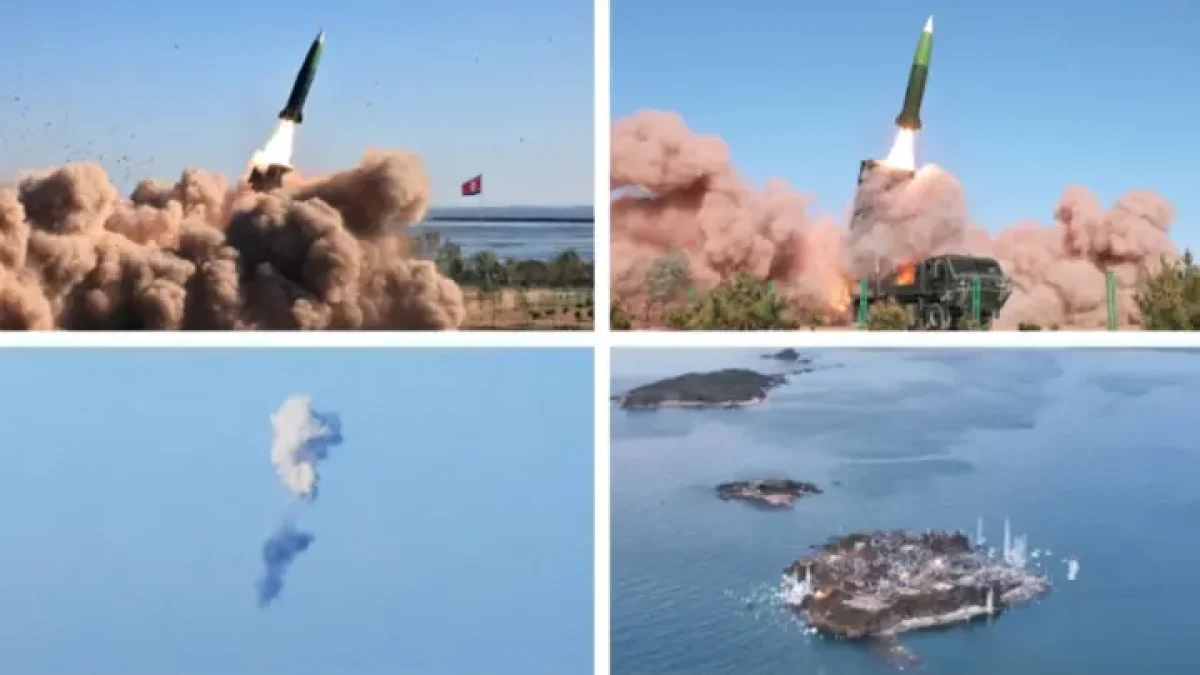
North Korea has tested a cluster-bomb warhead fitted to its short-range tactical ballistic missile. The country said Saturday’s test verified the warhead’s ability to destroy targets across an area of 12 to 13 hectares.
The test is the latest in a series of weapons trials by the nuclear-armed state. North Korean state media described it as an “important” weapons test.
Citing defence officials, the Korean Central News Agency (KCNA) said the test checked the performance of a “standard Type-2 cluster bomb warhead”. The officials claimed the warhead can completely destroy a target area of 12 to 13 hectares through strikes of maximum density.
Photographs released with the report showed the launch of a Hwasong-11D short-range ballistic missile. They also showed the cluster warhead striking an island used as a target.
North Korea’s Missile Administration said warheads of this kind have been divided into four classes, but it gave no details of the classes. KCNA quoted the administration’s director general as saying: “Within this year, military units will be given the ability to choose and use every type of warhead according to their mission objectives and the nature of their targets.”
The test was conducted by General Kim Jong-sik, a senior official involved in developing North Korea’s weapons programme. The country’s leader, Kim Jong Un, did not attend. South Korea’s Yonhap news agency said Kim Jong-sik is a member of the ruling Workers’ Party’s Central Military Commission and a first vice department director of its Central Committee.
How cluster bombs work
A cluster bomb is a weapon whose main bomb or warhead bursts open and scatters many smaller bomblets, or submunitions, over a wide area. This lets it strike many points across a large area at once. Some of the bomblets can fail to explode and lie on the ground, and they can go off later, killing and injuring civilians.
According to the International Committee of the Red Cross (ICRC), cluster munitions pose a serious danger to civilians both when they are used and later, from bomblets that did not explode. Civilians made up 87 percent of cluster munition casualties recorded in 2025.
The Convention on Cluster Munitions, adopted in 2008, bans the use, production, stockpiling and transfer of these weapons. North Korea is not a party to it. The Landmine and Cluster Munition Monitor’s 2026 report lists the country among states that produce and stockpile cluster munitions.
A string of weapons tests
North Korea has tested a range of missiles and military technology in recent weeks. On Thursday it fired about 10 ballistic missiles from its east coast towards the sea. The launches took place while German Chancellor Friedrich Merz was visiting South Korea.
Earlier, on October 17, Pyongyang said it had tested a new type of torpedo that uses artificial intelligence (AI) to identify targets and steer itself along a set course. KCNA said the test of the high-speed torpedo, named “Jam-2.0”, was carried out to check its technical development. North Korea claims AI is used in the torpedo’s target identification and guidance.
Before that, North Korea also reported testing two types of strategic cruise missile from a submarine. Its military is testing missile launches from different platforms to strengthen its naval warfare capability.
Last week Kim Jong Un inspected a display and trial of unmanned aircraft technology, where advanced drones built with AI were shown. He urged the country to achieve “absolute superiority” in drone technology.
Tests amid rising tension between the two Koreas
The recent tests come as tension between North and South Korea has risen again. Last week a North Korean self-propelled gun was seen in the open near the border with South Korea. Reuters noted that such a visible presence of heavy weapons in the heavily fortified border area is unusual.
A Reuters witness at a South Korean observation post saw three North Korean armoured vehicles near the border. Yonhap identified the weapons as 122 mm self-propelled howitzers. Reuters reported that their barrels were pointed towards South Korea.
About 20 to 30 North Korean soldiers were also seen building a fence in the Demilitarized Zone (DMZ) along the border, prompting accusations from both sides.
A show of force before a Trump-Kim meeting?
The Asia-Pacific Economic Cooperation (APEC) summit is due to be held in Shenzhen, China, on November 18 and 19. There has been talk of a possible meeting between US President Donald Trump and North Korean leader Kim Jong Un on its sidelines.
Trump has said several times that he wants to sit down with Kim, but the North Korean leader has not yet publicly responded. Analysts believe the recent tests may be an effort to display military strength before a possible meeting and to strengthen Pyongyang’s bargaining position.
Whether the meeting will happen remains uncertain. On Saturday, US Secretary of State Marco Rubio said Trump is ready to meet Kim if North Korea is willing to discuss the concerns of Washington and its allies. No meeting has been scheduled so far.
On October 23, Reuters reported, citing US and South Korean officials, that the chances of a Trump-Kim meeting this year were fading. North Korea has not responded to US attempts at contact, although a meeting during the APEC summit has not been ruled out entirely.
US, Japan and South Korea hold firm on denuclearisation
On Saturday the United States, South Korea and Japan reaffirmed their commitment to the complete denuclearisation of North Korea. The three countries’ foreign ministers discussed the issue on the sidelines of a G20 foreign ministers’ meeting in Atlanta.
US Secretary of State Marco Rubio, South Korean Foreign Minister Cho Hyun and Japanese Foreign Minister Toshimitsu Motegi also agreed on full implementation of UN Security Council sanctions. They stressed in particular stopping activities that could fund North Korea’s nuclear and ballistic missile programmes.
Pyongyang, however, has rejected demands that it give up its nuclear weapons. Its own law enshrines its status as a nuclear power. Kim Jong Un and other senior officials have repeatedly said there is no question of giving up the nuclear arsenal.
The demand for disarmament from the United States and its allies on one side, and North Korea’s steady push to expand its military capability on the other, are complicating diplomatic efforts to ease tension on the Korean Peninsula.
বাংলায় মূল প্রতিবেদন পড়ুন · Read the original Bengali report