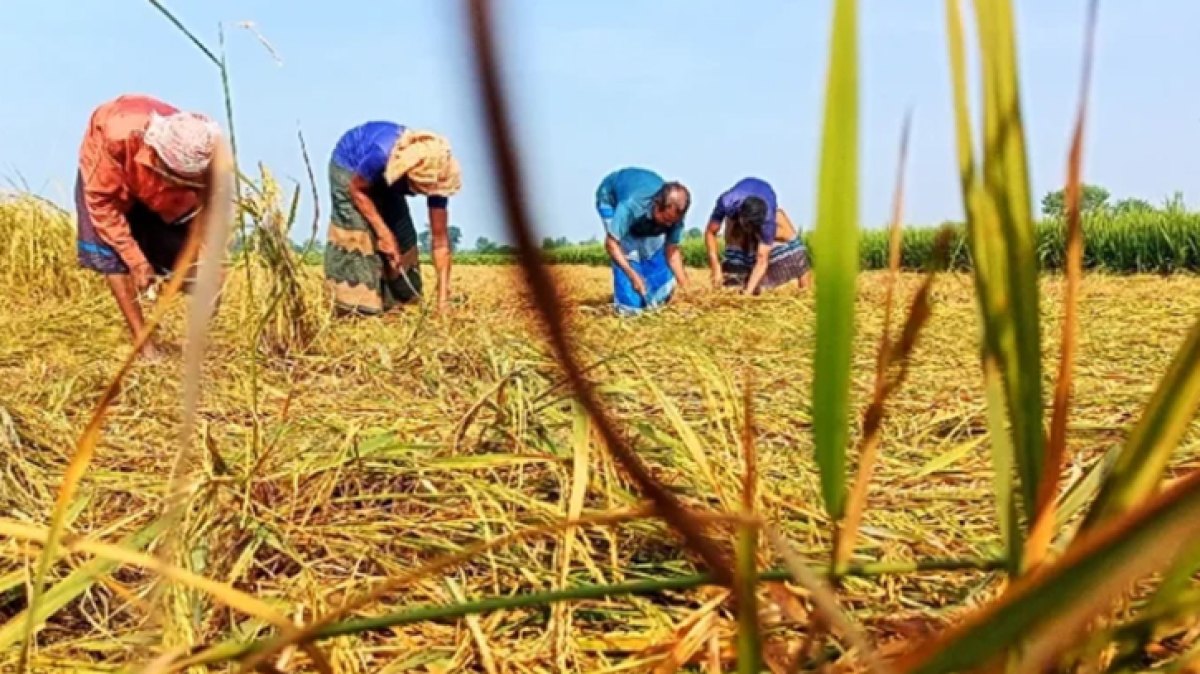
The fields are full of ripe Aman paddy. In some places the harvest is under way; in others farmers are getting ready to bring the crop home. Yet farmers in Gangni upazila of Meherpur feel none of the usual joy of the harvest. The cost of fertiliser, diesel, pesticide, irrigation and labour has risen, pushing up production costs, while local middlemen are paying only Tk 800 to 900 a maund for paddy. Unable to recover what they spent, farmers fear losses.
Farmers say the harvest season usually brings a festive mood to the villages, with folk songs, stories and laughter in the fields, and the next round of farm work starting once the crop is in. This year the gap between costs and prices has dimmed that joy. Even with the crop home, they worry whether they will get their money back.
By the farmers’ reckoning, it costs about Tk 18,000 to 20,000 a bigha from preparing the land to bringing the paddy home. Even a good yield gives at most 20 maunds a bigha. Sold at Tk 800 a maund, that brings in Tk 16,000, less than the cost of growing it. Count land rent or the value of family labour and the loss grows further.
“Fertiliser, pesticide, irrigation, diesel, everything costs more. The only thing that has not gone up is the value of a farmer’s labour,” said farmer Jofer Ali. “Fertiliser that should sell at the government price of Tk 1,350 costs us Tk 1,700 to 1,800 a sack. One sack of fertiliser eats up the price of about two and a half maunds of paddy. How will farmers survive, and how will they keep farming? We ask the government to set a fair price for crops. Then farmers will smile again.”
Paddy grower Hanif Ali said: “I spent about Tk 25,000 growing paddy on 25 katha of land, and selling the crop does not even bring that back. I have to sell at Tk 800 to 900 a maund. Often traders do not even come to buy, so we are forced to sell cheap to local middlemen. If we do not get a fair price, how can we farm? Prices of everything rise every day, and farmers are being ruined.”
Another grower, Jaker Ali, said: “Aman usually needs eight to 10 rounds of irrigation. This time it is taking 25 to 30, because there has been no rain. Farming has got harder. Costs rise by the day, but we do not get a fair price for the crop.”
According to the Gangni upazila agriculture office, transplanted Aman was grown on 14,200 hectares in the upazila this season, against 14,000 hectares last year, an increase of 200 hectares.
“Early Aman harvesting has begun in the upazila,” said Gangni upazila agriculture officer Abdullah Al Mamun. “The yield is good, but farmers are not getting a fair price and production costs have risen. The agriculture office is working to make sure farmers get a fair price for their crops, and steps are also being taken so that they do not face problems getting fertiliser at the fair price.”
বাংলায় মূল প্রতিবেদন পড়ুন · Read the original Bengali report