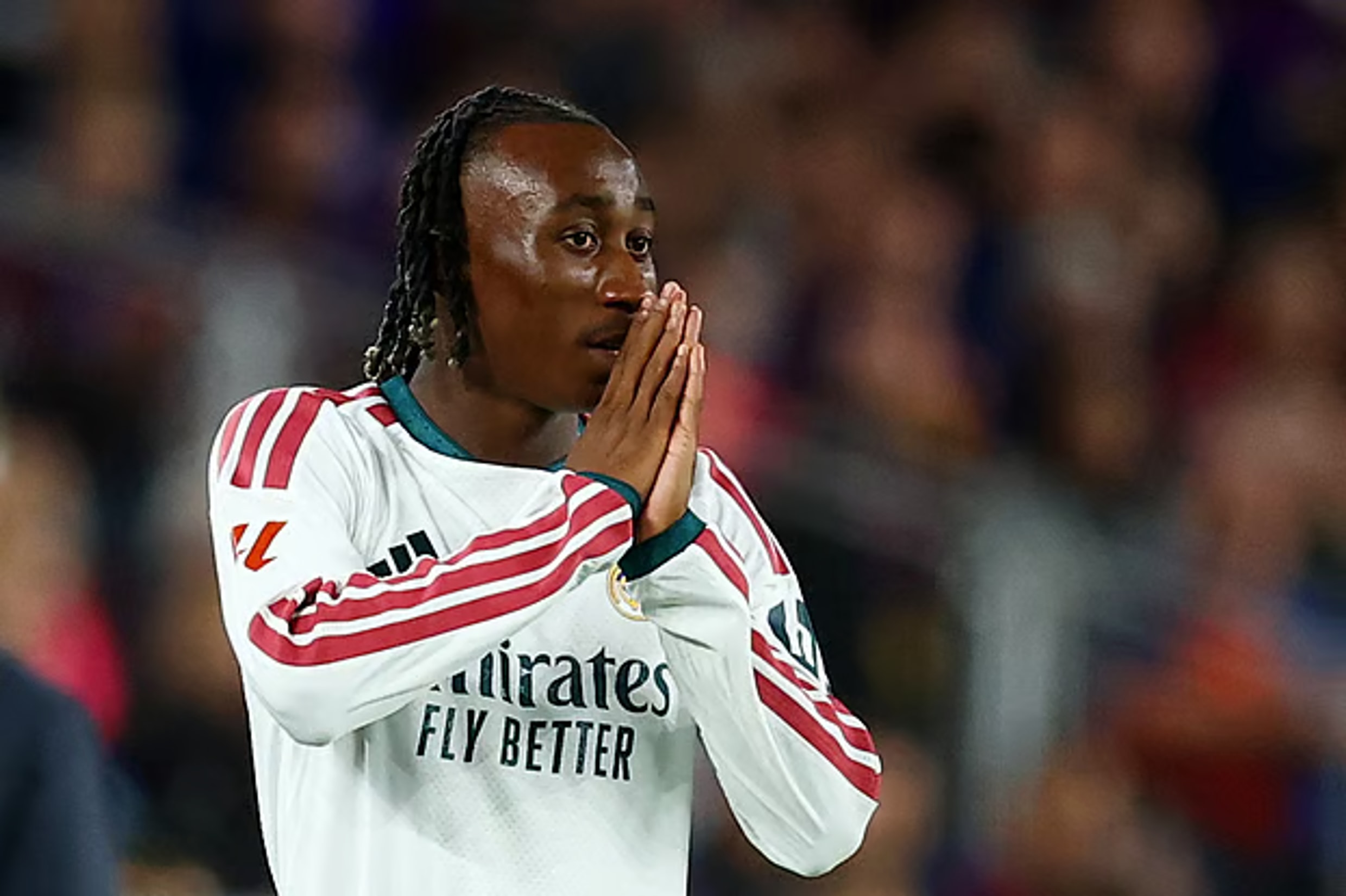
Nobody can say where fate will take a person. The rich man of today can be on the street tomorrow; the king of today a beggar the next. Real Madrid’s Yan Diomande is the hero of just such a story, in reverse.
A football made from old clothes, torn socks or rags wound together. With luck, a plastic ball. With more luck, an old leather one.
That is how a group of children played football in the Sicogi neighbourhood of Yopougon, in the Ivorian city of Abidjan. Sometimes on dirt, sometimes on concrete road, dodging the crowds with the ball at their feet. No shoes; at best, sandals. One of those children was Yan Diomande.
In a neighbourhood where three meals a day was a dream, football boots were a royal luxury. Yet the boy’s dream was royal too: one day he would be Africa’s Cristiano Ronaldo. Who knew it would come this close to coming true? Diomande now plays for Real Madrid. Feet that once had no shoes now carry the hopes of European football’s grandest club. It reads like a fairy tale.
But the fairy tale did not begin prettily. His father had gone to France in search of work, and Diomande grew up with his mother and his sister, Roxane. Want was a constant companion; football was the only joy. And at football the boy was different from the start.
His dribbling was extraordinary and his shot ferocious, so the neighbours called him “Roberto Carlos”, after the famous left-footed Brazilian. Then one day street football changed his life.
A businessman and talent scout named Dez Bamba spotted the boy and took him to the academy he had founded, AFI Sud-Comoé, in Assouba, 100 kilometres east of Abidjan. Diomande arrived in 2014, aged 10. There were 40 other gifted children there, many going to school for the first time, with three meals a day and sometimes four. To Diomande it was heaven.
The academy was run by a Spanish coach, José Julián López, now coordinator of the Valdemoro football academy in Spain. He still remembers the little boy vividly. “From the first moment I knew that, with the ball at his feet, he was something special,” López said. “He dribbled, he took on defenders, he cut inside. He was incredibly brave.” He was so gifted that he was moved straight from the under-12 to the under-14 side.
There was only one problem: once he had the ball, Diomande did not want to stop. He would set off from near his own goal, beat five or six bigger players and reach the opposing goal, sometimes scoring, sometimes losing the ball. López’s first job was to teach him when to stop, when to dribble and when to pass. The boy learned astonishingly fast. “I still remember the way he looked at me when I explained something,” López said. “He did not just want to know what to do, but why.”
He was bright in the classroom too. Of the children who came to the academy, 80 percent could not read or write, and it taught them as well. Diomande was ahead in both. And football? “Dribbling and shooting were in him from birth,” López recalled. “We gave him his first pair of boots, and then it was as if he took off. The other boys’ shots could not even reach the goal, and he took corners with incredible skill.”
He was not afraid even of boys five years older. With no regular league, the academy played friendlies against all kinds of teams, and Diomande played mostly on the right wing, a nightmare for defenders. He moved to the left wing later. Fran Castaño, director of the African Talent Elite Academy, first saw him at a qualifying tournament for the Under-17 Africa Cup of Nations, when he was only 15. “He caught the eye from the first moment,” Castaño said. “He could play on either wing. He had pace, strength, skill and the ability to score, and he scored several goals in the tournament. He was clearly ahead of the rest.”
A talent like that was bound for Europe, but FIFA’s rules stood in the way: players cannot play in Europe before 18, and while a contract can be signed at 16, they cannot play. So Diomande had to go to Florida in the United States. His academy went to Spain for tournaments twice a year, yet although many were impressed by him, nobody dared invest in a long-term project. That boy has now reached Real Madrid.
In the last transfer window Real Madrid bought him from Leipzig for 125 million euros, making Diomande the most expensive player in African history. His start was slow. His first goal in a Real shirt came on October 10 against Villarreal.
That goal won the match 1-0. After that he quickly found his rhythm: a goal and an assist in a 4-1 La Liga win over Sevilla, and in the Champions League, coming off the bench against his former club Leipzig in another 4-1 win, he set up Kylian Mbappé and scored the fourth goal himself. In all he has played 656 minutes in 13 matches for Real this season, with 3 goals and 4 assists. Real have won all five La Liga matches he has started, so he is also talked of as coach José Mourinho’s lucky charm.
Côte d’Ivoire is celebrating. Miguel Ángel Oyo, the Spanish coach of the country’s basketball team, told the Spanish outlet AS from Abidjan: “Everyone here talks only about Diomande. He is proof that talent, hard work and perseverance can take you from extreme poverty to the very top.”
The white of Real Madrid and the blue and maroon of Barcelona are already familiar sights on the country’s streets. Now the white is taking over. “The whole country is turning white,” Oyo said.
Kader Gilavogui, a journalist with Sport Ivoire, says there is history behind the craze. After the controversial 2009 Champions League semi-final between Chelsea and Barcelona, many Ivorians turned against Barcelona out of loyalty to Didier Drogba. José Mourinho’s popularity has also drawn fans to Real.
Now Diomande has taken that affection to a new level. Ivorians are putting his name beside legends such as Drogba and Yaya Touré. Gilavogui says that having got past his early settling-in problems, Diomande is now showing what he can do and has become an example for the country’s young people.
For all his fame, Diomande has not forgotten his roots. He has lifted his family and close friends out of poverty and regularly sends money to his old neighbourhood, Sicogi, where he once ran with a rag ball. The greatest inspiration of his journey was his sister Roxane, who has since died. It was her encouragement that set him dreaming of becoming Africa’s Cristiano Ronaldo.
In all, 11 players from López’s academy now play in Europe and more than 20 in Côte d’Ivoire’s top division. But to him Diomande’s story is different. Why? López once asked the academy boys what the greatest joy of being there was. The answer: “Being able to eat every day.” One of those children is now at Real Madrid.
Sometimes football does not just change a life. It gives a child the sky.
বাংলায় মূল প্রতিবেদন পড়ুন · Read the original Bengali report