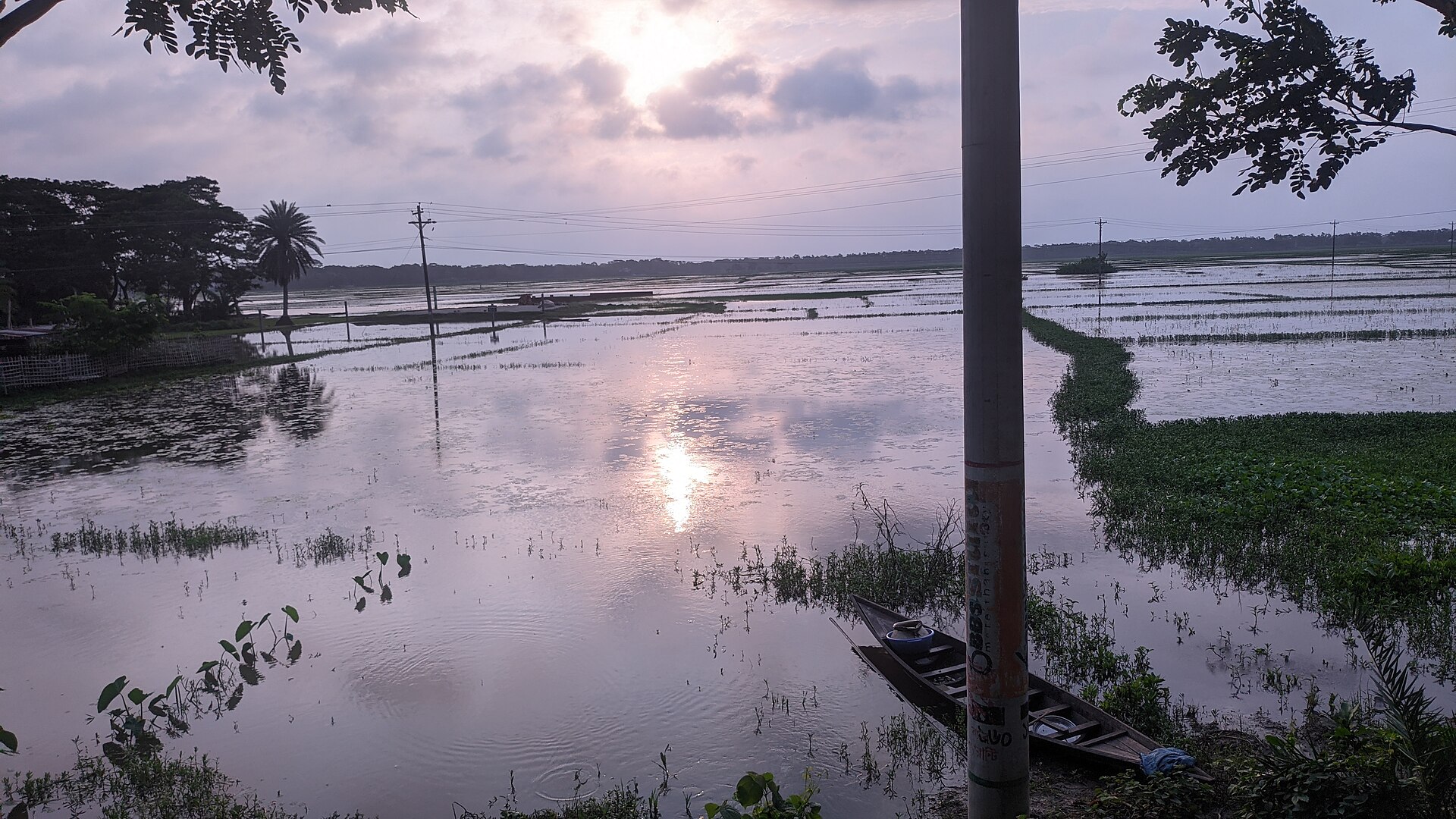
Long-standing waterlogging has again kept wide stretches of land in five upazilas of Satkhira from being planted with Aman paddy this season. By the count of the district Department of Agricultural Extension, about 12,685 hectares are under water, leaving 25,000 to 30,000 farmers unable to grow Aman. Tala upazila is the worst affected. With water standing year after year, Aman farming on much of the land has all but stopped.
According to the department, 3,730 hectares in Satkhira Sadar upazila, 1,360 in Kalaroa, 7,065 in Tala, 450 in Assasuni and 80 in Shyamnagar are permanently waterlogged. Aman seedlings cannot be planted on this land in time, so farmers are losing an important crop season.
One of the hardest-hit areas in the district is Shakdah beel in Tala upazila. Farmers there, Sohrab Hossain and Gobinda Das, said they have not been able to grow Aman on their own land for 8 to 10 years, though the beel once produced plenty of it. Now only Boro paddy is grown there each year. The long waterlogging has also shrunk grazing land for cattle.
Iqbal Ahmed, acting deputy director of the district Department of Agricultural Extension, said that because water stands for so long, farmers cannot plant Aman seedlings in time. Besides losing the crop, they face uncertainty over what they spend on seed, fertiliser, labour and land preparation. But thanks to the re-excavation of several canals last year, Aman acreage has risen by about 450 hectares this season, he said.
Ashek Elahi, a central leader of the Krishak Andolan Committee, said: “To end the waterlogging, rivers and canals must be re-excavated and the government canals in the beels opened to ordinary farmers. Drainage is blocked because the canals are in the hands of influential people.”
Dr Shimul Mondal, chief scientific officer at the Satkhira office of the Bangladesh Agricultural Research Institute, stressed the need for area-by-area scientific studies of water flow and drainage, as well as wider use of waterlogging-tolerant rice varieties and alternative farming methods.
বাংলায় মূল প্রতিবেদন পড়ুন · Read the original Bengali report