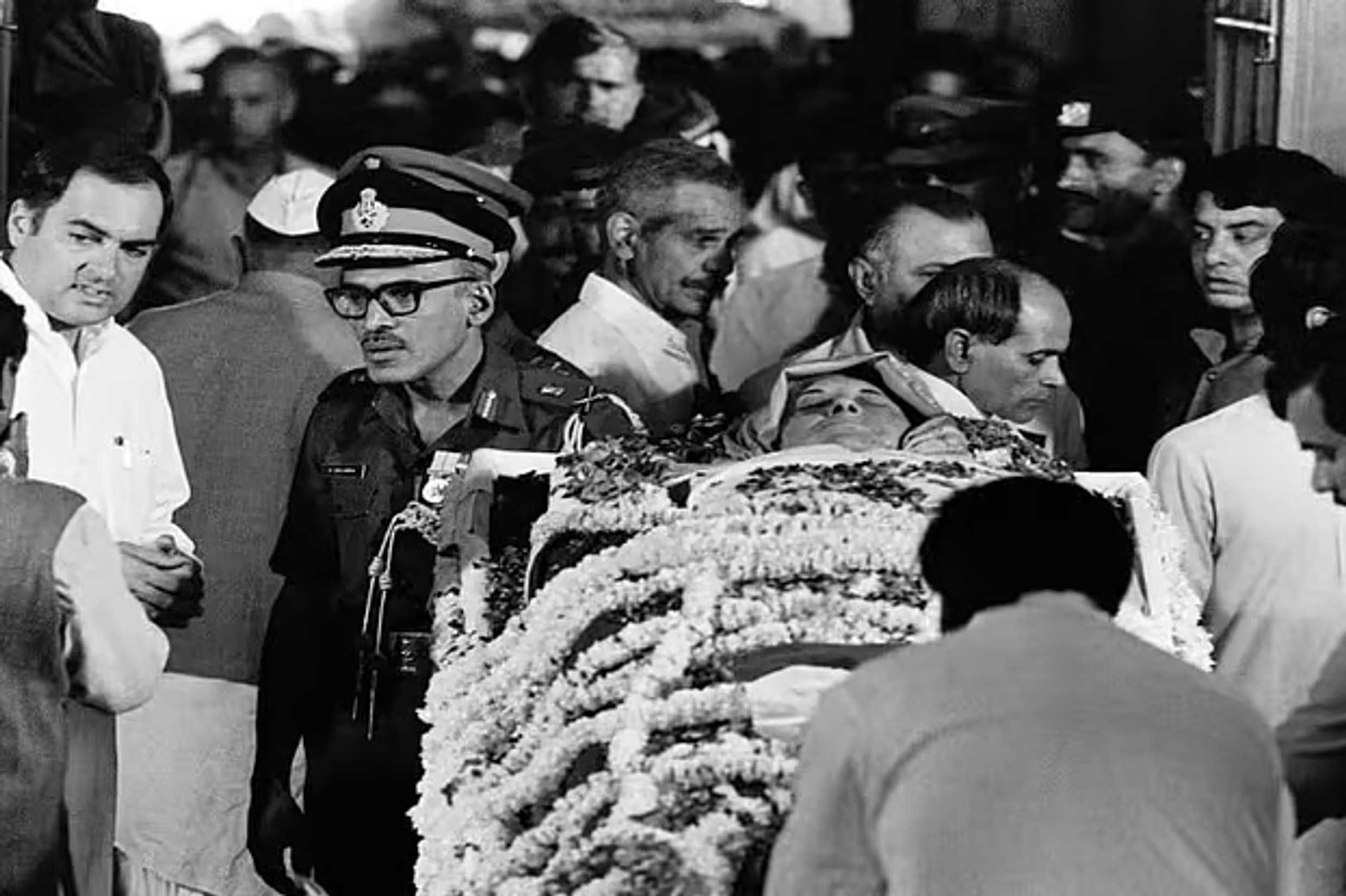
Shot by two trusted bodyguards, Indira Gandhi fell to 30 bullets
It began like any other day. The morning was bright and sunny. As on every working day, she was up early and ready by 7:30. From her wardrobe she chose a saffron sari with a black border. A foreign documentary maker was due to film her first thing, which may be why she picked it.
Dressed, she came to the breakfast table. After breakfast a make-up man dabbed a little powder and blusher on her face. Soon her personal physician, K P Mathur, arrived for his routine check.
The date was October 31, 1984. The first appointment of the day for India’s prime minister, Indira Gandhi, was with Peter Ustinov, who was making a documentary about her.
At 9:10 she stepped out of her residence. Sepoy Narayan Singh walked beside her holding a black umbrella. The prime minister was heading to her office.
A little behind her was her personal secretary, R K Dhawan, followed by her personal attendant, Nathu Ram, and at the back her personal security officer, Rameshwar Dayal.
Her office stood next to the residence on Akbar Road, and a path with a gate connected the two buildings. At that gate Indira was talking to Dhawan, giving him a string of instructions. Then came gunfire: not one shot, not two, but three in a row.
Those present watched the prime minister fall, unable to grasp what was happening. A few seconds later came a shout: “Fire!” A submachine gun opened up close by.
That day India’s first woman prime minister was killed by two of her own favoured bodyguards, and a bloody chapter opened in the country’s political history.
“Are we not secular?”
Uncompromising and resolute in politics, Indira Gandhi came to be known as the “Iron Lady of India”. Her leadership, judgement and courage earned her a name far beyond India.
But in mid-1984 she took a “hard” decision as prime minister, one she paid for with her life. It is known as Operation Blue Star.
In June 1984 she ordered the army into the Golden Temple in Amritsar, Punjab, the holiest shrine of the Sikhs, to drive out Sikh separatists. That military operation is what became known as Operation Blue Star.
The bloody assault provoked fierce anger against Indira and her government among Sikhs in India and abroad. Many saw it as an attack on the Sikh faith. In protest, a number of Sikh military and civilian officials resigned.
After the Golden Temple operation, India’s intelligence agencies warned that the prime minister could be attacked. They also recommended removing Sikh personnel from her security.
When the file with that recommendation reached her office, she rejected it herself. Angered when it landed on her desk, she wrote a note on the file: “Are we not secular?”
Operation Blue Star
Early in her fourth term, Indira Gandhi’s government faced one crisis after another over India’s political unity. Several states demanded greater autonomy from the centre.
In Punjab, meanwhile, Sikh separatists had taken up arms for a separate, independent state they called Khalistan. Clashes and violence were constant.
The Congress had wanted to use the Punjab Sikh leader Jarnail Singh Bhindranwale for its own political ends. The tie backfired: Bhindranwale turned against the central government and joined the pro-Khalistan movement.
In 1982 Bhindranwale and his followers set up base inside the Golden Temple complex in Amritsar, turning it into an armed stronghold. Tension reached its peak.
The central government first tried to resolve the crisis through talks. When they failed, Indira ordered the army into the Golden Temple in June 1984.
Through Operation Blue Star, a bloody military assault, the Sikh separatists were driven out of the temple.
By the official count, 83 Indian soldiers were killed and about 250 wounded, while 492 Sikh separatists and civilians died.
Other accounts put the casualties far higher than the official figures. The Golden Temple complex was also heavily damaged.
Fear of a bloody death
From the Golden Temple operation on, India’s intelligence agencies kept warning of a deadly attack on the prime minister. Besides tighter overall security, they recommended taking Sikh guards off her bodyguard roster.
But Indira liked her Sikh bodyguards and did not act on the advice, even though she probably sensed how serious the threat to her was.
On October 30, 1984, just a day before her bodyguards shot her, she spoke about the risk to her life.
That day she addressed a rally in Bhubaneswar, the capital of Odisha. As usual, the speech had been written by her media adviser, H Y Sharada Prasad. Partway through she left the script and spoke in her own words.
“I am here today, I may not be here tomorrow,” she said. “I do not care whether I live or not. I have lived a long life, and I am proud that I spent the whole of it in the service of my people. I shall continue to do so until my last breath, and when I die, every drop of my blood will strengthen India.”
It turned out to be her last speech. Afterwards she went to the governor’s residence, where Governor Bishambhar Nath Pande told her: “You frightened me by talking about a violent death.”
She replied: “What I said came from my heart. I believe it.”
She flew back to New Delhi from Odisha that night.
More than 30 bullets
On the morning of October 31, 1984, Indira was walking from her residence to her office on Akbar Road through the gate on the connecting path. When the Sikh security guard Beant Singh opened fire, she was talking to her personal secretary, R K Dhawan, giving him instructions.
Beant Singh was standing beside the gate. He suddenly drew his .38 revolver and fired at the prime minister.
His first bullet hit her in the abdomen. She raised her right hand to shield herself, and he fired two more shots from close range, hitting her in the chest and the waist.
Just five feet away stood another Sikh guard, Satwant Singh, with an automatic submachine gun. Seeing her fall, he seems to have frozen for a moment.
After firing, Beant Singh shouted at Satwant: “Fire!”
Satwant’s submachine gun opened up, sending some 28 to 30 rounds into the prime minister.
The other guards were so stunned that they had no real chance to respond.
Beant and Satwant dropped their weapons. “We have done what we had to do,” Beant said. “Now you do what you have to do.”
The prime minister lay on the ground, riddled with bullets. The first to react was Sepoy Narayan Singh, who had been holding the umbrella over her head. He threw it aside and shouted for help. At the sound of gunfire, men of the Indo-Tibetan Border Police (ITBP) and other guards came running.
Hearing the commotion, Indira Gandhi’s daughter-in-law Sonia Gandhi, wife of Rajiv Gandhi, ran out still in her housecoat. By then the guards had lifted the bleeding Indira from the ground and were rushing her to a white Ambassador car. Sonia ran after them, crying “Mummy, Mummy”.
Indira was laid on the back seat, bleeding heavily. Sonia climbed in and took her mother-in-law’s head in her lap. The white Ambassador raced to the All India Institute of Medical Sciences (AIIMS) in Delhi, three kilometres away.
An ambulance was normally kept ready at the prime minister’s residence. That day there was none.
The car reached the hospital within minutes. The stunned doctors could not at first tell what had happened to the prime minister.
At the scene, meanwhile, other guards shot and overpowered the two assassins. Beant Singh died on the spot. Satwant Singh was taken to hospital with gunshot wounds and later tried. He was convicted in 1986 and hanged in 1989.
Nobody had imagined that Indira Gandhi would be killed by bodyguards she herself had chosen.
Only weeks before her death she had pointed to Beant Singh and said with some pride: “If I have Sikhs like him around me, I have nothing to fear.”
Rise and fall as prime minister
Prime Minister Lal Bahadur Shastri died suddenly on January 11, 1966. After his death Indira was declared leader of the Congress and so became prime minister. A woman at the head of India’s government drew the world’s attention; the American magazine Time put her on its cover.
She served three consecutive terms as prime minister, from January 1966 to March 1977. In that time, in 1971, she gave strong backing to Bangladesh’s Liberation War.
On June 12, 1975, the Allahabad High Court found her guilty of electoral malpractice. In the wake of that ruling, on June 25, 1975, the then president declared a state of emergency in India on her advice.
Indira argued that the emergency was essential: without it, the country could not deal with internal disorder or outside threats, and with it, order could be restored.
Critics call the emergency a dark chapter in India’s history. In their view, it silenced the very soul of the republic.
The emergency lasted until March 21, 1977. During those 21 months, critics say, fundamental rights were suspended, the press was gagged and political dissent was ruthlessly crushed.
The emergency and other controversial, unpopular measures drew heavy criticism, and her popularity collapsed. In the 1977 election she lost her own seat and her party was routed. But in 1980 she returned to power as prime minister on a wave of popularity.
Who was Indira Gandhi
Indira was born on November 19, 1917. Her father was Pandit Jawaharlal Nehru, her mother Kamala Nehru, and her grandfather Motilal Nehru.
Motilal was one of the pioneers of India’s independence movement. His son Jawaharlal was also a leader of the freedom struggle and became independent India’s first prime minister.
Following her grandfather and father, Indira threw herself into the independence struggle as a child and teenager. At 25 she was jailed, and spent 243 days in prison.
She studied at several institutions in India and abroad, including a year each at Visva-Bharati in Santiniketan and Somerville College, Oxford, but did not complete her studies.
Indira joined the Indian National Congress in 1938. In 1942 she married Feroze Gandhi, a freedom fighter, politician and journalist. They had two sons, Rajiv and Sanjay Gandhi.
She became a member of the Congress Working Committee in 1955, was elected to the party’s Central Parliamentary Board in 1958, and became president of the Indian National Congress in 1959.
Her father, Jawaharlal Nehru, died in 1964. His successor as prime minister, Lal Bahadur Shastri, made Indira minister of information and broadcasting, a post she held from 1964 to 1966. The same year she entered the Rajya Sabha, the upper house of parliament. When Shastri died two years later, she became India’s first woman prime minister.
Born into one of India’s most powerful political families, she had politics in her blood. She was only 49 when she became prime minister of a country as vast and diverse in faiths and views as India. As head of government and of her party, she travelled a rough road and took many hard decisions.
Many of those decisions were fiercely debated at the time. Whether the emergency or Operation Blue Star was right or wrong is still argued over decades later.
From January 24, 1966, when she first became prime minister, until her death, she stood at the centre of Indian politics for nearly 18 years, three of them out of office.
Indian society was always divided over her. Some called her “Mother Indira”; others saw an authoritarian ruler.
Whatever people thought of her, it is widely accepted that her leadership changed India and helped set its future course. After her assassination her elder son, Rajiv Gandhi, became prime minister. He later met the same fate as his mother.
বাংলায় মূল প্রতিবেদন পড়ুন · Read the original Bengali report