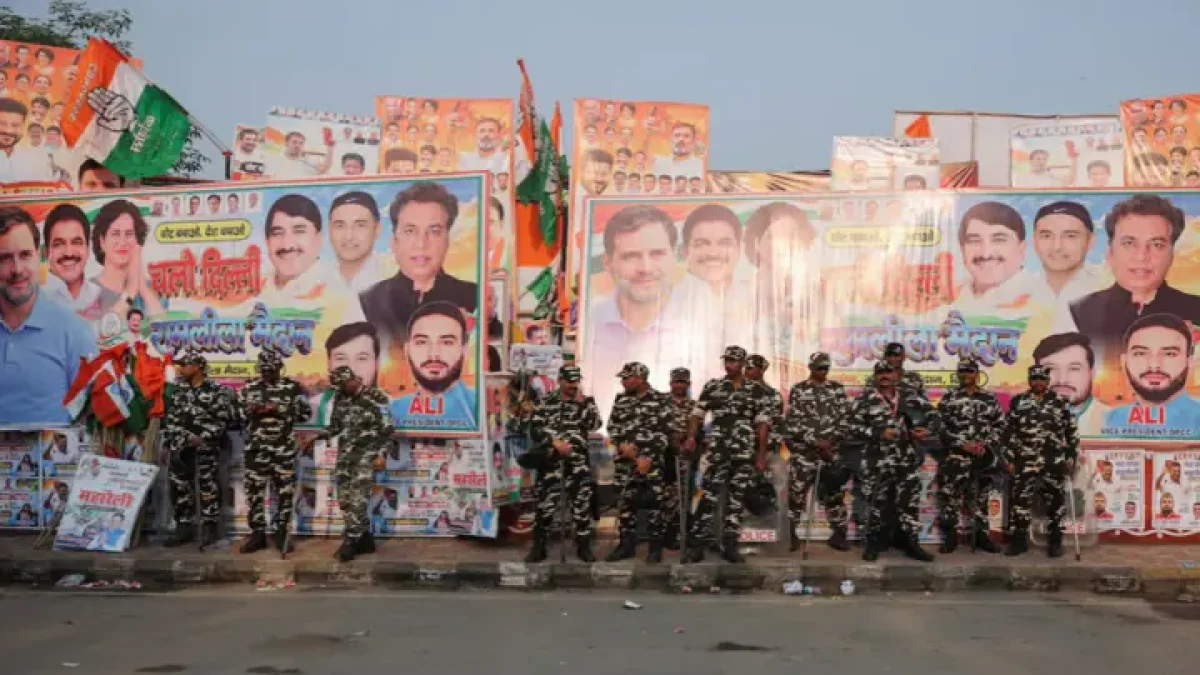
India’s opposition alliance held a rally in the capital, Delhi, accusing the Election Commission of irregularities and rigging in the voter rolls. Congress leader and Leader of the Opposition in the Lok Sabha Rahul Gandhi led the programme at Ramlila Maidan on Sunday. On the same day the ruling Bharatiya Janata Party (BJP) held a counter-march in west Delhi in memory of those killed in the 1984 anti-Sikh riots.
The main demand of the opposition’s “Chalo Delhi” programme is the resignation of Chief Election Commissioner Gyanesh Kumar. The opposition alleges widespread irregularities in the special intensive revision (SIR) of the voter rolls. The BJP called the programme “drama” and said it was disrespectful to democracy.
Former Congress president Sonia Gandhi, Rahul Gandhi, Samajwadi Party leader Akhilesh Yadav, Trinamool Congress chief Mamata Banerjee, CPI general secretary M A Baby and RJD leader Tejashwi Yadav were among the senior leaders of various parties at the rally. Several thousand activists and supporters joined the rally, attended by leaders of about a dozen opposition parties.
Congress general secretary K C Venugopal announced the rally last month. He described the programme, held under the slogan “Chalo Delhi, save the vote, save the country”, as a movement to stop electoral rigging and protect the country’s democracy.
The opposition alleges that large numbers of voters’ names were removed from the rolls in various states through the SIR process, about 130 million in all, it claims. It also accuses the commission of changing Form 6 without parliamentary approval and of taking control of the voter rolls through ECINET.
On Saturday, the day before the rally, Congress president Mallikarjun Kharge moved a symbolic resolution at an opposition alliance event listing six charges against the chief election commissioner.
It alleged that the Election Commission was conspiring to influence elections, had removed 132 million voters’ names from the rolls and had changed Form 6 without parliamentary oversight. It also accused the commission of taking control of the voter rolls through ECINET.
The resolution further said the other two election commissioners had in effect been kept out of important decisions by the chief election commissioner. The opposition also cited a report published in The Indian Express on the matter.
Congress leader Venugopal said there were widespread irregularities in the voter rolls and voters’ names were being removed in one state after another. He said Rahul Gandhi was fearlessly raising these questions and trying to hold those in power to account.
The BJP rejected the opposition’s allegations. Its president and Union minister J P Nadda called the programme “political drama” and accused the opposition of conspiring to create anarchy. Such rallies are disrespectful to democracy and the people can see through the opposition’s political drama, he said.
The Cockroach Janata Party (CJP), meanwhile, did not join the opposition rally. Its founder, Abhijit Dipke, met Trinamool Congress chief Mamata Banerjee in Delhi on Saturday and thanked her for supporting the youth movement. But he made clear that the CJP would keep its own separate identity and would not take part in Sunday’s opposition programme.
Dipke said Mamata Banerjee had stood by the young people during their first protest at Jantar Mantar, and had backed the protesters when Delhi Police arrested Saurabh and Ashutosh. He met her to thank her for that, he said.
Tight security was put in place in Delhi for the rally. About 10,000 police and paramilitary personnel were deployed in central and New Delhi, about 4,000 of them at Ramlila Maidan and along the route from Minto Bridge to the venue. Delhi Police, the Central Armed Police Forces, the Central Reserve Police Force (CRPF) and the Rapid Action Force (RAF) were deployed.
Multi-layer barricades were set up around Connaught Place, Jantar Mantar, Bhagwan Das Road, the Supreme Court and the Election Commission’s office. Traffic on various roads in central Delhi was controlled and diverted from 10am to 5pm, and police advised commuters to plan their journeys in advance.
Senior Delhi Police officer Rohit Rajbir said the whole area was being watched through 200 to 250 CCTV cameras, the organisers had their own control room, and police and organisers were working together to keep it safe.
Under the authorities’ permission, the Ramlila Maidan rally was due to end at 5pm, though it was unclear whether any “unexpected programme” might follow after that time.
The BJP, meanwhile, held its counter-march in west Delhi in memory of those killed in the 1984 anti-Sikh riots. The party accused the Congress of choosing the anniversary of the riots for its rally.
Union minister Hardeep Singh Puri, Delhi Chief Minister Rekha Gupta, Minister of State Harsh Malhotra, H S Phoolka, Manjinder Singh Sirsa and BJP MP Bansuri Swaraj took part in the march from the Hari Nagar bus depot to Tilak Nagar metro station.
BJP MP Vikramjit Singh Sahney also spoke to journalists with people affected by the riots at Shaheedganj Sahib Gurdwara. Many relatives of those killed in the 1984 violence and survivors joined the BJP’s programme.
Delhi traders also voiced concern over the two sides’ programmes. They fear road closures and traffic jams will hurt business in the festive shopping season before Diwali. While supporting the right to protest, they objected to the place and time of the rally.
Vinay Narang, president of the Automotive Parts Merchants Association, said they are not linked to any political party and are not against democratic protest, but the time and place of the rally were wrong. Important wholesale markets such as Chandni Chowk, Sadar Bazar, Daryaganj, Mori Gate and Kashmiri Gate are within three kilometres of the venue, he said, and traders from outside Delhi usually avoid coming to the city for three days before and after such programmes.
The association’s vice-president, Ravinder Singh Kohli, said day labourers, porters, goods carriers and handcart pullers are hit hardest in such situations. Many of them earn 200 to 300 rupees a day, and that income puts food on their families’ tables. The association’s general secretary, Dharampal Ratra, said the protests could cost traders more than 2,000 rupees.
Rahul Gandhi dismissed the traders’ concerns. He urged people coming to the rally to shop in Delhi’s markets as well as protest, saying traders would benefit. The rally would not hurt traders, he said; the BJP was spreading such fears because it was afraid.
While political tension has risen around the rival programmes in Delhi, the main issues have become the neutrality of the Election Commission, the transparency of the voter rolls and the Congress and BJP’s opposing positions on the 1984 riots. Political circles are watching where the dispute between the Election Commission and the opposition goes in the days ahead.
বাংলায় মূল প্রতিবেদন পড়ুন · Read the original Bengali report