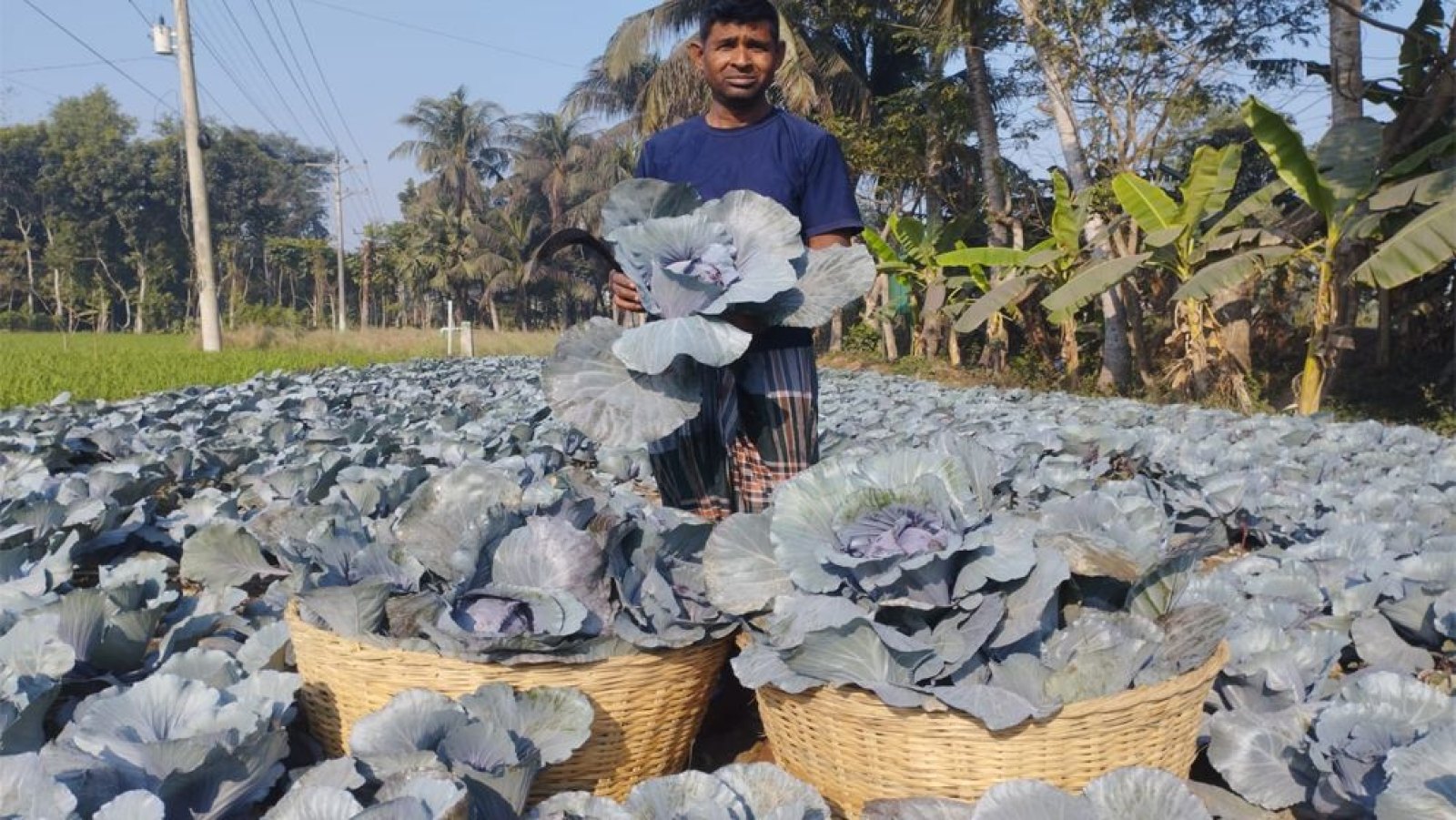
Yellow, pink-purple and in places blue heads sit among the green leaves. From a distance they look like flowers in bloom, but these are fields of winter cauliflower and cabbage, a sight now found in several villages of Dumuria upazila in Khulna.
Alongside the Department of Agricultural Extension, several government initiatives have helped farmers grow coloured cauliflower and cabbage across wide stretches of land in a number of Khulna’s upazilas. Pests are controlled with organic methods, pheromone traps and yellow sticky traps. Yields are good, demand is strong and farmers are getting good prices, which is helping them make up for losses on other vegetables this season. Wholesalers are buying straight from the fields.
Growers of coloured cabbage and cauliflower in Dumuria’s Khorniya union say that while white cauliflower sells for 10 to 15 taka a head, the coloured kind is still fetching 30 to 40 taka a head at market.
Abu Hanif Morol, a vegetable farmer in Khorniya village, planted coloured cauliflower on 20 decimals of land, putting in 1,000 seedlings as a trial and growing coloured cabbage for the first time. The upazila agriculture office supported him with seedlings, organic fertiliser, pest control and advice. Four other growers, among them Mrityunjoy, have also had success with the crop. Abu Hanif Morol plans to grow it on a larger scale.
On the agriculture office’s advice, Abu Hanif Morol and Mrityunjoy grew the crop by organic methods, using yellow traps against insects, which keeps the heads healthy and free of poison.
“This cauliflower is very nutritious,” said Abdul Jalil, a vegetable trader at the market. “Coloured cauliflower sells out as soon as it reaches the market, and the price is as good as we hoped.”
Akirul, a local shopper, said he had bought coloured cauliflower at 25 taka. It looks attractive and tastes good, he said; he had eaten it twice before and bought it again.
“Farmers growing coloured cauliflower and cabbage have had the yields and market prices they hoped for,” said Md Nazmul Huda, the Dumuria upazila agriculture officer. “Coloured cabbage and cauliflower are far more nutritious than white cauliflower and are high in antioxidants, which are very good for health. This year cauliflower was grown on 110 hectares in Dumuria upazila, and coloured cauliflower was planned on 25 acres of that. With demand in the market so high, more farmers will take it up next year.”
Farmer Rashedul Islam said he grew coloured cauliflower on 10 decimals of land with seed from United Seed Company, using only organic pest control and pheromone traps. “Demand in the market is so strong that wholesale traders are buying the cauliflower straight from the field. The price is good, too,” he said.
“This is the first time I have grown coloured cauliflower, and the yield has been very good,” said farmer Imtiaz. Using pheromone traps and yellow traps against pests, he got about 1,500 heads from 22 decimals of land at a cost of only 12,000 taka. “I am selling each head wholesale at 30 to 35 taka and have sold 30,000 taka worth so far, with more still in the field. People are keen to buy the coloured kind. I have made a good profit on a small outlay, and next season I will grow it on more land.”
Tapas Sarkar of Baratia village in the upazila said he planted about 5,000 seedlings near his home: four kinds of cauliflower, white, pink, green and yellow, along with broccoli, Chinese cabbage, red cabbage and ordinary cabbage. “The yield has been good and I got a good price when I sold. But I regret that other winter vegetables did not fetch the prices I hoped for. The coloured cauliflower and cabbage have made up some of the loss, so I feel some relief.”
“Coloured cauliflower and cabbage have been grown in the district for the past two years under the sustainable agricultural development project, and many farmers have done well with them,” said Md Nazrul Islam, deputy director of the Department of Agricultural Extension in Khulna. “With good demand in the market, commercial cultivation of coloured cauliflower will grow. Other farmers are also showing interest.”
Coloured cauliflower has medicinal value and tastes good. It contains more than 25 percent more carotene than ordinary cauliflower, which is good for the skin and eyes. It carries vitamins A, C and K, along with minerals including potassium and manganese, and plenty of beta-carotene, which acts as an antioxidant.
বাংলায় মূল প্রতিবেদন পড়ুন · Read the original Bengali report