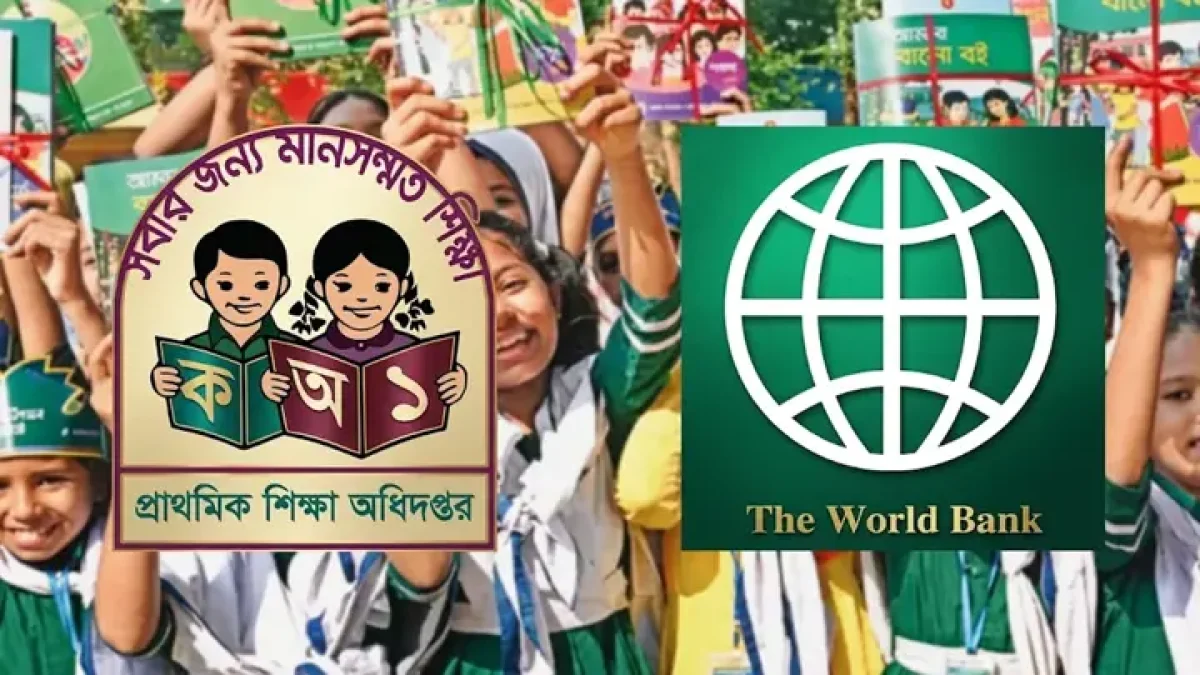
The World Bank has approved a $300 million loan to improve the quality of pre-primary and primary education in Bangladesh. The money will be used to raise the learning skills of 26 million children from pre-primary to Class 5, in particular helping them reach the reading, writing and maths skills expected for their grade.
The World Bank Group’s Board of Executive Directors recently approved the financing. The programme, called the Learning Enhancement and Acceleration in Primary Education Program, will improve Bangladesh’s pre-primary and primary education system. It will also support the government’s Fifth Primary Education Development Programme.
A World Bank press release said Bangladesh has achieved almost universal access to primary education, but quality remains a major challenge. About 50 percent of the country’s 10-year-olds cannot read and understand a simple text suited to their age and grade.
The picture is starker in comparison with upper-middle-income countries. In Malaysia, 42 percent of 10-year-olds cannot read and understand a simple text. In Brazil, the figure is 47 percent.
Jean Pesme, the World Bank’s division director for Bangladesh and Bhutan, said quality primary education is one of the foundations of a workforce able to compete in the global market.
He said that over the past two decades the World Bank Group has helped give almost every child in Bangladesh the chance to go to school. The new financing will help children learn better and encourage them to stay in school, laying the foundation for better jobs in the future.
A focus on reading, writing and maths
Bangladesh’s primary education system is one of the largest in the world. More than 20 million children study in it, across government schools, schools run by non-governmental organisations, kindergartens and madrasas.
Under the new programme, special packages will be introduced to improve children’s basic literacy and numeracy. These will include teaching materials, structured lesson plans and teacher training.
Head teachers at 90 percent of government primary schools will also be trained in leadership and management, and school governance will be strengthened.
Tasmina Rahman, a senior education specialist at the World Bank and the programme’s team leader, said strengthening the basic foundations of learning is the first step towards acquiring the skills needed for good jobs. To make sure no child is left behind, the programme will provide extra lessons for pupils who are falling behind, with special attention to the districts that lag furthest in education.
She added that, alongside improving teachers’ skills and the quality of school leadership, the programme will help ensure accountable use of budgets and effective use of data in decision-making.
Teachers in government primary schools will receive training and the support they need under the programme, to improve the way children are taught reading, writing and maths in the classroom.
Better pre-primary education
The programme also plans to improve the quality of pre-primary education in government primary schools. This will help children build a foundation for learning before they start school, and better prepare them for formal schooling.
The World Bank expects the programme to create 843,000 additional and comparatively better-paid jobs in government primary schools.
The financing comes through the World Bank Group’s International Development Association (IDA), which provides funding on easy terms to low-income countries. The loan has a term of 25 years, with a five-year grace period on repayment.
বাংলায় মূল প্রতিবেদন পড়ুন · Read the original Bengali report