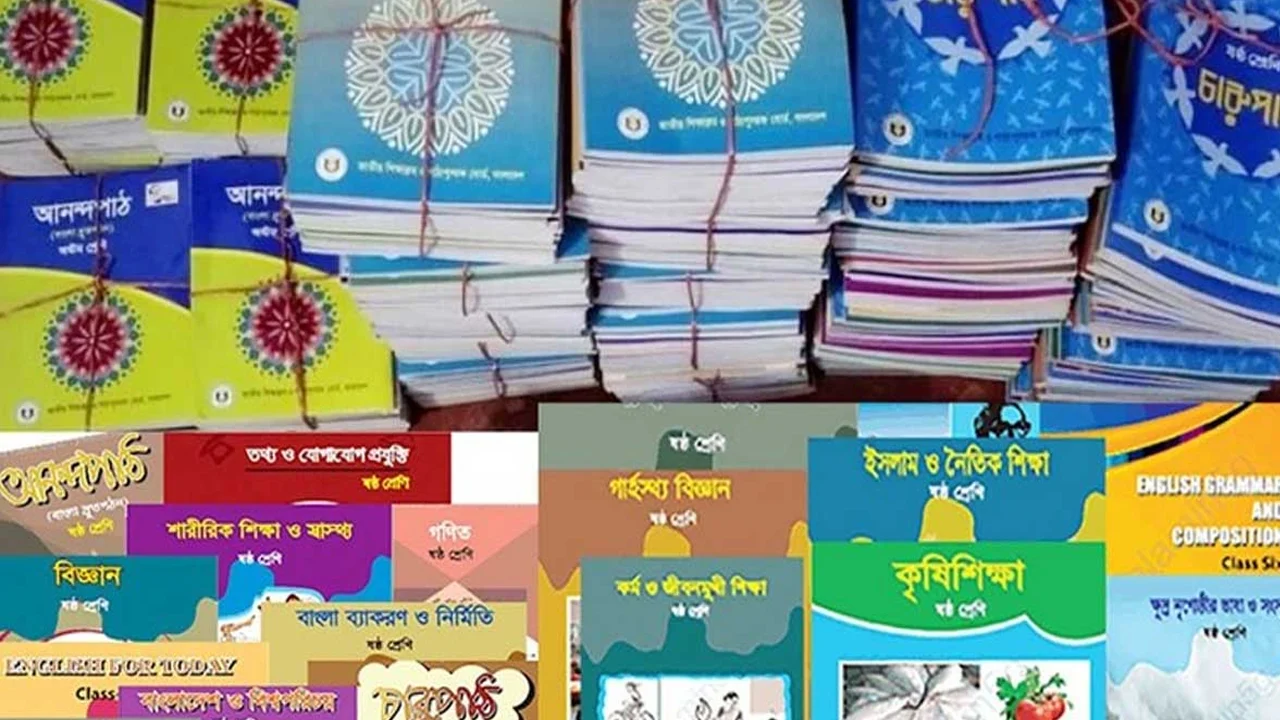
Awami syndicate still active in textbook printing
An old Awami syndicate is still active in the printing of free government textbooks for the primary and secondary levels. In collusion with several officials of the National Curriculum and Textbook Board (NCTB), the ring of 10 to 12 people is shrewdly carving up and taking the lion’s share of nearly Tk 2,000 crore in printing work. As a result, businesspeople in the small and medium printing industry are being ruined. Many, in despair, are leaving the profession.
Talking to people connected with the NCTB and the printing industry, it was learned that the ringleaders had been transferred out of the NCTB during the previous interim government. But after the current government came to power, those controversial officials returned and became active again.
Among the most controversial is NCTB secretary Professor Shah Muhammad Firoz Al Ferdous. He was also an active member of the syndicate of Pani Jahangir, Shahedul Khabir, Ratan Kumar and Nizamul Haque, close associates of Dipu Moni, the education minister under the Awami government. Following various allegations against him, he was transferred out of the NCTB in April 2025. According to relevant sources, his recent reposting to the NCTB is linked to an influential quarter and to the syndicate led by Agrani and Karnaphuli Printing Press, close to Pani Jahangir, the peon of Sheikh Hasina.
It was learned that those two printing firms, through the syndicate of Jahangir, the much-discussed peon of Sheikh Hasina who owned Tk 400 crore in the Awami era, plundered thousands of crores of taka in textbook printing. Although they faced some pressure over the printing of the 2025 and 2026 textbooks, they shrewdly secured large volumes of work. They are now playing a role in reposting their own people to key positions to reactivate the old syndicate, it was learned.
The tender process for next year’s textbook printing is under way. The NCTB said that, to ensure timely delivery of free textbooks, a specific tender schedule of 206 to 220 days had been set under PPR-2025. According to the roadmap, the division of lots and the call for tenders began on June 3.
Sources said that, as the next steps, tenders will be submitted and opened on June 28, tenders evaluated by July 28, tenders approved by August 27, work orders issued on August 30, and contracts with printing firms completed by September 20. After that, printing and binding will be finished and 100 percent of the textbooks supplied to the field by November 29.
In the meantime, the ring has become active. In this case, some NCTB officials are secretly helping them and are working to bring the entire tender process under their own control. This syndicate extends from the NCTB to the ministry.
Those concerned said that among those involved in this syndicate business are the associates of Jahangir, Hasina’s peon who owned Tk 400 crore. Also among them are Rabbani Jabbar, owner of Anand Printers and brother of former minister Mostafa Jabbar; the owner of Agrani Offset Printers, former president of the printing industry association and Jubo League leader Jahurul Islam; and Junayedullah Al Mahfuz, senior vice-chairman of the printing industry association.
While delivering new textbooks on time to the country’s crores of students is the NCTB’s main responsibility, in recent years this important sector has fallen into the grip of a powerful syndicate, it is alleged. It is alleged that an influential “Awami syndicate” formed during the previous government still holds control of the tender process, and that small and medium-grade printing businesses have fallen into severe crisis as a result.
An investigation into the control of tenders and the syndicate’s manipulation found that the NCTB’s huge annual textbook printing tenders have long lacked transparency. A specific ring has been controlling the market for the past several years. Formed in collusion with influential people, the syndicate carves up the tender work in advance. As a result, even when ordinary or new printing businesses take part in tenders, winning work has become impossible for them because of cunning conditions and political influence.
Those involved in the syndicate also shrewdly use NCTB officials to blacklist and exclude small presses on various pretexts.
Zahir Moni, owner of the affected Hakkani Printers, told Amar Desh: “My firm was served a show-cause notice on the pretext that it had no binding machine. Yet the allegation is entirely fabricated and false. Our press has a permanently installed binding machine. The notice was issued deliberately to shrewdly exclude us. This was essentially done at the signal of the syndicate ring.”
He said: “In this way, not only us, but many ordinary press owners are being harassed. This is mainly being done to keep the syndicate alive.”
Affected printing businesses say that, although government rules call for open participation in tenders, in practice this does not happen. Speaking on condition of anonymity, one businessman said: “We have been in this profession year after year, but because of the syndicate’s dominance we are now on the verge of ruin. The big contractors divide up all the work and we are left without any. We have to be content with whatever little work the syndicate members give small businesses.” Several printing businesses in the Arambagh, Fakirapool, Sutrapur and Banglabazar areas of the capital said that, because they were not getting textbook work, it had become difficult to pay their workers’ wages. Under the syndicate’s pressure, tenders are arranged in such a way that survival is impossible for firms of small or medium capacity.
At the same time, a huge syndicate in the free government textbook sector is fueling corruption worth hundreds of crores of taka. Even after learning of this, the ministry concerned is taking no steps. The ministry is even having to take various decisions, including bringing back old controversial officials, by yielding to the syndicate’s improper pressure.
Talking to those concerned, it was learned that, in the printing of free secondary-level books, complaints had been received of substandard books printed from different presses in the names of multiple members of one particular family. Last year, complaints also arose of printing on substandard paper from a press called Nahar Press in primary book printing. The NCTB itself received serious complaints against four presses of the same family in secondary book printing.
Sources said two firms, Karnaphuli Art Press and Agrani Printing Press, had won work to print a large number of books across multiple lots in various secondary-level subjects. These two presses used 8,500 tonnes of paper to print the textbooks. By printing a large number of books on substandard paper, the accused presses siphoned off more than Tk 20 crore from the government.
NCTB sources said the government distributed more than 30 crore free textbooks to primary- and secondary-level students in 2026. The work of printing these books was done by 104 private presses, several of which had faced serious complaints of irregularities from the start.
Sources said the NCTB, as the supervising body, had even suspended binding, cutting and supply because 50 lakh formas printed from the firms Karnaphuli and Agrani, and books, were printed on substandard recycled paper. The supervising body had also ordered that these substandard printed books and formas be destroyed.
Despite the various allegations against that firm, it consistently wins large-lot work. According to the NCTB’s work plan, a total of 30,71,98,101 copies of textbooks will be printed for the pre-primary, primary, ebtedayi, secondary, dakhil, vocational and technical levels in the 2027 academic year. The government’s estimated expenditure for this program has been put at Tk 1,643 crore.
When several senior NCTB officials were asked about the matter, they said the tender process is carried out fully by the rules and digitally. But on the syndicate allegations, they made no direct comment, saying only that if any specific complaint was received, they would investigate properly and take action.
Mahbubul Haque Patwari, the outgoing NCTB chairman, declined to comment on the return of the controversial officials.
Education Secretary Abdul Khalek recently said that those who did poor work in the past or tried to deliver substandard books at the last moment would be vetted in detail before being given book-printing work this year. “Ensuring full transparency in textbook printing is our main goal. No negligence or irregularity will be tolerated in delivering textbooks on time next year,” he said.
বাংলায় মূল প্রতিবেদন পড়ুন · Read the original Bengali report