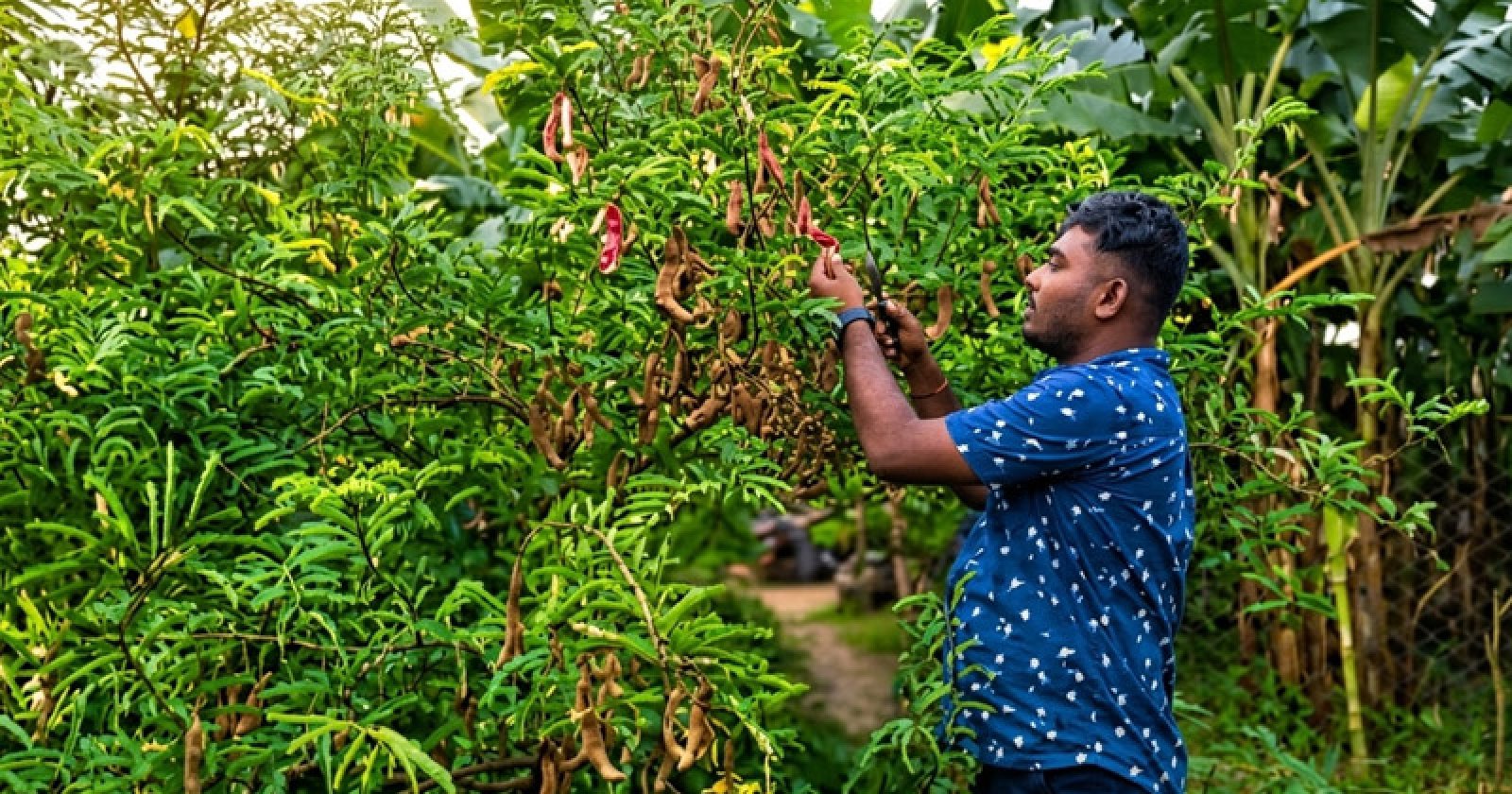
In Jibannagar, a border upazila of Chuadanga, agricultural entrepreneur Sajal has opened a new opportunity beyond conventional farming. Thai red tamarind, brought in from Maharashtra in India, is changing his fortunes. He grows the striking Thai red tamarind commercially. Fruit hangs in clusters from the trees, and flowers, green fruit and ripe fruit can be seen on the same tree. Because it fruits all year round, interest in growing it is rising among farmers. The agriculture department says it is giving him all-round support.
On a visit to Sajal’s orchard, red tamarind hung in clusters from branch after branch. The mere mention of tamarind makes the mouth water, and a tamarind as red as blood is something else again. The fruit’s eye-catching colour draws everyone’s attention. Its flesh is quite unlike that of ordinary tamarind: when ripe it turns deep red, the colour of blood.
Sajal said red tamarind is known as a profitable variety. Its special feature is that it fruits all year round and does not depend on any particular season. He brought saplings home to plant on his roof after a trip to Maharashtra in India. Later, on his father’s advice, he planted an orchard of red tamarind in the field.
Because red tamarind is sweet, everyone wants it, he said. Flowers, green fruit and ripe fruit can be found on the same tree at different times of the year. The trees start bearing two years after planting. They stay small and can be grown in a rooftop garden. The taste is usually sweet or mildly sweet and sour. Another attraction of red tamarind is its pulp. The flesh is light pink or reddish when unripe and turns deep red when mature. That makes it far more attractive to look at than the tamarind usually sold in markets, and it is in great demand.
Growers say that fruiting can begin within just one to two years of planting a grafted sapling. Because the tree does not grow very large or bushy, it can be grown in a home courtyard or a rooftop garden, and even in a drum or a large pot.
People in agriculture say that growing new, high-value fruit varieties alongside conventional crops can help farmers earn more. Red tamarind in particular has commercial potential because it fruits all year. But more local information is needed on marketing, the real market price of saplings and fruit, and long-term yield, along with advice from the agriculture department, they say.
The new fruit growing in Jibannagar’s soil has already made local people curious. The grower hopes that, with proper care and a sound market, red tamarind could become a new opportunity for Jibannagar’s farming.
Jibannagar Upazila Agriculture Officer Alamgir Hossain said: “Jibannagar is an upazila rich in agriculture and full of promise. Many local and foreign fruit varieties are being grown here by agricultural entrepreneurs, and red tamarind is now being grown too. There is demand for it in the market. Because it turns a profit in a short time, everyone is interested. I hope red tamarind farming will ease unemployment on one hand and bring financial gains to young unemployed entrepreneurs on the other.”
বাংলায় মূল প্রতিবেদন পড়ুন · Read the original Bengali report