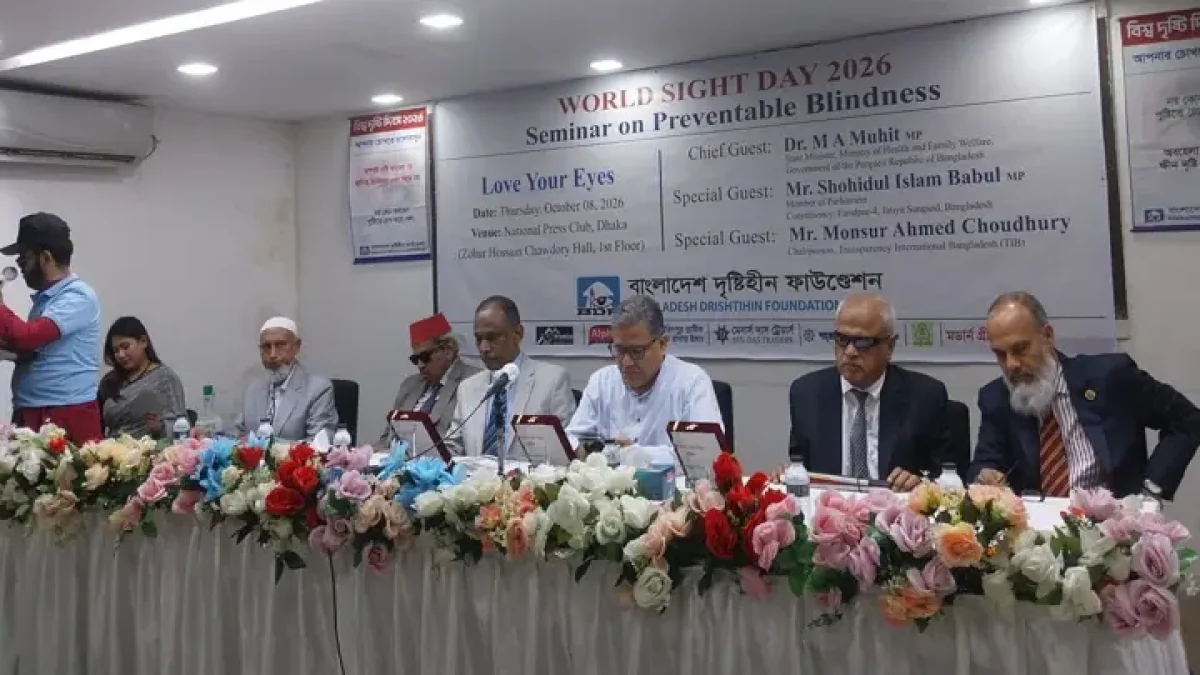
About 7.4 million people in Bangladesh suffer from serious eye problems. The main cause for a large share of them is cataract. Although cataract can be cured by surgery, many people are deprived of timely treatment because access to eye care at the grassroots is limited.
The figures were presented in the keynote paper at a discussion organised by the Bangladesh Drishtihin Foundation at the National Press Club on Thursday morning to mark World Sight Day.
Presenting the paper, the foundation’s founder, Golam Mostafa, said most of those with serious vision problems suffer from cataract, which is completely curable by surgery. Refractive errors among children and conditions such as diabetic retinopathy among older people are also rising. Losing one’s sight does not only mean losing the light of the eyes; a person’s livelihood, dignity and economic independence are bound up with it. So besides caring for one’s own and one’s family’s eyes, everyone must come forward to prevent blindness, he said.
The paper also noted that eye treatment is still centred on the capital and the big cities, so eye care must be made available in every district and upazila. It laid particular stress on taking eye care to people’s doorsteps with modern technology by opening vision centres in remote areas. According to the World Health Organization and the International Agency for the Prevention of Blindness, more than 2 billion people worldwide have eye problems, and the vision problems of about 1 billion of them could be prevented with proper treatment and awareness.
Speakers said that alongside the government’s goal of eliminating cataract-related visual impairment within five years, non-government development organisations must strengthen free cataract surgery and the distribution of spectacles at the grassroots. To protect children’s eyes they called for regular school-based eye tests and wider regular distribution of vitamin A capsules.
They also proposed regular eye tests and awareness programmes in factories and offices to ensure eye care at work. To reduce the strain on the eyes from too much use of digital screens, they urged people to make a habit of the 20-20-20 rule: every 20 minutes, look at something 20 feet away for at least 20 seconds.
Special guests at the seminar included Shahidul Islam Babul, MP for Faridpur-4, and Monsur Ahmed Chowdhury, chairman of the board of trustees of Transparency International Bangladesh, along with other members of the foundation and distinguished guests.
বাংলায় মূল প্রতিবেদন পড়ুন · Read the original Bengali report