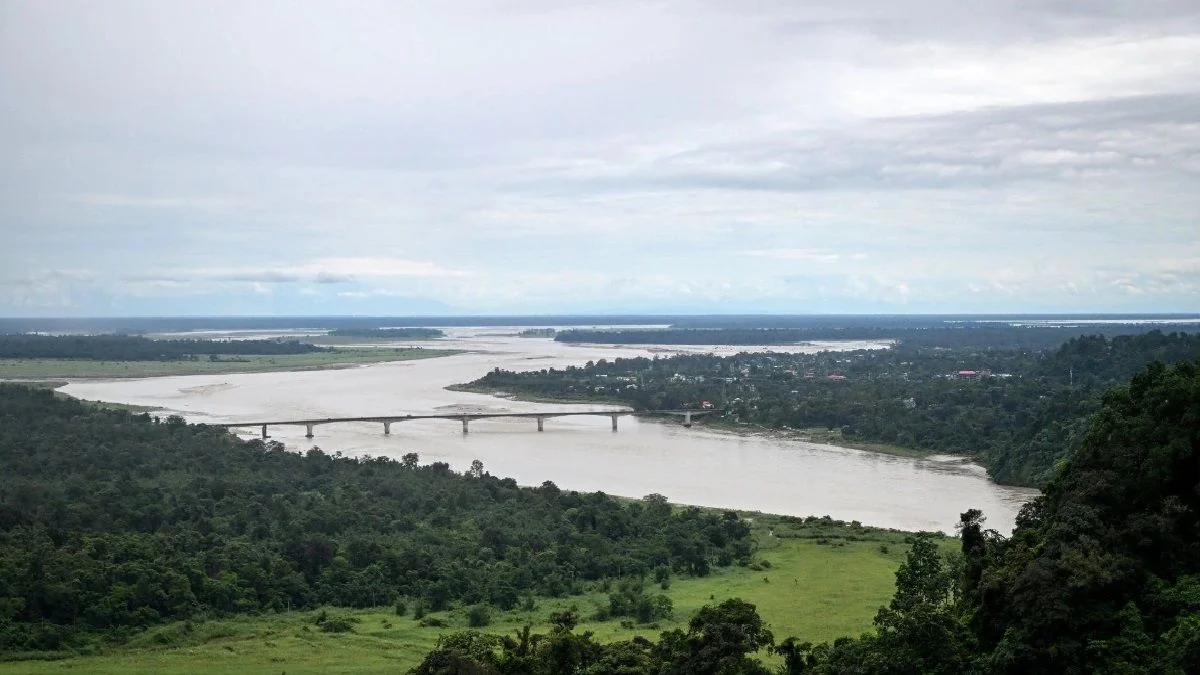
India is planning an 11,200-megawatt dam on the Siang, a tributary of the Brahmaputra, to counter China’s huge hydropower project. But opposition from the indigenous Adi community of Arunachal Pradesh has raised tensions over the project.
After protests recently turned violent, the central government deployed security forces to bring the situation under control, India Today reported.
On Friday, October 23, during protests in East Siang district of Arunachal Pradesh, the homes of local politicians, a police station and an office of the state-owned National Hydroelectric Power Corporation (NHPC) were vandalised and set on fire. Tension has gripped the area since.
India Today reported that after the violence the central government sent two companies of the Rapid Action Force (RAF), about 250 personnel, to Arunachal Pradesh.
The Siang rises in Tibet, flows through Arunachal Pradesh and becomes part of the Brahmaputra, which then flows through Assam into Bangladesh. The dam is planned in East Siang district under India’s proposed Siang Upper Multipurpose Project (SUMP).
Why India wants the dam
Behind India’s move is concern over China’s giant hydropower project in Tibet. In July 2025 China began building a large hydropower dam in the Medog area of Tibet, with planned investment of about 1.2 trillion yuan and a potential capacity of about 60,000 megawatts. Once finished, it could be the world’s largest hydropower project.
India fears that if China controls the river’s flow upstream, water security and flood management in downstream countries could be affected. Changes in flow, diversion of water or a sudden release of huge volumes are among the concerns.
Arunachal Pradesh Chief Minister Pema Khandu has said India’s proposed Siang dam could store about 9.2 billion cubic metres of water. By his estimate, China’s Medog project could hold about 5.5 billion cubic metres.
The Indian government says the Siang dam could help regulate the river’s flow, tackle flood risk and strengthen the country’s water security. It could also generate hydropower and open up economic development in the northeast.
Why local people oppose it
Adi residents fear the dam could submerge their ancestral land and homes, putting their livelihoods, environment and cultural heritage at risk.
Local journalist Tongam Rina told India Today Digital that the movement against projects on the Siang has gone on for about 40 years but has grown more intense in recent years. Rina said police use of tear gas on women protesters had angered the younger generation.
Protesters fear that allowing the preliminary survey will make it easier to build the dam later. They say the consent of a few families cannot substitute for the approval of the whole village community, and they have called for wide consultation with traditional local institutions and village communities.
Chief Minister Khandu, for his part, has said no final decision on the dam has been taken. The proposed survey will assess the project’s technical and geological feasibility, earthquake risk and possible role in flood control. It is due to run for three months, from November 2026 to January 2027.
Even if the project is found feasible, an environmental and social impact assessment, the necessary government approvals and consultation with affected communities will be needed.
Earthquake concerns over China’s dam
China’s Medog project raises geological risks as well as geopolitical concerns. A South China Morning Post report, citing research, said the active Paizhen fault lies beneath the project area and is linked to earthquake risk.
The research did not conclude that the dam would collapse, but stressed the need to assess the geological risks of the area carefully.
In all, the dispute over the Siang dam sets India’s strategic plans for national security and control of river flows against local people’s concern to protect their land, livelihoods and cultural heritage.
বাংলায় মূল প্রতিবেদন পড়ুন · Read the original Bengali report