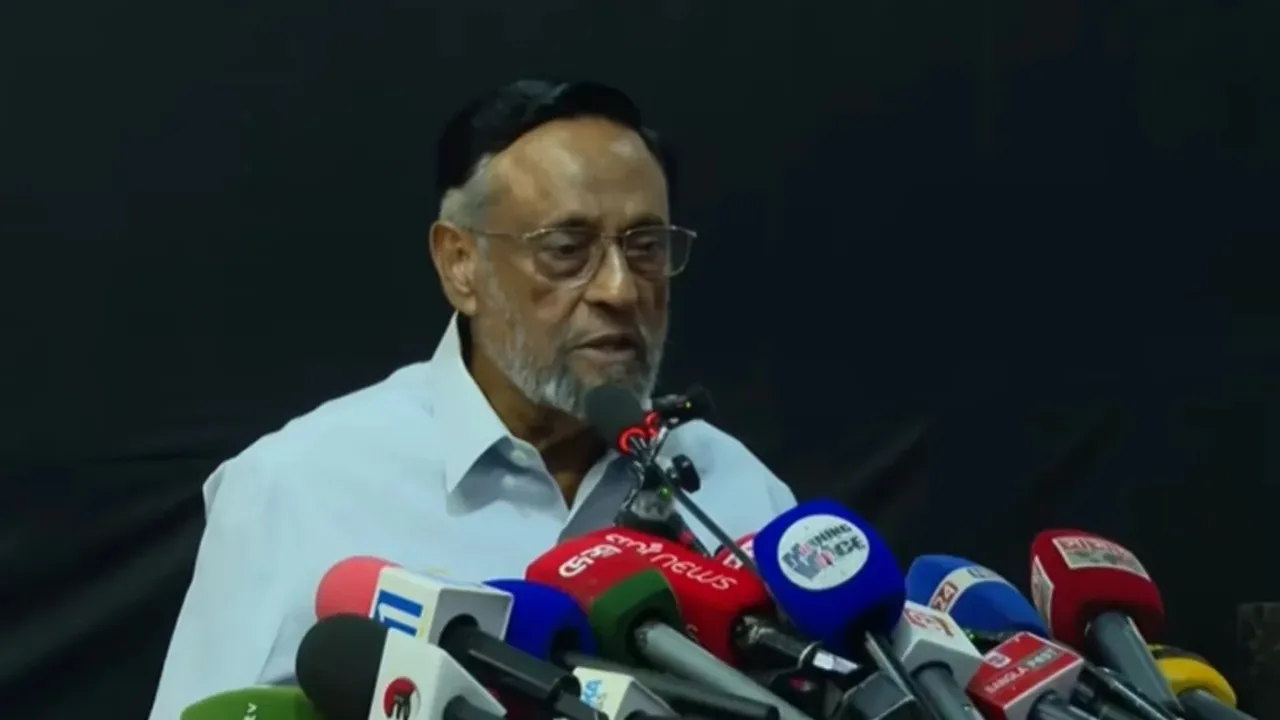
About 80,000 people have lost their jobs since the BNP government came to power, Liberal Democratic Party (LDP) chairman Col (retd) Oli Ahmed said on Sunday.
He was speaking at a discussion at the National Press Club in the afternoon, organised by Jamaat-e-Islami’s central leadership to mark the first anniversary of the signing of the July National Charter.
“Since this government took office, domestic and foreign investment has almost come to a halt. Many factories are shutting down,” the LDP chairman said.
“Before coming to power, the government promised to create jobs. Instead, the opposite has happened. About 80,000 people have lost their jobs. There is no new domestic or foreign investment, no new employment is being created, and existing workers are being laid off.”
“The law and order situation is very bad,” he said. “People cannot sleep safely at night or move safely on the streets. It has become a question whether there is any law and order in the country at all.”
On the judiciary, he said: “People are not getting justice. Those who are with the government get justice, but people outside the government do not.” Citing a recount case involving his own son, he said such matters had been waiting for a year, although a quick decision was possible once the arguments and documents had been examined.
On the banking sector, he said: “Many banks are on the verge of closing. Let action be taken under the law against those facing allegations. But bank owners in the country who face no allegations should be allowed to run their banks again. That will create jobs and bring momentum back to the economy.”
Raising the problems of Bangladeshis working abroad, he said: “Many migrants went abroad on visas two or three years ago. Their visas have expired, and they have applied for new visas and work permits as the law requires. Many are not getting permission even after spending between one and three lakh taka.” He said the problem was particularly acute in the United Arab Emirates.
“It is the foreign ministry’s job to solve the problems of Bangladeshis abroad,” he said. “The prime minister must instruct the foreign minister so that officials go to different countries, hear migrants’ problems and take steps to solve them. Ambassadors also have a duty to resolve our citizens’ problems through talks with the governments of the countries where they serve.”
“If Bangladeshi workers return from the Middle East, the country’s economic and social crisis will deepen. So the problems of migrants must be solved quickly,” he said.
On rising prices, Oli Ahmed said: “The prices of essentials go up every day, but people’s incomes do not. Their purchasing power is falling. The rural economy is not moving either, because the economic activity it needs is not happening.”
On the role of the administration and elected representatives, he said: “When some members of parliament visit their constituencies, the upazila nirbahi officer (UNO) and the officer-in-charge (OC) of the police station have to accompany them. But administrative duties and political activity are separate. The job of a UNO or an OC is not to follow MPs around but to carry out their own official duties.” He urged the prime minister to understand these issues and said the problems had to be solved while there was still time.
Recalling the political situation of 1996, the LDP chairman said the Awami League and Jamaat-e-Islami were then campaigning for a caretaker government. The BNP had given him the task of negotiating with Sheikh Hasina, and after meeting her he drew up a compromise proposal.
“Under the proposal, the government would step down 40 days before the election, and the structure of the cabinet or advisory council would be settled through talks between the two sides,” he said. “The BNP accepted the proposal too. But later some conditions were added, and the compromise went no further.”
He said he believed the BNP could have returned to power had the proposal been accepted then, and urged the party’s current leadership to learn from that experience.
Addressing BNP chairman Tarique Rahman, he said: “Many of the people around you do not have the experience or the ability to give you the right advice. You may be harmed because of them. Your enemy is not the opposition but the wrong advisers around you.”
Criticising remarks made by some leaders during Durga Puja, he said: “Such remarks should not be made. A prime minister’s duty is to protect the rights and dignity of people of all faiths. Cabinet members must also behave responsibly.”
“People have no rice in their stomachs and no sleep in their eyes,” he said. “Yet instead of giving these matters importance, political conflict is being stoked. The prime minister must pay attention to people’s suffering.”
Calling for the July Charter to be implemented, the LDP chairman said: “Announce that the reforms will be carried out quickly. Then everyone will have the chance to move the country forward together.”
বাংলায় মূল প্রতিবেদন পড়ুন · Read the original Bengali report