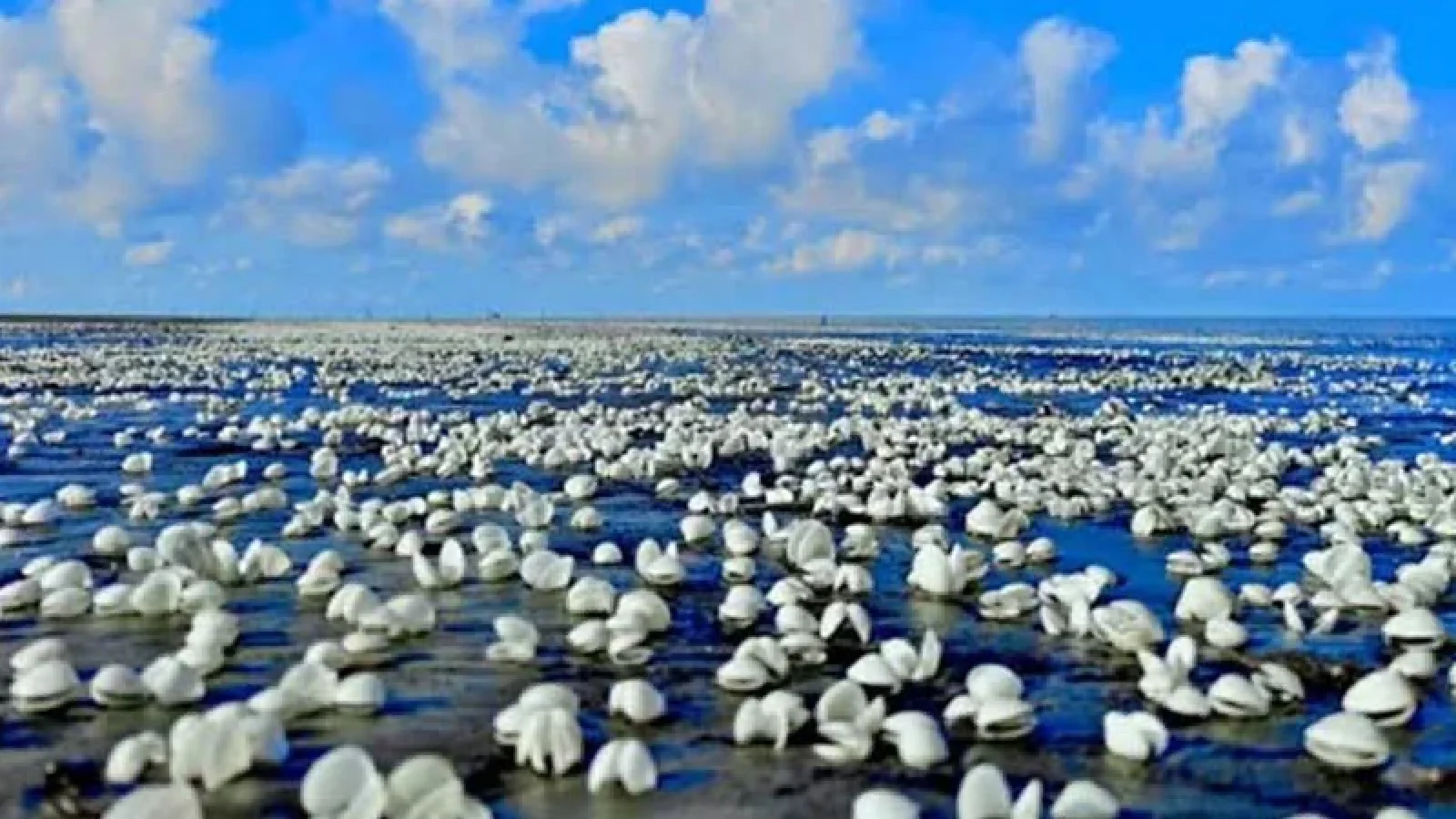
As dawn breaks and the tide goes out, shells can be seen in abundance along parts of Kuakata. Countless shells, large and small, lie scattered across the beach, especially at the confluence of three rivers, Gangamati, Lembur Char and Dolna Point. In some places they lie in rows; elsewhere white shells mingle with the shallow water, giving the beach a different kind of beauty.
With its blue sea, wide sands and open sky, Kuakata beach in Patuakhali is a popular destination, and tourists come from all over the country every day to watch the sunrise and sunset. Now white shells have been added to Kuakata’s familiar beauty. From a distance, the beach looks as if a white carpet has been laid across it.
Locals say shells of various kinds of bivalves and snails drift towards the beach with the normal flow of the tides. Carried ashore at high tide, they are left on the sand when the water recedes, so they are most visible at low tide. Some tourists collect them and take them away.
Long-time residents and local fishermen say shells appear on the beach at some point every year, though not always in the same numbers. How many appear depends on the waves, the tides, the currents and natural changes along the coast.
Locals have observed that shells are more likely to be seen along Kuakata’s beaches from mid-September, after the monsoon, until the start of winter, though there is no guarantee they will appear at the same time or in the same quantity each year.
Amir Hamza, the forest department’s Lemburban beat officer, said shells are seen more often from mid-September into the winter. Tourists need to be mindful of protecting these naturally occurring shells and the biodiversity of the estuary, he said. The shells do not stay in the same place on the beach for months; their position shifts with the tides, and a spot covered in shells one day may be cleared by waves or currents the next. Seeing the shells makes many tourists want to collect them, so local people and environmentalists are asking visitors to look, take photos and enjoy the beauty, but not to take the shells away.
KM Bachchu, convener of Upokul Paribesh Rakkha Andolon Kuakata (UPORA), said the natural abundance of shells on Kuakata beach is an important part of coastal biodiversity. The shells collect on the beach through the natural process of the tides, he said; they are a new aesthetic attraction for tourists as well as part of the coast’s natural environment.
Bakhtiar Rahman, a research assistant on the Sustainable Oceans (Sushtho Sagar) project implemented in coordination with WorldFish, said the shells on the beach are the remains of bivalves and other molluscs that live in the sea. When they die, their shells lie on the seabed and are gradually carried towards the shore by waves, tides and currents, where they are left behind at low tide.
বাংলায় মূল প্রতিবেদন পড়ুন · Read the original Bengali report