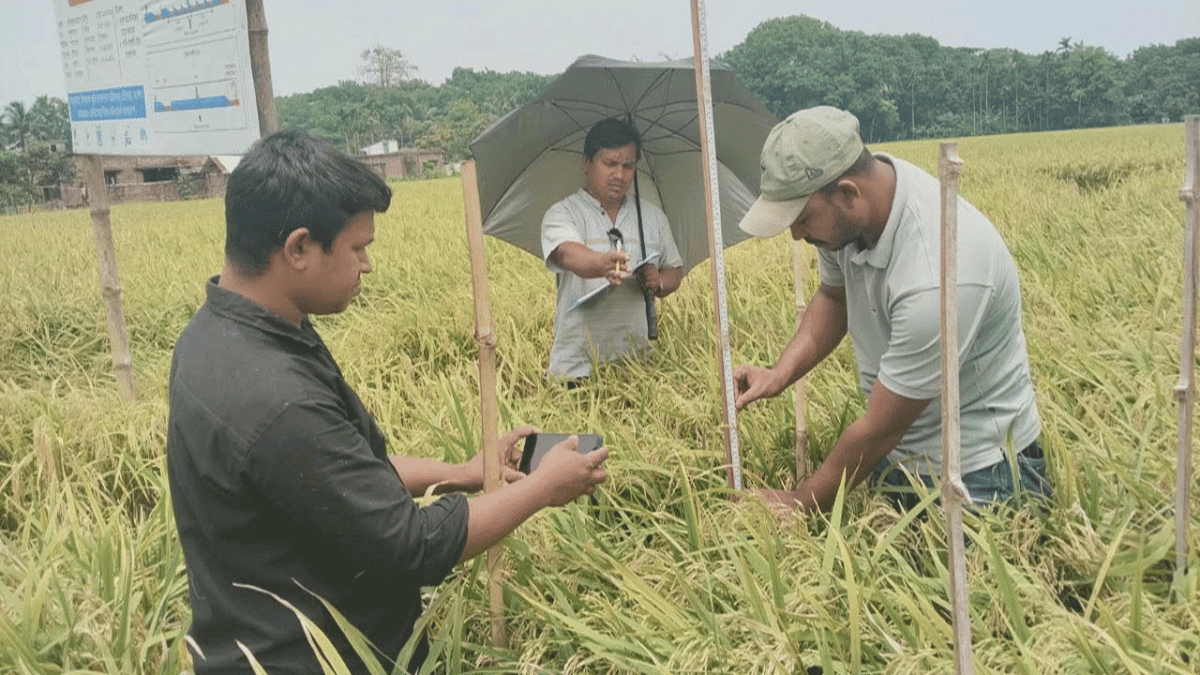
Arsenic above the tolerable limit has been found in paddy in Chaugachha upazila of Jashore. To tackle it, the non-governmental organisation Asia Arsenic Network is running work to grow arsenic-safe rice by controlling irrigation, with technical and financial support from Japan’s JICA and JST.
According to information from the organisation, the tolerable level of arsenic in rice set by the international Codex Alimentarius Commission (CAC) is 0.35 ppm, a level not harmful to the human body. Yet arsenic above this level has been found in the upazila: it is being found in 56 to 70 per cent of paddy.
Asia Arsenic Network says there is no alternative to controlling irrigation if arsenic in paddy and rice is to stay within tolerable limits. It is making farmers aware of the 3F4D method (flooding the land for three days, drying it for four), which was developed by Bangladesh Agricultural University (BAU).
The method was developed under the Safe and Nutritious Rice (SUNRISE) project. To carry out the project, the organisation is working in the upazila to grow safe rice with arsenic within tolerable limits, with technical and financial cooperation from Japan’s JICA and JST (Japan Science and Technology Agency).
Twelve model plots have been set up in villages across the upazila’s 11 unions and the municipality: Hudopara in the municipality, Koyarpara in Chaugachha union, Majali in Singhajhuli union, Araradah in Fulsara union, Marua in Jagadishpur union, Sadipur in Patibila union, Bokshipur in Hakimpur union, Narayanpur in Narayanpur union, Swarupdah in Swarupdah union, Makapur in Sukhpukuria union, Kushtia Rambhadrapur in Dhuliani union and Raghunathpur in Pashapole union.
A total of 144 farmers are involved with these plots. In addition, 60 irrigation pump owners across the unions and the municipality will, on their own initiative, use the 3F4D method in the coming Iri-Boro season to grow arsenic-free paddy. Meetings, seminars and training have already been held to make them aware.
Amirul Islam, the organisation’s upazila coordinator, said people need to eat rice from safe and nutritious grain, which is why growing paddy free of arsenic, or within tolerable limits, is urgent. “We are working through two methods,” he said. “But the main thing is to control the use of water in paddy fields. To do this, the farmer method and 3F4D have been introduced. Using this method saves 20 per cent of water.”
He said the method can also give 8 per cent more yield. The organisation added that in the Iri-Boro season water is lifted to the surface by irrigation pumps. When the groundwater level falls, the concentration of arsenic rises, which raises the risk of more arsenic in paddy.
Farmers Imdadul Haque of the Araradah village plot and Hafizur Rahman Tapan of Majali village said they had never known that paddy could contain arsenic. “We no longer water our paddy fields the way we used to. We are getting good results using the 3F4D method,” they said.
Upazila agriculture officer Mosabbir Hussain said: “Farmers will get good results with the 3F4D method. Instead of the usual standing water, the land holds water for three days and is then dried for four. This raises the soil’s redox potential and creates an oxidative environment, so the rice plant absorbs less arsenic. At the same time, the level of inorganic arsenic in the rice falls markedly.”
Ferdousi Khatun, assistant engineer at the upazila office of the Department of Public Health Engineering, said there is no government initiative on arsenic in paddy or rice, though there are government initiatives to control arsenic in water. “We have so far provided 90 shallow tube wells in 11 unions. We collect water from the tube wells and send it to the regional water testing laboratory. Where we find high arsenic levels, we provide water treatment vessels,” she said. “This upazila has a high level of arsenic. In the last report, an average of 20 milligrams of arsenic was detected.”
Upazila health and family planning officer Dr Ahsanul Mizan Rumi said: “We do not have updated figures on the number of arsenic patients. But from earlier surveys we know there are about 1,500 arsenic patients in the upazila. Patients still come to the upazila hospital and are treated regularly. If the disease is caught early, treatment together with drinking arsenic-free water can cure it. Neglecting it can put life at risk.”
Upazila Nirbahi Officer Farzana Islam said: “I have learned that an organisation is working on arsenic in paddy. No initiative has yet begun at the government level. Shallow tube wells are being provided to control arsenic in water, and where a tube well is found to have arsenic, the government provides treatment vessels.” She added: “The arsenic problem has existed in this area for a long time. Most of the tube well water we use is no longer safe. We have to be careful about the water we use.”
বাংলায় মূল প্রতিবেদন পড়ুন · Read the original Bengali report