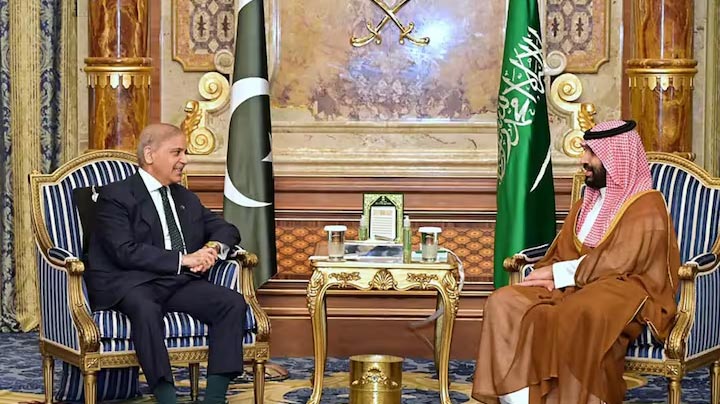
Pakistan has launched diplomatic outreach to manage its relationship with Saudi Arabia after stepping back from its position favouring military action against Yemen’s Iran-backed Houthis. Islamabad’s changed stance on the Houthi threat has raised questions over its defence commitment to Saudi Arabia.
For most of this year, Pakistan cooperated with behind-the-scenes talks between the United States and Iran on one hand, while further strengthening defence ties with Iran’s Gulf rival, Saudi Arabia, on the other. But after fighting broke out last week between Saudi forces and Yemen’s Iran-backed Houthis, maintaining that balance with both sides has become difficult for Islamabad.
Pakistan’s outreach to reassure Saudi Arabia
Pakistan moved over the weekend to reassure Saudi Arabia. After stepping back from its earlier firm position on military action against the Houthis, questions arose over whether Pakistan would honour its defence commitment to Saudi Arabia.
The two countries have an agreement under which Pakistan pledges to come to Saudi Arabia’s aid if the kingdom is attacked.
Pakistan’s Prime Minister Shehbaz Sharif spoke by phone with Saudi Crown Prince Mohammed bin Salman, during which he strongly condemned the Yemeni Houthi attacks on Saudi Arabia.
Pakistan’s prime minister’s office said Shehbaz Sharif expressed full solidarity with Saudi Arabia. He warned that these attacks pose a threat to regional security and global energy supply.
A test of the ‘Mecca agreement’
A day before Shehbaz Sharif’s call to the Saudi crown prince, Saudi Arabia temporarily shut down its 1,200-kilometre East-West oil pipeline following a drone strike launched from Iraq.
This pipeline serves as an important alternative route for Saudi oil exports, allowing crude to be transported via the Red Sea while bypassing the Strait of Hormuz. Shipping through the Strait of Hormuz has been severely disrupted since February amid the broader conflict surrounding the United States and Iran.
Saudi authorities said a missile fired by the Houthis wounded two people and damaged several buildings, including a mosque.
These attacks are part of a broader Houthi campaign against Saudi Arabia, whose targets include Saudi cities and energy facilities.
This conflict has become the first major test of the mutual defence alliance signed last month between Pakistan, Saudi Arabia and Turkey. Alongside this, Pakistan and Saudi Arabia already had a defence agreement in place before that.
Under the new agreement, an armed attack on any one of the three countries is to be treated as an attack on all three.
However, Pakistan said last week that the Mecca agreement does not mean Pakistan will automatically take military action against the Houthis. This is believed to have created some discontent among the pact’s other partners.
‘Damage control’ to preserve ties with Saudi Arabia
In recent diplomatic activity, Shehbaz Sharif has condemned Houthi attacks on Saudi civilian and economic infrastructure.
He said these attacks could further disrupt the global economy and energy supply.
A statement from Pakistan’s prime minister’s office said Shehbaz Sharif, expressing full solidarity with the Saudi leadership and people, stated that the Houthis’ recent actions pose a threat to regional peace and security and could further disrupt the global economy and energy supply.
Shehbaz Sharif further said that he, along with Pakistan’s army chief, Field Marshal Asim Munir, and deputy prime minister Ishaq Dar, would continue efforts to reduce tensions and restore peace in the Middle East.
A difficult equation ahead for Pakistan
Pakistani officials fear that the Houthi threat could further increase the risk of the country being drawn into the ongoing conflict. Compared with Iran’s missile attack on Saudi energy infrastructure at the start of the year, they believe the Houthis’ current activities pose a more direct risk to Pakistan.
A Reuters report said Pakistani troops are stationed near the Saudi border with Yemen, meaning there is also a risk of Pakistan being drawn directly into the conflict.
Meanwhile, defence agreements with Gulf states play an important role in Pakistan’s plans to overcome its long-running economic crisis. Alongside these agreements, investment from Gulf countries is also often discussed.
At the same time, however, Pakistan itself depends on oil and gas imports through the Strait of Hormuz and the Red Sea. It has already become clear that Iran and the Houthis are capable of disrupting supply through these critical shipping lanes.
As a result, Islamabad must maintain a difficult balance — deepening ties with Saudi Arabia while avoiding provoking Iran further.