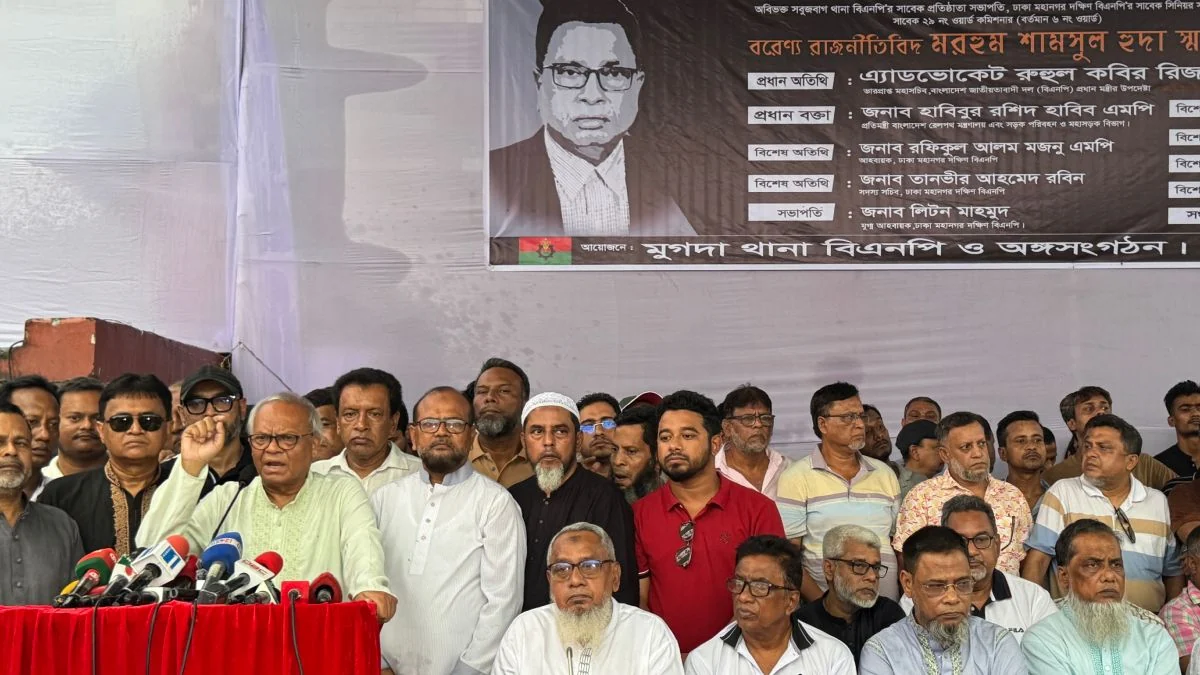
The July Charter cannot be implemented in full without amending the constitution, BNP acting secretary general and adviser to the prime minister Advocate Ruhul Kabir Rizvi said on Saturday.
He was speaking as chief guest on Saturday morning (31 October) at a memorial meeting for the late politician Shamsul Huda at the Manda Haider Ali School and College ground in the capital. The meeting was organised by the Mugda police station unit of the BNP and its affiliated organisations.
Rizvi said the legal framework needed to implement the July Charter must be put in place. Where amendments are needed while keeping the continuity of the constitution, they must be made through the national parliament, he said. But the opposition, instead of taking the route of constitutional amendment, wants to impose its own demands, he added.
Criticising the opposition’s long march programme in Khulna, Rizvi said: “You have been invited to parliament to implement the July Charter. Come, let us discuss it together and take the necessary steps.” But they want to implement the July Charter without amending the constitution, he said. To keep the continuity of the constitution, it has to be done through amendment.
He said the constitution was framed after independence and has been amended at various times. The parts of the July Charter that relate to the constitution need a constitutional amendment, while those that need only ordinary legislation can be implemented by passing laws in the national parliament.
Describing Prime Minister Tareque Rahman’s economic work, Rizvi said the prime minister was working tirelessly to make the economy dynamic. Besides travelling from one end of the country to the other, he is seeking more investment, loans, grants and economic cooperation through foreign visits, Rizvi said. Agreements and memorandums of understanding signed on the visits to China and Japan have opened up prospects for industrialisation and job creation, he said.
He added that during the Japan visit the prime minister went to Toyota’s headquarters, and that steps had been taken on the prospect of setting up a Toyota factory in Bangladesh and producing car parts. Industries of this kind would create jobs for a large number of people, he said.
Referring to the government’s family card and farmer card programmes, Rizvi said they were meant to improve the economic condition of poor and marginalised people. If poor families receive Tk 2,500 a month, they can take up small income-generating work such as rearing ducks and chickens, which would reduce poverty and strengthen the rural economy, he said.
On the country’s gas and energy crisis, he said international events had disrupted energy supplies around the world. The war situation centred on Iran has obstructed an important sea route for energy shipments, and this has affected Bangladesh and many other countries, he said.
“Is the BNP government responsible for the international war situation? Is Tareque Rahman responsible for it?” Rizvi asked. An energy crisis has developed worldwide, he said, and the prime minister is still trying to obtain gas and fuel from other sources.
He said steps were being taken to obtain fuel from countries including Malaysia, Indonesia and Myanmar to keep factories, power plants and fertiliser plants running. He also claimed that the power situation was improving because of the government’s measures.
Addressing the opposition, Rizvi said the government’s sincere efforts could not be called into question through propaganda and political programmes. The BNP practises a politics of truth, justice and public welfare, he said, and Prime Minister Tareque Rahman is running the country by following the ideals of the late President Ziaur Rahman and former Prime Minister Begum Khaleda Zia.
Recalling the political life of the late Shamsul Huda, Rizvi described him as a principled, brave and committed politician who stayed with the BNP and true to its ideals until the last day of his life. The BNP will always remember the contribution of dedicated leaders like him with respect, he said.
The meeting was chaired by Liton Mahmud, joint convener of the Dhaka Metropolitan South BNP. The chief speaker was Habibur Rashid Habib, member of parliament for Dhaka-9 and state minister for the railways ministry and the road transport and highways division.
The event was moderated by Nazmul Hossain Parrot and Masud Hossain, joint conveners of the Mugda police station BNP.
বাংলায় মূল প্রতিবেদন পড়ুন · Read the original Bengali report