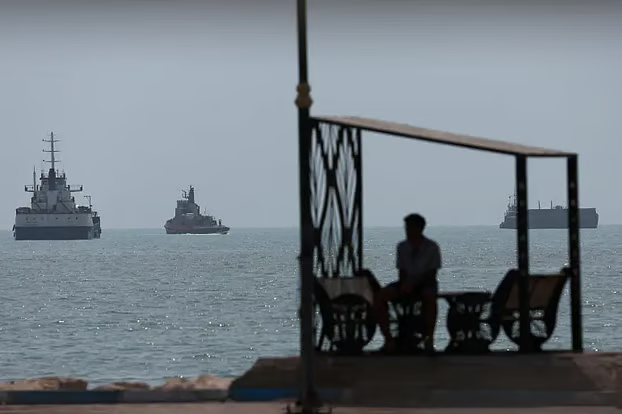
The US struck Iran again last Sunday, ending a month of relative calm. This time the strike targeted Iran’s rocket-launch system on Larak Island in the Strait of Hormuz.
US officials say the strike was carried out to stop Iran from using rockets to lay mines in the Strait of Hormuz.
The US described the strike as a “limited and precise operation” against Iranian forces engaged in mine-laying.
US Central Command (CENTCOM) spokesman Tim Hawkins said US forces observed Iran’s Islamic Revolutionary Guard Corps (IRGC) preparing to launch rockets carrying sea mines.
Iranian leaders sharply condemned the strike, calling it an act of aggression. Iran, however, did not sit idle after the US attack — the IRGC said it retaliated by striking two US military bases in Jordan.
The IRGC said the US strike killed its personnel and civilians. Iran’s semi-official Tasnim news agency reported at least two killed and two injured.
But the US claim has raised a question: is it actually possible to lay sea mines using rockets? Here is what’s known so far.
Harlan Ullman, a retired senior US Navy official, called the US administration’s claim about laying sea mines via rockets implausible.
Ullman speculates US intelligence may have secretly learned that Iran was preparing to lay new mines at sea using launchers aboard warships, but that officials framed it as a rocket story to downplay the threat internationally.
Ullman said that when a rocket slams into water at high speed, the impact itself could detonate or destroy a mine. He said Iran has far better methods and technology for laying sea mines, and questioned why it would take such a risk using rockets instead. He said the whole scenario struck him as quite strange.
Iran itself, however, has previously publicized its capability to lay sea mines using missiles.
A report aired on Iranian state television in January 2025 showed the IRGC using a Fajr-5 multiple-launch rocket system to lay mines during a naval exercise.
How sea mines are normally laid
Sea mines are typically laid using specialized warships, submarines or aircraft. They can be placed on the seabed, or left floating at a set depth below the surface. The mines are built to detonate automatically when they sense the engine vibration or magnetic signature of a passing ship.
It’s believed Iran used small, fast attack boats to drop a number of explosives in the Strait of Hormuz. These boats lay the mines and then move away from the area quickly. US forces, however, have already struck several such fast Iranian vessels.
Last week, US President Donald Trump said CENTCOM had finished clearing mines from the Strait of Hormuz, claiming the strait was now mine-free. He warned Iran that any vessel used to lay new mines would be destroyed.
Experts say making the Strait of Hormuz safe for normal shipping requires CENTCOM to run an extremely slow operation, locating each mine individually and neutralizing it through a controlled detonation.
The US Navy typically uses Avenger-class mine countermeasure ships for mine clearance. These are built with materials designed to minimize the magnetic and engine vibration signature they give off in the water, so that mines lying hidden below don’t easily detect the ship’s presence, greatly reducing the risk of detonation.
What’s known about Iran’s Fajr-5 rocket system
Iran is well known internationally for using low-cost tactics capable of outsized impact — a form of asymmetric warfare.
Iranian media reported in January last year that the IRGC demonstrated an entirely new method of laying sea mines during a naval exercise, using a Fajr-5 rocket system fired from land to place mines directly into the sea.
Analysts called the tactic “novel” at the time, but also voiced concern — because with a single rocket launch, the IRGC could scatter thousands of mines across a vast area of ocean.
First developed in the 1990s, the Fajr-5 is a medium-range, 333-millimeter rocket system, typically used to fire rockets in the manner of long-range artillery.
The system’s key advantage is that it is mounted on a mobile truck. The truck’s launcher can fire up to four rockets in quick succession. Each rocket carries roughly 175 kilograms of high-powered explosive. When it detonates, the rocket’s internal components turn into a spray of fast-moving, sharp metal fragments capable of shredding multiple targets across the surrounding area at once.
The Fajr-5 has a range of about 75 kilometers. Iranian forces have mainly used it to strike air bases and military installations.
With a 75-kilometer range, the Fajr-5 could, even when fired from land, easily scatter mines across the strategically important waters of the entire Strait of Hormuz.
Iran has since further developed the technology. Newer variants such as the Fajr-5C have added more advanced, GPS-based precision navigation systems. These upgraded rockets can now strike targets accurately at a greater distance — up to roughly 130 kilometers.
How Fajr-5 could be used to lay mines
Iran has not confirmed whether it is currently scattering sea mines using the Fajr-5 or any other rocket system.
In theory, the section of a rocket that normally holds explosives or a warhead could instead hold a sea mine in place of the explosive. It’s believed the IRGC’s naval exercise in January 2025 demonstrated exactly this method.
In this method, the rocket is first launched from a truck-mounted launcher on land near the coast. The mine-carrying rocket then flies out over the sea. When it reaches the designated sea area, the rocket’s outer casing automatically opens in mid-air.
The unexploded mines inside the rocket then fall directly from the sky toward the water. To keep the mines from slamming into the water at high speed and detonating on impact, each one is fitted with a small parachute or another speed-reducing mechanism, allowing the mines to land in the water gently.
Once in the water, the mines can automatically sink to the seabed, or remain floating at a set depth below the surface.