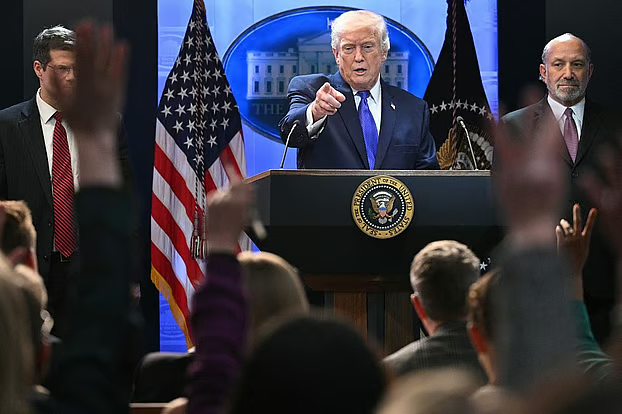
US President Donald Trump has threatened a “harsh” strike on Iran. Trump issued the threat Monday, after a fresh round of tit-for-tat attacks between the two countries following a lull of several weeks. US Treasury Secretary Scott Bessent, meanwhile, announced continued pressure to weaken Iran’s economy.
Six months have passed since US and Israeli forces began their war against Iran. The standoff between the two sides has yet to break. Iran has kept the strategically vital Strait of Hormuz closed, while the US continues a counter-blockade around Iran’s ports.
US forces struck an Iranian island in the Strait of Hormuz last Sunday. Tehran responded by striking US military installations in the Middle East. The exchange of attacks has raised fears of a fresh, larger conflict — prompting Trump’s threat of a tough response.
In a brief conversation with a Fox News correspondent, Trump said: “We’re going to hit them [Iran] hard. The country will be answered.”
US officials said the strike on Iran’s rocket-launch system on Larak Island was meant to stop Iran from laying mines in the Strait of Hormuz. In response, Iran struck Jordan and the United Arab Emirates with missiles and drones. Tehran said the strikes targeted US forces stationed there.
Iranian President Masoud Pezeshkian, however, called late Monday for talks to ease tensions. Speaking at a summit in the Central Asian country of Kyrgyzstan, he said: “We are looking for a path of understanding and mutual accommodation. Continuing the war serves the interest of neither Iran nor anyone in this region.”
According to the Iranian president, dialogue and cooperation are the way to resolve the existing problems.
Missiles and drones
Three people were killed in Sunday’s US strike on Larak Island, with several more injured, Iranian state media said.
Iran’s powerful Islamic Revolutionary Guard Corps (IRGC) said ballistic missiles struck two US air bases in Jordan, causing “significant damage.”
Trump, however, told Fox News that all missiles fired at US forces were shot down except one, which was not intercepted but posed no threat.
Jordan’s military said eight missiles were shot down, without saying where they were launched from.
Iran also said it struck US troops at an air base in the United Arab Emirates and shot down a US drone over the Strait of Hormuz.
Abu Dhabi, for its part, said a drone was shot down in its territorial waters, and dismissed as “baseless” the claim of a strike on Al Minhad air base.
The IRGC said Monday evening that another US drone had been shot down over the Strait of Hormuz. Iran’s armed forces central command warned regional neighbors against allowing the US to use their territory to launch attacks.
Separately, an oil tanker leaving the Strait of Hormuz was struck by three “unidentified objects” near Oman’s northeastern coast, the UK Maritime Trade Operations agency said Monday night. It said there were no reports of casualties and no adverse environmental impact.
‘Pressure will continue’
The Middle East had seen relative calm for several weeks before this fresh exchange of attacks between Iran and the US. The Trump administration has also recently turned its focus toward “economic warfare” against Iran.
Trump on Monday called Iran a “failed state.” On social media, he said Iran’s military is now in disarray, its economy is collapsing, and its leadership has descended into total chaos.
US Treasury Secretary Scott Bessent said economic pressure on Iran will continue. Speaking to reporters at the G20 summit in North Carolina, he said: “We will keep up the pressure [on Iran]. That could bring major change within weeks or months.”
Iran, too, has created economic pressure by maintaining its blockade of the Strait of Hormuz. Global markets are already seeing volatility, with oil and other commodity prices rising. Prices are trending upward in the US as well, becoming an important issue ahead of the country’s November midterm elections.
Tensions around Hormuz
Shipping through the Strait of Hormuz has been disrupted for six months because of the Iran war. Trump has claimed the US Navy has “full control” of the strait.
Last week, the US said it had finished clearing mines from the strategically vital waterway.
Iran, however, says it retains control of the Strait of Hormuz. The IRGC said Monday that a “reckless” oil tanker caught fire near the strait after two mines exploded while the vessel was crossing through an illegal route.
The US military has denied Iran’s claim, calling it “disinformation.” US forces said: “No mine explosion involving any vessel occurred in the Strait of Hormuz.”
Mediation efforts to end the Iran war have been under way for months, though an earlier ceasefire memorandum ultimately collapsed.
Iran is trying to bring the US back to that earlier agreement. In an interview with Iranian state television Monday, Foreign Minister Abbas Araghchi said: “The path to a solution is completely clear and simple. The United States must return to its own commitments.”