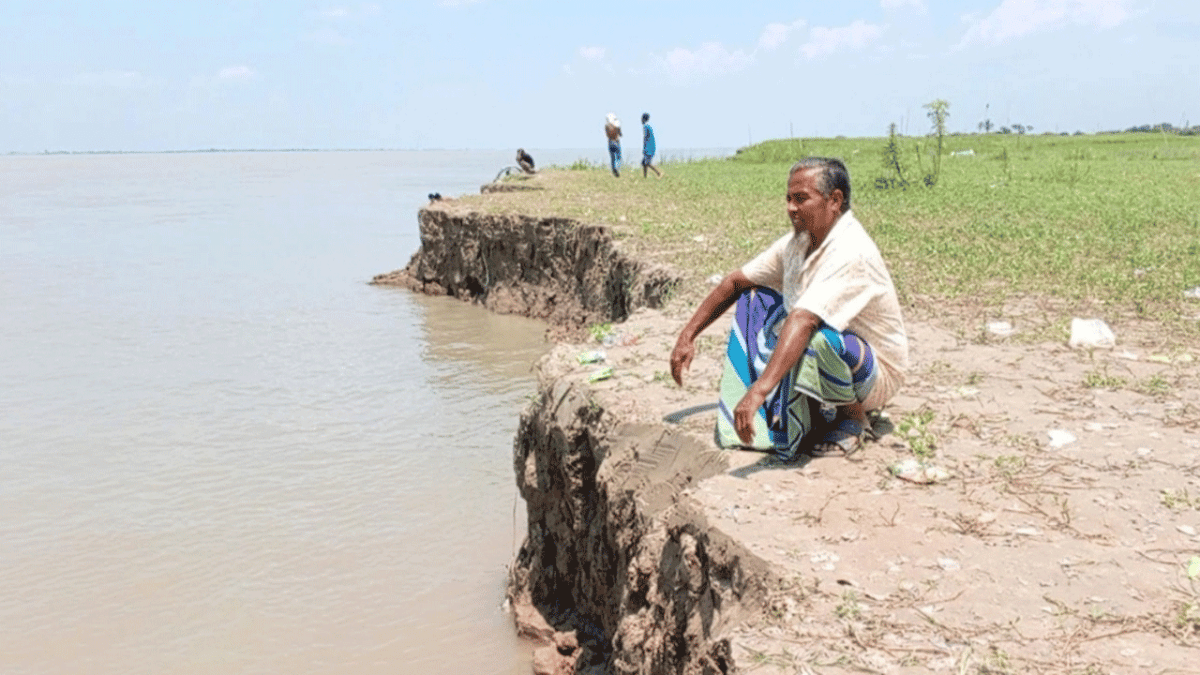
The monsoon is nearly over in Sadarpur, Faridpur, but erosion by the Padma has not stopped. Strong currents are still breaking the riverbank, and people are watching their homesteads, farmland and businesses disappear before their eyes. Those living along the river spend their days in fear and their nights without sleep, afraid that the current will take whatever is left of their homes.
Erosion by the Padma intensifies every monsoon, but this year it has continued even after the season ended. New areas have already been hit and many families have lost everything. People who have suffered river erosion for years say that, alongside temporary sandbagging, the river needs permanent and sustainable management.
Erosion has struck again this year, and is continuing, across wide areas of the riverside Dheukhali, Akoter Char, Diara Narikelbaria, Char Manair and Char Nasirpur unions of Sadarpur upazila. Strong currents are eating into the bank at Shoitankhali, Beparidangi and Munshir Char in Dheukhali union, and at Cholenama, Kalikhola, Mollakandi and Khalashikandi in Akoter Char union. In Diara Narikelbaria union, residents of Nuruddin Sardar Kandi, Abdul Hamid Jangir Kandi, Alef Sardar Kandi and Jabbar Sikder Kandi are also living in fear of the river.
Locals said erosion has intensified along several kilometres as the Padma’s water level and current have risen. Hundreds of bighas of farmland and many homesteads have already been swallowed. Several businesses, a brickfield and part of an important road have been damaged. By local estimates, around a hundred homes have gone into the river, and residents put the losses at several crore taka. Many families, fearing the river, are dismantling their houses and moving them to safer ground.
Among those who have lost everything, the story of Hasmat Bepari, 100, of Beparidangi village, reflects the cruelty of river erosion. He had hoped to spend the last part of his life on his own land. But over several decades the river took his homestead again and again. He built a house eight times in his life and was never able to settle. After the latest erosion he once more had to leave the home that held his memories and move into a rented house with his wife, daughter-in-law and grandchild. His only son works in Saudi Arabia.
Local resident Sajjad Sikder said: “I have built a house seven times in my life. The Padma has swallowed them all. At this age I have no strength left to start again. I have been forced into a rented house. I do not know whether I will be able to die in a home of my own.”
Countless families along the Padma have fought the river for years. Some have lost their homes, some their farmland, and others the business that was their only livelihood. With erosion continuing after the monsoon, fresh fear has spread among these families. Many are moving furniture, livestock and essentials, and some have already left for safer places.
Locals fear that if the erosion continues, Akot Janasangha High School, two government primary schools, Piyajkhali bazar, a government shelter project and a cluster village could all be put at risk. Families living in the cluster village in Akoter Char union are deeply worried. The houses they received through a government scheme are their last refuge, and they do not know where they would go if those too were lost. Locals said Chowdhury’s Haat and the Shimultali bazar ghat in Char Nasirpur are also under threat.
Arif Mahmud, who lives in the cluster village in Akoter Char union, said: “Whenever this time of year comes, we cannot sleep. As soon as the water rises, the erosion starts. The monsoon has gone, but the erosion still has not stopped. The government gave us a place to live, and these homes are now all we have left. If we lose them too, we will have nothing.”
A Aziz Chokdar, of Nuruddin Sardar Kandi village in Diara Narikelbaria union, said people are hit by river erosion every year, losing homes and farmland to the river. Instead of acting after erosion begins, sustainable river management should be started in advance, he said. “How many more times will we people of the char face this kind of danger?”
Residents of the affected areas complain that despite years of demands for permanent measures, no effective or sustainable action has been taken. As a result, new areas are hit every year and more people lose their homesteads. They want emergency measures to stop the erosion, alongside a long-term river management project.
Aslam Bepari, chairman of Akoter Char union parishad, said: “River erosion is no longer a sudden disaster. It has become an annual one. We have repeatedly informed the Water Development Board and the other authorities concerned. They have visited the area. I hope action will be taken quickly.”
Sadarpur upazila project implementation officer Nurunnahar said: “We have started collecting information on the damage and preparing a list. We have spoken to the local representatives of the affected areas. Subject to a government allocation, we will arrange humanitarian assistance and relief for those affected. The situation has also been reported to senior authorities.”
Sadarpur upazila nirbahi officer Sharif Shawon said: “The upazila administration is closely monitoring the erosion by the Padma. The departments concerned have already been informed. Necessary steps will be taken in coordination with the Water Development Board and other authorities to put long-term, sustainable measures in place against river erosion.”
Md Rakib Hossain, executive engineer of the Faridpur Water Development Board, said: “We have identified the erosion-prone areas and informed our senior authorities, who are aware of the matter. The erosion-prone areas are being monitored regularly. Steps towards a sustainable solution will be taken very soon.”
Shahidul Islam Khan Babul, the member of parliament for Faridpur-4, said: “We need a long-term plan for the river. I have spoken to the minister concerned, the deputy commissioner and the Water Development Board about the erosion. A project is under way in neighbouring Charbhadrasan. In Sadarpur, too, we will move towards a permanent solution. For now, sandbags are being dropped to hold back the erosion. With the Water Development Board’s help, permanent river management will be put in place soon.”
For people who have lost homesteads, farmland and livelihoods to the Padma year after year, the suffering seems endless. They say relief or temporary help cannot address the long-term damage done by erosion; what is needed is effective river management to protect homes and land. They are demanding that erosion-prone areas be identified and that permanent embankments and sustainable river management projects be built. Their one hope is that they never again have to watch their homesteads vanish into the Padma’s current.
বাংলায় মূল প্রতিবেদন পড়ুন · Read the original Bengali report