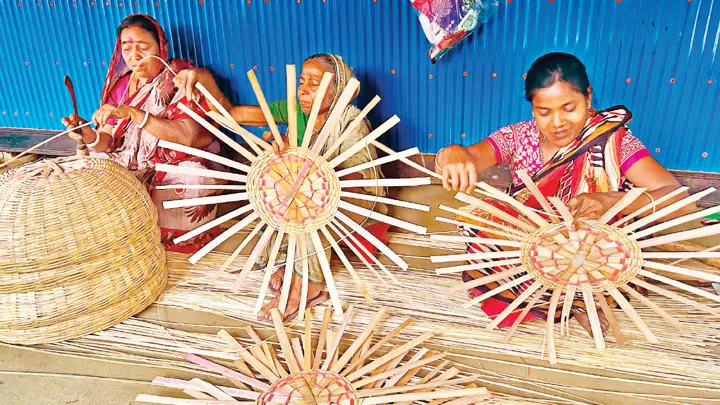
Bangladeshi women have long been known for their skill at making household items and handicrafts. Among these, bamboo craft is one of the country’s distinctly own cultural industries. Beyond the country’s broader rural female population, this craft also symbolises the way of life and sentiment of small ethnic communities. Women artisans deprived of urban amenities make decorative bamboo items to earn a living. Even today, a touch of comfort has never reached their own lives.
Byaskathi’s bamboo craft
Asked about the varied realities of their lives, Sukola Mojumder said: “A cheap piece of cloth and two handfuls of food — that’s our daily means of survival.” Plastic goods have taken over the space that once brought them joy. At one point in the conversation, her tears and sighs seemed to say it all: “For them, simply staying alive means doing well.” With modernisation, this handicraft has faded considerably, and the bamboo industry’s economic importance has declined along with it. Two underprivileged bamboo-craft units at Swarupkathi’s BSCIC industrial estate shut down nine years ago. As recently as the late 20th century, Nesarabad upazila (Swarupkathi) had 46 bamboo-craft clusters across 137 villages. Over time, 26 of these have disappeared, though 20 still survive.
Sarengkathi’s bamboo craft
Owner Shila Haladar said: “I’m still in this trade my father and grandfather worked in, but I don’t know how much longer I’ll be able to hold on.” Because of the unusual rise in bamboo prices, plastic goods taking over the market, a shortage of bamboo, a lack of government support, and the absence of any planned initiative, this traditional craft of Nesarabad’s rural villages is heading toward extinction. As recently as about five decades ago, multipurpose bamboo products were used in nearly every household across the countryside.
Local sources say that even half a century ago, around 40,000 women bamboo artisans in Nesarabad upazila carried on their ancestral trade with business in mind, earning a living by making 30 to 40 types of decorative goods. But with a lack of support and the dominance of plastic products, this bamboo handicraft is now heading toward extinction. According to the Rural Women’s Productive Employment and Awareness Programme (Gramuksok), bamboo craft is one of the major cultural traditions among Bangladesh’s rural women, woven into folk life through one of the few natural materials still closely tied to it. To preserve this ancestral tradition, around 7,000 women workers from more than 500 women-headed families across 20 villages in Nesarabad — including Karafa, Sarengkathi, Goyeshkathi, Bharatkathi, Katapitania, Jirbari, Khejurbari, Lebubari, Chilatala, Rajabari, Debdaskathi and Byaskathi — still rely on bamboo craft as their main source of income. Nearly every household in these villages still functions, in effect, as its own small bamboo-craft workshop, with women sitting in rows weaving bamboo goods from 3pm until midnight, helping thousands of women become self-reliant. Children in these women-headed households also help their mothers with the work between their studies.
Setu Sikder, a widow from Chilatala village, said: “My husband died 13 years ago. I have a family of four children to run. I have to fund three of their education and run the household by making bamboo strips and splints.” Sabita Dali, a divorced bamboo artisan from Jirbari, said: “My married life ended long ago. With two children, I somehow survive on whatever I get from making these fishing baskets.” Kabita Haldar of Bharatkathi said: “I make ‘aura’ baskets from bamboo from 3pm until midnight. My husband used to earn a decent living selling bamboo products wholesale across different districts, enough to support our three children. But now plastic goods have taken away our food. Even so, I’m holding on to this ancestral trade.”
Asked how household bamboo items are made, Pushpa Rani, a bamboo-craft business owner from Goyeshkathi, said: “First, depending on the product, the bamboo has to be soaked in water for three days. Then the bamboo is split into strips, laths and splints, and prepared into binding strands, according to the required measurements, to make various items.” Using these raw materials, the skilled hands of rural women craft baskets, mats, trays, hand fans, winnowing baskets, sieves, brooms, small containers, food-covering baskets, fish cages, fishing baskets, cages to protect trees from livestock, baskets for keeping chicks, and around 20 to 22 other types of items, each a symbol of their own distinctive culture.
A visit to several areas showed many scenes of decorative bamboo products being made. There, 70-year-old veteran bamboo artisan Horimon Bibi of Debdaskathi spoke about her life. She said: “My husband died 22 years ago. My children don’t check on me either. In my old age, I somehow get by on what I earn making bamboo fibre goods. There’s no end to my illnesses. Buying medicine takes everything I have. I can’t work like I used to. If the work stops, I don’t know what I’ll eat to survive, son!”
Aware observers say that although this industry falls under small and cottage industries, no government or private organisation has stepped forward to help sustain it. To save this craft from destruction, urgent government support, easy-term bank loans, planning and modern training arrangements are needed.
On this, Swarupkathi Bangladesh Small and Cottage Industries Corporation (BSCIC) manager Mojahidul Islam said special emphasis would be given to the rapid development of the medium-industry sector in implementing the inclusion of bamboo craft among small-industry entrepreneurs. He said senior officials would be informed about providing various incentives and financial support to help women entrepreneurs establish themselves in small, cottage and medium industries.