Rows of banana trees stand on both sides, with a road running between them, newly paved this year. Here and there along the road there are date palms too. The road looks almost like a picture: an unspoilt, lovely scene of rural Bengal that fills the heart. A little way along, a muddy bypass branches off to the left. At its start stands a medium-sized wood apple tree whose branches spread out in every direction, so that from a distance it looks like a banyan. It is heavy with fruit, as if small white balls were hanging from it.
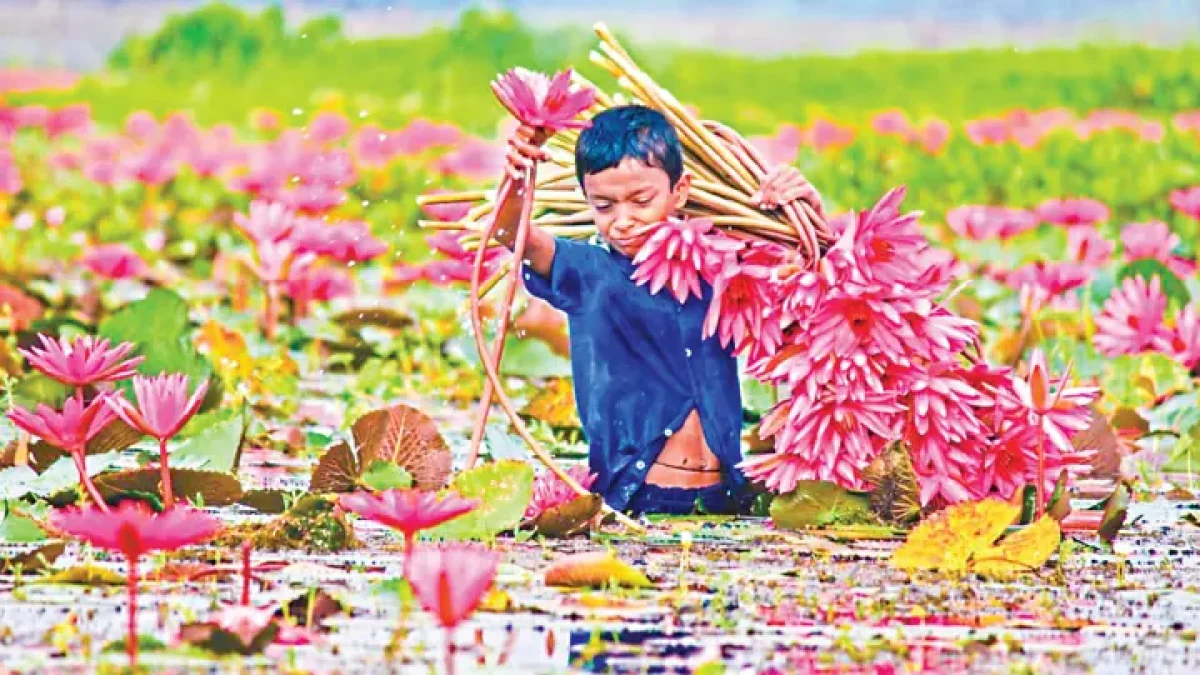
Push on a little further through the mud and there is a very old banyan tree, witness to much history. Farmers from the fields come to rest in its shade and share their joys and sorrows. A short way on, in the monsoon, water gathers over a wide area and turns it into something like a sea. Local people call it Kanabil. The story goes that a one-eyed gentleman once caught an enormous rui fish in this beel, and the beel was named after his feat. In the rainy season the beel blooms with water lilies. The whole of it fills with white shapla, and from afar it looks like a white carpet spread over the land; up close, Kanabil seems dressed in a wonderful blend of white and green. Teenage boys and girls gather the lilies on rafts and sell them at the market. The lower part of the flower is a long, soft, tender stem called nail, which is cooked as a vegetable and is nutritious. Many people make a living gathering it from the beel. The lily leaves float on the water and sway when a ripple comes; when leaves, flowers and water sway together, a wave of joy runs through those who come to see them.
Kanabil is no famous beel. It has no place in the newspapers, on Facebook or in any media. But in the rainy season the blooming lilies give nature a matchless form. For those of us who are poor and cannot go far away to drink in the beauty of nature, Kanabil is our store of loveliness. With nature’s form, flavour and scent it keeps our beauty-hungry hearts enchanted, if only a little.
বাংলায় মূল প্রতিবেদন পড়ুন · Read the original Bengali report