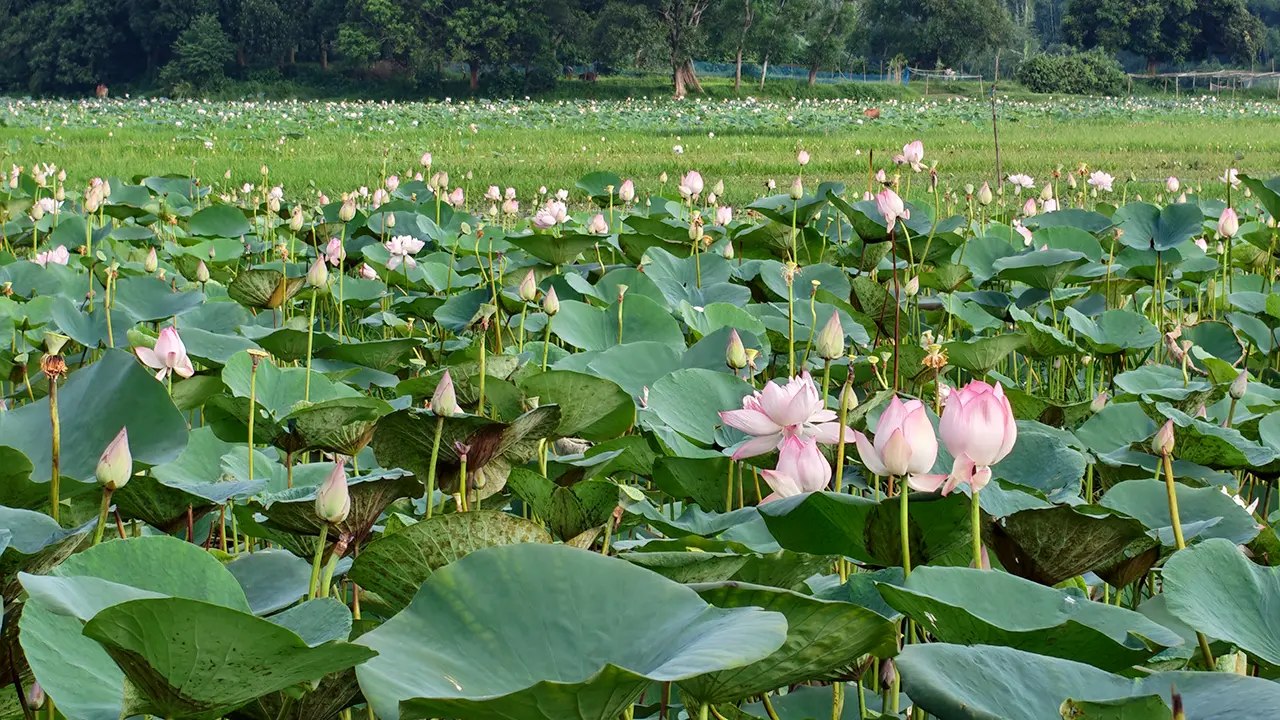
As autumn’s pure white clouds drift across the sky of this beautiful land, following the curtain of monsoon rain, an obscure wetland on Brahmanbaria’s northeastern border transforms into something like a painting from another world. As far as the eye can see, there is nothing but a sweep of green, pierced everywhere by countless unblemished lotuses. When the soft light of dawn and dusk spreads across the dark water, thousands of pink and white lotuses hold droplets of dew like nature staging an unmatched royal celebration.
This wetland at Ghaghutia and Minarkut, bordering Akhaura, is no longer just a body of water — it has become a living poem of this beautiful land.
Every autumn, hundreds of lotuses bloom naturally in this beel (wetland). In recent times, thanks to beauty-seeking travelers and photographers, it has turned into something of a crowded paradise. As soon as dawn breaks, the beel’s calm waters awaken with a hum of wonder. The scent of alluvial soil, the eager stirring of aquatic plants, and the sweet fragrance of lotus blend together to perfume the air. The calls of whistling ducks, cormorants and gulls drifting in from the distant horizon lend the beauty its own unique rhythm and melody.
From the first light of dawn until dusk, the small boats moored at the beel’s edge set off toward its beautiful shores. Sitting in a mahogany or sal-wood boat, gliding slowly across the beel, one feels as though drifting into some unknown, enchanted realm beyond time. Each lotus rising above the water’s surface feels like its own quiet thrill — some just opening their buds, others with full petals unfurled, embracing the sun’s first rays. Seeing the reflection of young lotuses in the glass-clear water, it seems as though the clouds of the sky and the water of the earth have merged into one enchanting illusion.
To escape the city’s mechanical noise, the lifeless walls of brick and concrete, and the self-sacrifice of endless busyness, thousands of homesick people rush to this quiet paradise. They touch the water, find spiritual peace in the softness of lotus petals. Some silently paint pictures of feeling on the canvas of the mind; others capture a fleeting immortality through a camera lens. The calm waters come alive with the chatter of young people, the awed breaths of the elderly, and the babble of children.
Md. Nurujjaman, who came from Gulshan in Dhaka, said, “The environment here is very gentle. I live in Dhaka with my children, where it feels a bit like living in a zoo. It feels wonderful here — I took a boat out into the lotus beel, and my mind feels at peace.”
Shahida Begum, who came from Bonosree in Dhaka, said she was so captivated by the environment that words could not describe it. She said this was her first visit to the lotus beel, and she enjoyed touring it very much.
Tasmia Akter, who came from Brahmanbaria, said, “I liked it here so much, I don’t feel like going home. The environment has left me completely enchanted.”
This transformation of nature does not merely quench a poetic thirst — it also paints a touch of prosperity onto the canvas of local life. Boatmen who usually go without work once the monsoon water recedes now find oars back in their hands during this lotus season. Rowing to a gentle rhythm, they carry visitors deep into the beel and earn their daily bread.
Md. Shah Alam Mia, a boatman on the lotus beel, said, “Alhamdulillah, we’re earning quite well because of this lotus beel. Hundreds of people come every day. I can earn 3,000 to 4,000 taka a day.”
Another boatman, Billal Hossain, said, “Tourists come every day now, and we take them by boat among the lotus flowers. Seeing their joy makes me happy too.” He added that before the lotus beel drew visitors, boatmen would sit idle during the monsoon season, but now they no longer have to.
Behind this extraordinary natural beauty, however, lies an urgent plea. The unchecked footfall of visitors, and the frenzy of needlessly picking flowers, is threatening the beel’s natural character. Preserving this indestructible beauty of nature requires responsible behavior and awareness.
Shamim Ahmed, convener of the environment and river-protection organization Tori Bangladesh, said, “Nature has arranged this beel according to its own rules for hundreds of years. Please don’t uproot lotus flowers, lotus stems or plants just for photos or momentary pleasure. A single flower you pluck disrupts the beel’s reproduction process and natural balance.” He added that the lotus beel is a habitat for countless native and migratory birds, and urged visitors to help maintain a calm, quiet environment.
Deepak Chowdhury, chairman of the local Moniyand Union Parishad, spoke about the potential centered on this lotus beel and the need to protect the overall environment: “Nature has adorned this wetland on the border of our Moniyand union in a wonderful way. Hundreds of people are coming here every day from far and wide, which is a matter of joy and pride for our entire area. On behalf of the union parishad, we are calling on visitors to pay attention to certain specific matters to protect the local environment. We are providing the necessary local support to ensure visitors’ safety and allow them to enjoy this beauty without hindrance.”
Akhaura Upazila Executive Officer (UNO) Tapasi Rabeya said, “This lotus beel has added a new dimension to Akhaura’s natural beauty. The upazila administration is taking various initiatives to develop the area as environmentally and tourism-friendly, building on this potential. Alongside ensuring visitors’ safety, we are keeping strict watch to make sure the beel’s natural environment and rare ecosystem are not damaged in any way.”
This fairy tale of pink lotuses set against green is more than just a scenic sight — it is an enchanting bridge between nature and humanity’s mutual existence. If the goodwill of local authorities, the awareness of nature lovers, and the responsible conduct of visitors can be woven together, this lotus beel in Brahmanbaria will not remain merely a fleeting autumn paradise — it will become nature’s eternal garden. As the lotuses lean gently over the calm water in the light of dusk, they seem to say, quietly, that loving and preserving nature is how people find the peace they seek.