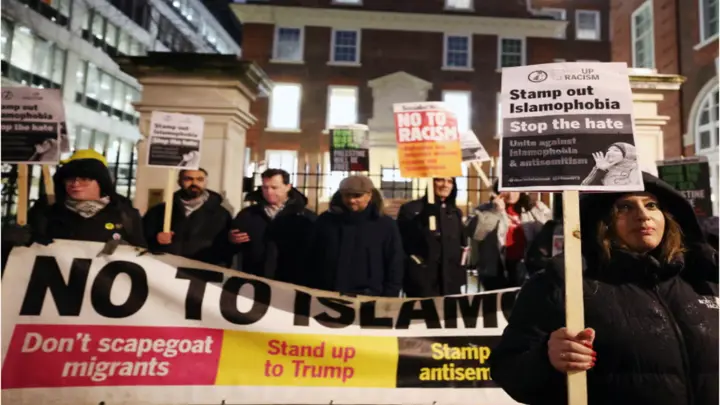
Islamophobia, or hostility toward Muslims, is rising in Britain, and the country’s mainstream politicians remain dangerously indifferent to confronting it. Hostile rhetoric and discrimination against Muslims are not simply a matter of individual bias — they are also deeply tied to political and institutional structures.
Alongside negative attitudes toward Muslims in British society, incidents of discrimination and violence have also reached a worrying level. Yet political leadership’s response has, in many cases, failed to grasp the depth of the problem. This political inaction is creating an environment in which far-right parties are able to use Islamophobia as a political tool.
The roots of contemporary Islamophobia are not confined to politics of recent years. The development of Western neoconservative political thought in the post-Cold War period, and various policies adopted during the subsequent “War on Terror,” institutionalised suspicion toward Muslims. Britain’s “Prevent” policy is one example of this kind of institutional suspicion.
A similar problem has been seen recently around pro-Palestinian protests. Muslim political activism is at times viewed through the lens of extremism or security risk. This has raised concern that legitimate political expression by Muslim citizens is being narrowed.
The response from political leaders, including British Prime Minister Keir Starmer, has also drawn criticism. Viewing Muslim political activity with suspicion, rather than resolving the underlying problem, risks deepening political alienation within Muslim communities. At the same time, structural inequality in society and the distance of certain communities from political power are contributing to the spread of Islamophobia.
Viewing racism merely as individual prejudice fails to capture the real picture of the problem. Racism can also function as a tool of broader social and political dominance. The way Muslims are being targeted today, the same political process could be used against other marginalised communities in the future.
The difference in Britain’s treatment of Afghan and Ukrainian refugees is also an example of institutional bias. When state policy discriminates between different refugee populations, it reinforces a broader perception of inequality in society.
Viewing Islamophobia solely as individual hatred or isolated crime leaves the problem’s political dimension hidden. British politicians now need to confront anti-Muslim hostility clearly. Otherwise, social and political alienation among Muslims will grow, while at the same time creating an even more favourable environment for far-right politics.