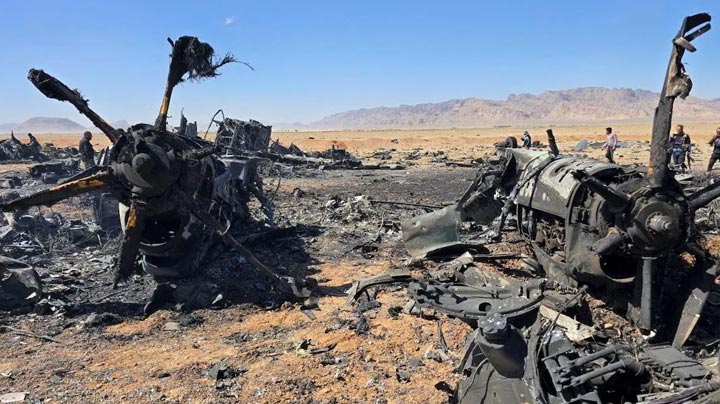
A US Air Force F-15E weapons systems officer, a colonel known by the callsign “Dude 44 Bravo,” spent nearly 50 hours severely injured and hiding alone after his fighter jet crashed on Iranian soil. He described that terrifying experience on the US programme “60 Minutes” on CBS.
He said that because his parachute didn’t open properly, he slammed into the ground at tremendous speed, breaking his spine and an arm and suffering a serious shoulder injury. Cuts to his head and face caused heavy bleeding. Despite these serious injuries, he kept his mental strength and stayed hidden in the mountains.
The American military officer later returned safely from Iran with the help of a special rescue team.
According to a report by Indian outlet NDTV, the US Air Force “F-15E Strike Eagle” fighter jet was shot down on April 2 by an Iranian shoulder-fired missile. The two-seat jet, worth around 30 million dollars, carried pilot “Alpha” and weapons systems officer “Bravo,” a colonel in the US forces.
After the jet was destroyed, both officers had to parachute down onto Iranian territory.
Parachute failing to open mid-air
Describing the moment the Iranian missile struck the jet, Bravo said it felt as though an enormous, high-speed freight train had slammed into the aircraft.
It quickly became clear the jet could no longer be controlled, so both had to eject. Pilot “Alpha” was rescued within a few hours. But weapons systems officer “Bravo” landed in rugged, mountainous terrain and was seriously injured. His real identity has not been disclosed for security reasons.
As he descended by parachute, he noticed it wasn’t opening properly. Recalling that moment, Bravo said: “I looked up and saw the parachute wasn’t opening. That was the most terrifying moment of my life.”
He believes he fell to the ground without a parachute at a speed of 70 to 100 miles per hour, landing around five miles away.
Slamming into the mountainous terrain broke his spine and one arm. He also suffered a serious shoulder injury. Cuts to his head and face caused heavy bleeding.
Hiding in the mountains while badly injured
Despite such serious injuries, Bravo did not stop. He understood that staying in one place in enemy territory risked capture by Iranian forces.
At the time, around 1,500 Iranian soldiers and armed group members were searching a 10-mile area for him. Iranian television even announced a bounty on his head. Bravo said: “I didn’t stop, out of fear of seeing my own face shown as a prisoner on Iranian television.”
Ahead of him lay a mountain-ringed valley. With a broken back and arm, he climbed to an area roughly 7,000 feet high, later taking shelter in a mountain crevice.
He had almost no food or water with him. Combined with the cold, his physical suffering grew even worse.
Resting in short bursts, he kept changing position repeatedly to avoid detection by Iranian forces. At the same time, he kept trying to send out signals. For nearly 24 hours, US forces had no information about his location.
A major rescue operation begins
Meanwhile, back in the United States, planning began for a large-scale operation to rescue him. This marked the first time in 46 years that a rescue operation was carried out inside Iranian territory for a US serviceman.
US defence secretary Pete Hegseth was informed of the jet’s downing in the middle of the night. A decision was then made that both servicemen had to be found and rescued.
The operation involved more than a hundred troops and a large number of aircraft and drones. According to US forces, more than 90 American troops were deployed on Iranian soil as part of the rescue operation, with more than a hundred fighter jets and drones in the air.
The CIA’s crucial role in the rescue
The CIA played a crucial role in locating Bravo and rescuing him. Covert technology was used to track his movements.
At the same time, a deception campaign was run to confuse Iranian forces. The US Air Force also struck Iran’s IRGC forces near the area where Bravo was hiding.
The final rescue operation then began. After nearly 50 hours, the US rescue team finally managed to reach Bravo.
Bravo has described the moment he reached his rescuers as one of the best moments of his life. After returning home, he called his wife to tell her he was alive.
According to Bravo, the incident isn’t just a personal survival story. It also reflects training, trust among fellow soldiers, leadership, and the American military’s commitment to “never leaving anyone behind.”
Despite the injuries and intense pain, he never lost his mental strength. When the rescue team reached him, Bravo reportedly said only one thing: “Let’s go.”
Experts describe this US military rescue operation and Bravo’s survival with a single word: a “miracle.”