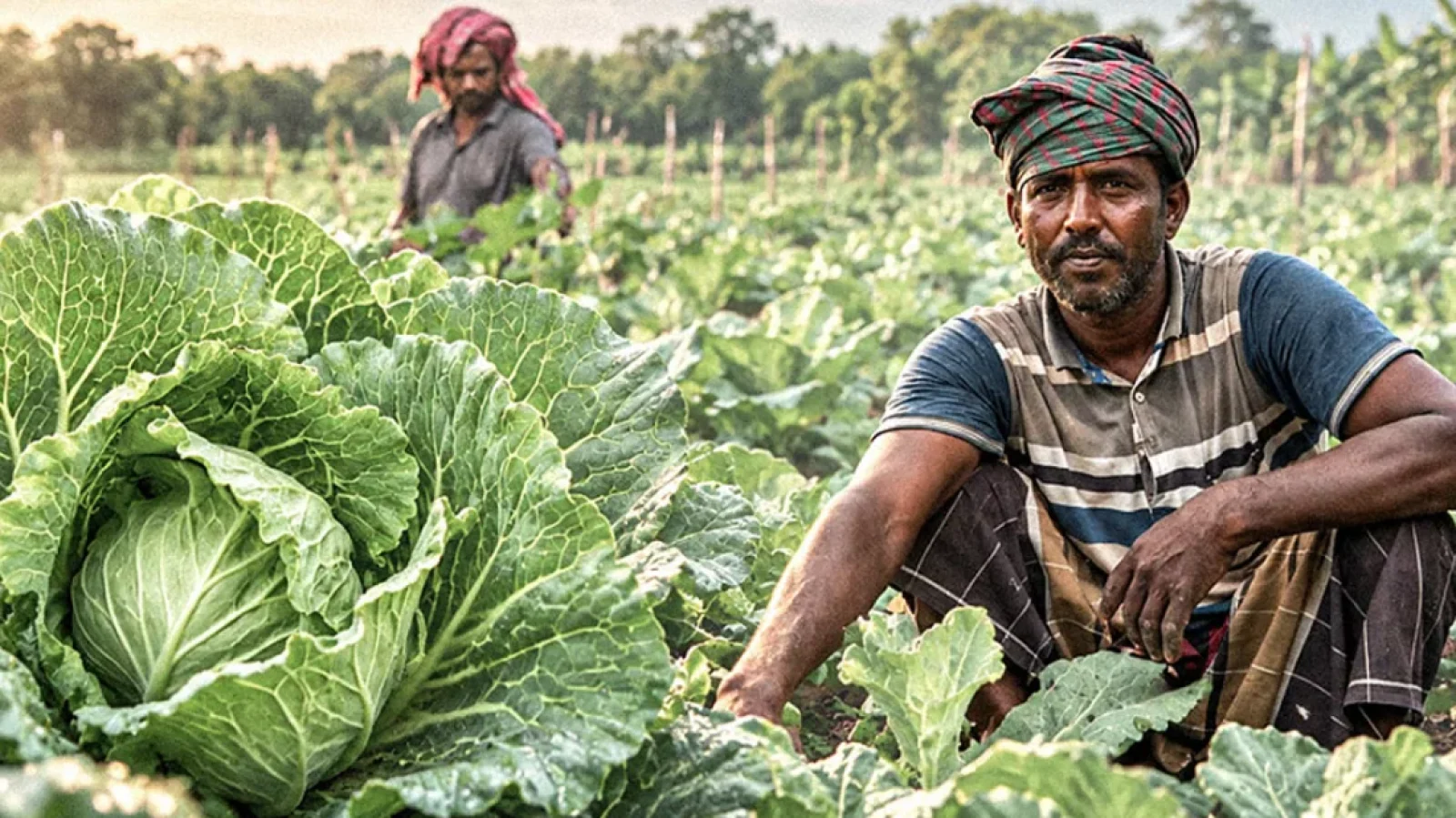
Thanks to mobile phones, rural vegetable growers can find out at once what their produce is fetching in city markets. Farmers and small traders at Mahasthan in Bogura, one of the largest vegetable markets in the north of the country, say they now come to market with a realistic idea of what their vegetables are worth.
They say easy access to price information through mobile phones has strengthened their bargaining power, although in the end prices depend on supply and demand.
Research cited in development literature suggests that mobile connections sharply reduce the cost of looking for information. Vegetable growers now often use voice calls and SMS services to contact buyers before harvest. Md Aminul Islam, 36, a farmer from Rahmatbala village in Bogura Sadar upazila, has grown radish, bottle gourd, pumpkin and yardlong beans on one acre. On 2 October he brought radishes to Mahasthan vegetable market. ‘Three days ago I knew the price was about Tk 1,000 a maund (40 kg), but today it has fallen to Tk 500 to 600 a maund,’ he explained. ‘That is because of oversupply, and because the quality of this vegetable is sometimes poor when it is grown in hot weather.’
‘Farmers cannot get together to fix prices. Farmers and traders have mobile phones, so both can get information on supply and demand.’ Rabbi Molla, 25, from Uthli in Shibganj, has grown an early variety of cauliflower on about 50 decimals of land this season. Before harvesting, he talks to other farmers and traders to get an idea of the likely price.
‘I sold some cauliflower from the field,’ he said. ‘I come here (to Mahasthan) hoping for a better price. Sometimes the price rises, sometimes it falls. When demand for vegetables goes up in Dhaka or other cities, that is when wholesalers and traders give us a good price.’
Reading the price situation, many wholesale buyers purchase seasonal vegetables from farmers and sell them to Mahasthan-based commission agents, who sell the produce in bulk to their counterparts in Dhaka and other cities.
One such trader is Masum Islam, 27, from Bichok in Shibganj. ‘Today I bought bitter gourd from farmers at Tk 1,600 a maund and hope to sell it at Tk 1,800,’ he said. ‘We struggle to get that because we do not know the right price in advance.’ He said Mahasthan’s wholesalers buy vegetables according to orders from city wholesalers and according to supply. At present there is plenty of cucumber, aubergine, ridge gourd, pumpkin, yardlong beans and olives.
‘The more supply there is, the more profitable it is for us. But when demand is high in Dhaka, farmers also ask for more. Everyone keeps an eye on demand and supply by phone or on Facebook. Farmers now get a share of any price rise,’ said Abdul Hamid Pramanik, 48, of Lahiripara in Bogura, who has been in the wholesale vegetable trade for about a decade.
The Mahasthan trading centre supplies vegetables to several cities. It has about 200 wholesale buyers and 70 wholesale traders who own commission warehouses. Al-Mamun, 40, owns one of them, Maisha Traders. He said the use of mobile phones by farmers and small traders has revolutionised farming and is ensuring farmers a fair price.
‘It has increased competition in the business,’ he added. ‘Now you do not see a huge gap between the farmer’s selling price and the wholesale price. Of course any price rise affects consumers, but farmers benefit.’
Hefzul Bari Fakir, 40, lives at Mahasthan as the representative of Bishal Bhandar, a wholesale warehouse in Mirpur, Dhaka. ‘Every morning I get the demand for vegetables from Dhaka by mobile phone, along with guidance on likely prices,’ he said. ‘Then I buy vegetables from farmers and small traders and transport them to Dhaka. But often I cannot buy at the price given from Dhaka, and sometimes I can buy below the expected price. That depends mainly on how much is being supplied.’
‘Farmers have access to market information and try to sell to whoever gives them a good price. When production falls, or there is a transport problem, vegetable prices rise.’ Vegetables are perishable and spoil quickly.
Experts estimate that 30 percent of vegetables produced spoil before they reach consumers. Now that farmers and traders can get price information quickly, it should help them sell vegetables faster, and it is hoped this will reduce waste.
বাংলায় মূল প্রতিবেদন পড়ুন · Read the original Bengali report