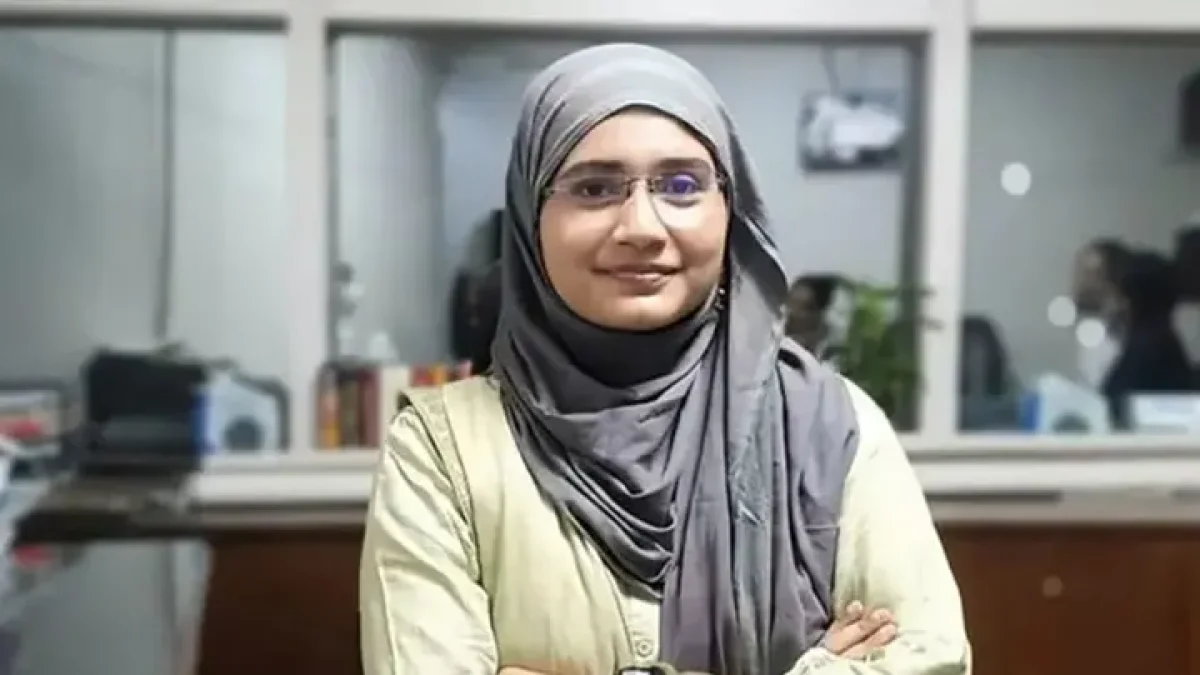
Samanta Sharmin, a joint convener of the National Citizen Party (NCP), has resigned from the party. She announced her resignation herself in a Facebook post on Thursday (5 November), setting out her reasons for leaving and her objections to the NCP’s political stance. Sharmin, who played an important part in the July uprising, had been serving as a senior joint convener of the NCP.
In the new committee the NCP announced last Friday (23 October), she was kept only as a joint convener, which amounted to a demotion.
Explaining her resignation, Samanta Sharmin said: “About a year ago I took a separate position on the question of the National Citizen Party forming an alliance. I said that Jamaat-e-Islami was not fit to be an ally on either principle or strategy, and that the NCP would pay a heavy price for allying with it.”
“For the past 11 months, in line with my political understanding, whenever I had the chance I submitted written complaints and proposals at various levels of the party, and argued and discussed the NCP’s past actions and its future course,” she said.
Voicing frustration with the party’s political position, she said: “Today I am ending this struggle of almost a year, because I do not believe it is possible any longer for the NCP to be sincere to the values it began with.”
Explaining her opposition to the alliance with Jamaat, she said: “Bangladesh Jamaat-e-Islami does not truly hold to the politics of reform. The organisation’s philosophical basis and its proposed state project are not a democratic state project.”
“When the NCP took Jamaat as a friend on the path of reform, the ordinary people of Bangladesh, who are by nature liberal and democratic and who are the real force for reform, were forced to turn away from the politics of reform,” she said.
Giving her assessment of the 2026 election, Samanta Sharmin said the NCP had a chance, despite the failures of the consensus commission, the election commission and the interim government’s reforms, to ally with those who wanted to confront the old system politically, or to go into the election on its own with a political message. Had it done so, she said, the NCP could have done better than it did.
“But the NCP ignored this lesson of history and took part in the election as the tail of a ‘big’ party, and so used up its own politics and the possibility of a new politics after the uprising,” she said.
On the role and rights of women in the uprising, she said: “The NCP did not take that path. Instead the party’s role came to match conservative, anti-women political tendencies. Through this, the anti-discrimination and inclusive character of the 2024 uprising has been degraded.”
“The NCP did not want to hold on to the possibility the uprising created for women to come forward in the politics of a future Bangladesh. Like the old parties, it pushed women into a corner, did not give their protests due weight, and took decisions on the basis of a male majority,” she said.
She also questioned democracy within the party. “Restructuring the convening committee again without holding a council has damaged the democratic environment inside the party, a tendency that exists in the old political parties. The NCP has used the old methods of suppressing dissent,” Samanta Sharmin said.
Setting out her own political position, she said: “Bangladesh has today been driven into many divisions. Yet the greatest need of post-uprising Bangladesh was to create a political dream and possibility that would not set people against one another, but would unite them, despite different opinions, beliefs and identities, around a shared national aspiration.”
At the end of her statement, Samanta Sharmin said: “As part of this effort, I invite everyone who is committed to working with me and wants to discuss this in detail to get in touch. I want to take forward the project of building a democratic Bangladesh together with you.”
বাংলায় মূল প্রতিবেদন পড়ুন · Read the original Bengali report