The chance that Sheikh Hasina, sentenced to death for crimes against humanity and living in India as a fugitive, will return to Bangladesh is close to zero. But rumours of her return have set off various propaganda on social media, along with attempts to create disorder and instability across the country through sabotage.
As part of this, allegations have emerged that leaders and activists of the Awami League, whose activities are banned, are involved in the ongoing garment workers’ protests. The government has also alleged the involvement of what it calls a fascist group in the protests, and several of the party’s leaders and activists have already been brought to book on allegations of direct involvement.
Around Hasina’s reported “announcement that she will return by December”, party leaders and activists at home and abroad have begun various activities. These include creating fear through sabotage and hit-and-run attacks, trying to make a so-called “show of strength” with flash processions in the capital and elsewhere, spreading propaganda and rumours on digital platforms, and making their presence felt through quiet lobbying abroad.
According to political analysts, Hasina will not actually return. Such messages are meant to restore the morale of leaders and activists who went into hiding out of fear after the July uprising, keep the disheartened energised and signal the Awami League’s presence at home and abroad. Once December passes, a new announcement will come to keep activists in the field, they say.
With responsibility for enforced disappearances and killings over the past decade and a half, the taking away of voting rights, the looting of the financial sector, torture in Aynaghar and the killing of 1,400 people during the July uprising, Hasina’s path home has effectively been closed, analysts say. The stain of July’s bloodshed has not yet dried, and intense public anger has blocked her political return for good, they say.
People involved say the Awami League wants to exploit divisions that have emerged among the forces that backed the July movement, and is trying to fish in troubled waters through sabotage.
Hasina fled to India on August 5, 2024, during the student-led uprising. While a fugitive, she was sentenced to death by the International Crimes Tribunal for crimes against humanity over the July killings. After the court’s order, on November 21 last year Bangladesh sent India a diplomatic note seeking her handover under the extradition treaty. India later said the matter was a legal one and that steps would be taken accordingly.
Amid the exchange of letters between the two countries, Hasina announced, first to an Indian media outlet and then in a telephone interview with the international news agency Reuters, that she would return home by December. Soon after, Awami League and associate body leaders and activists at home and abroad stepped up their activity. Small groups of party activists began holding flash processions in the capital and elsewhere, and party leaders who fled abroad are holding preparatory meetings and other programmes.
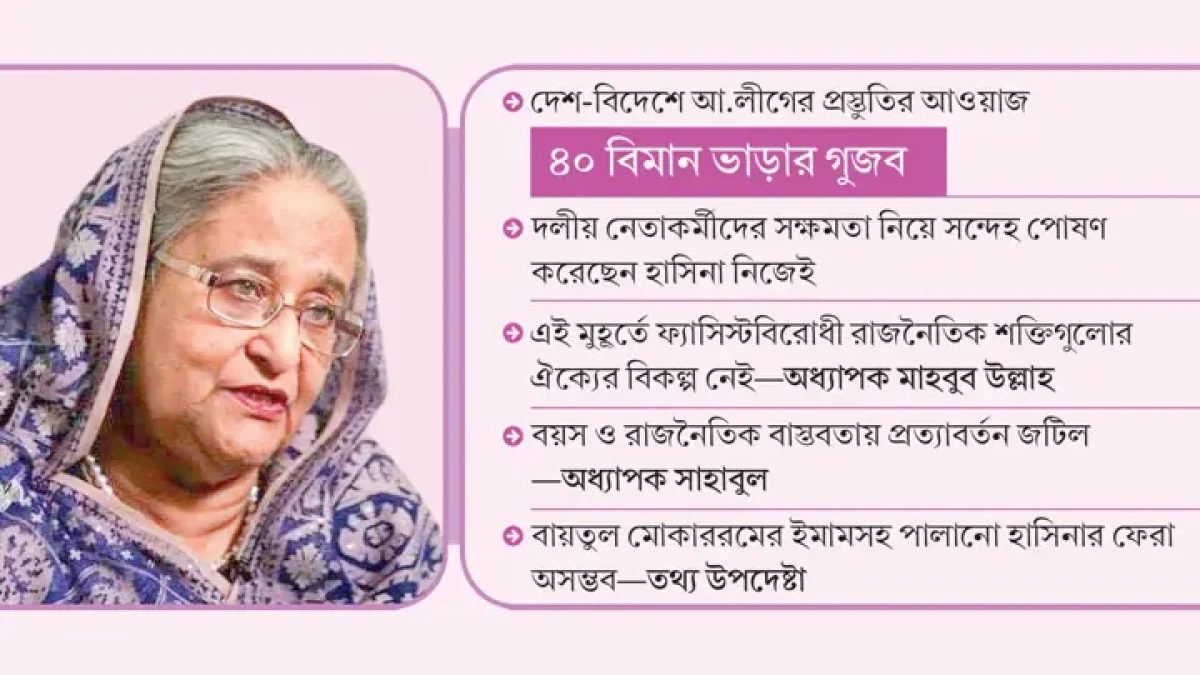
Campaigns are being run through talk shows, podcasts and other formats on several Indian media outlets and on YouTube channels that push the Awami League narrative, some of which have interviewed Hasina. Leaders abroad have announced they will come to Dhaka with Hasina on 40 planes; some have spoken of coming by helicopter. Party activists and hardline supporters have begun saying Hasina will take over directly as prime minister on her return. Rumours and fake news are being spread widely, as they try through various propaganda to convince people that Hasina will certainly return.
Analysts say the Awami League is trying to profit from the growing distance between the current government and the opposition, and that it gains from the tussle between them over the party. They say it is engaged in conspiracies to destabilise the country, and its involvement in the ongoing labour protests has been alleged; several people have already been arrested on this allegation. Inside the country there are also regular attempts, they say, to provoke law enforcement agencies, to cripple the economy by creating artificial labour unrest in industrial areas, and to film secret flash processions to show leaders abroad that activists are active.
After a meeting with garment industry representatives on Monday, Home Minister Salahuddin Ahmed told the media that genuine garment workers and trade union leaders are not involved in the violent protests in the ready-made garment industry. “Opportunists and supporters of the fascist,” wearing masks, have infiltrated the protest sites to gain political advantage and destroy the industry, spreading violence with fake slogans, he said. He also alleged that former MPs and a former state minister are involved.
Meanwhile, by announcing her return Hasina is thought to have energised one part of her party but put a larger part at risk. Many Awami League leaders and activists who faced arrests during the interim government were released on bail after the parliamentary election and became active in their areas again, and a section who had long been in hiding re-emerged to run their businesses and resume normal life. Hasina’s announcement has put them under pressure again. Ahead of December, law enforcement agencies have begun a wide arrest drive across the country, and intelligence agencies have begun searches. Many Awami League activists who had largely returned to normal life now face arrest again and have had to leave their homes and live on the run.
Given the legal situation, the problem of a visa or travel pass and the government’s firm stance, analysts consider her return impossible despite her announcement.
Asked recently about her preparations in a telephone interview with an expatriate Bangladeshi journalist, Hasina said she had not prepared much because her passport and ID card were blocked and she could not buy a ticket. But she said she was trying and would arrange a way to go somehow, and that she had everything ready for her return.
Hasina herself said reports that a five-member panel of foreign lawyers had been prepared to seek a travel pass from Bangladesh were not true. Asked about it, she said many people were advising her on the matter. “I have to ask for a travel pass: either my passport must be reactivated or I must be given a travel pass so that I can return home,” she said. If she gets neither, she will act according to the situation, she said, but declined to say how.
Hasina has herself expressed doubt about her party activists’ ability to play a role in her return. Joining party activists online recently, she told everyone to be ready and to hit back if attacked. Former MP Nurunnabi Chowdhury Shaon promised to bring three or four hundred thousand people from Bhola to Dhaka. Hasina responded with some irritation: “You talk so big, yet you still haven’t been able to recover the Awami League office. If you went with one or one and a half hundred people, would they kill you all? And now you say you will bring hundreds of thousands. Talk realistically.”
After Hasina’s announcement, Awami League leader Mofazzal Hossain Chowdhury Maya, who is in India, in effect urged the army and police against the government. “Do not be afraid. We freedom fighters are with you. This humiliation will be avenged. Sheikh Hasina’s workers will show their game in Bangladesh,” he said.
Jatiya Party chairman GM Quader, whose party played the role of a tame opposition during the Awami League years, said on a recent talk show that he speaks to Hasina from time to time and she has told him more than once that she will return, somehow or other. She has announced a time frame but not said exactly when she will come, perhaps because the time has not been finalised, or if it has, it is not yet time to make it public, he said.
Government ministers and advisers have also spoken about Hasina’s return. They are not troubled by the threat and have expressed hope that the neighbouring country will return her under the extradition treaty. Law Minister Md Asaduzzaman said that if Hasina returns in December, the law’s handcuffs will reach her hands before any garland reaches her neck.
Referring to the repeated requests to the neighbouring country to return Hasina under the extradition treaty, Home Minister Salahuddin Ahmed said: “The government is not at all troubled about who wants to come when. The government is determined to establish the rule of law. Whoever comes, whenever, will be taken into custody according to the law. I do not think the people of this country will let them do politics. I do not believe any evil force will be able to create unrest here in December.”
Information Minister Andaleeve Rahman said: “She has made an announcement; time will tell whether she comes or not. But I think the political setting for that has not been created, because the people of the country have not yet come out of the trauma of the killings and repression of 2024.”
The prime minister’s information adviser, Zahed Ur Rahman, said that if Hasina returns she will not face a mob; she will face justice.
The government would be happy if Hasina came voluntarily, he said: “The person we want will come, and we are happy. We would not have to bring her in by force. If she comes she will face trial. She is a convict sentenced to death. We will take our revenge by giving her justice.”
Saying there is no chance of Hasina returning, the information adviser said she had stayed in the news for these six months. “Rest assured, she will then say not December, I will come in June, and stay in the news for another six months. Then she will say December. It will go on like this.”
“Ershad did not flee after his fall. What had she done that she had to flee taking the imam of Baitul Mukarram with her? That person will come back home! Impossible,” he said.
Professor Sahabul Haque of the Department of Political Studies at Shahjalal University of Science and Technology (SUST) thinks there is considerable doubt over how far Hasina’s announced December return is realistic. He told Amar Desh that given the bloodshed of July, public anger over her rule and the court’s sentence, it would be very hard for her to return and take part in normal political life. If she returned she would first have to face legal proceedings and the courts, and her age and the current political reality further complicate the prospect. The political analyst believes the announcement is mainly a strategy to stay in political discussion and keep up the morale of Awami League activists.
Calling the mutual accusations of the BNP and Jamaat over Hasina politically significant, he said: “We have learned that before the election both parties showed interest in winning Awami League votes and support. Their later statements and political positions brought the banned party back into discussion. But if Hasina really did return and get the chance to be active in politics, it would not be comfortable for either the BNP or Jamaat.” Professor Sahabul sees her announcement as part of an effort to organise and activate Awami League activists at home and abroad.
Professor Tarek Fazal of the Department of Political Science at Rajshahi University told Amar Desh that Hasina’s announcement of a return to Bangladesh can be seen as no more than an “announcement”. Her face was not seen, though her voice was heard, and that voice cannot be denied for now. At the same time, there is good reason to take into account the steps being seen at home and abroad as the next stage after her announcement, he said.
Noting that Hasina had earlier announced she would come back suddenly, the analyst said the difference this time is that she has announced something of a time frame, so there is reason to take it seriously. The legal process she would face on return is also a consideration. But everyone who sees her return as a threat, whether the current government or the opposition, has good reason to take it seriously, he said.
Although Hasina has announced her return, no public moves to face the law can be seen, he said, unless something is happening behind the scenes.
National Professor Mahbub Ullah believes the “fascist group” will make every effort to create unrest in the country. Speaking to Amar Desh, the analyst said it is hard to say whether they are involved in the ongoing labour protests, which is a matter of political calculation, but there is no denying that they may attempt sabotage.
Calling on the forces that backed the July movement, Mahbub Ullah said: “At this moment there is no alternative to unity among the anti-fascist political forces, including the government and the opposition. Everyone must unite to build strong public opinion. The people must be kept constantly alert to the killings, enforced disappearances, looting, money laundering and other lawlessness that the fascist Hasina created in the country.”
(Source: Daily Amar Desh)
বাংলায় মূল প্রতিবেদন পড়ুন · Read the original Bengali report