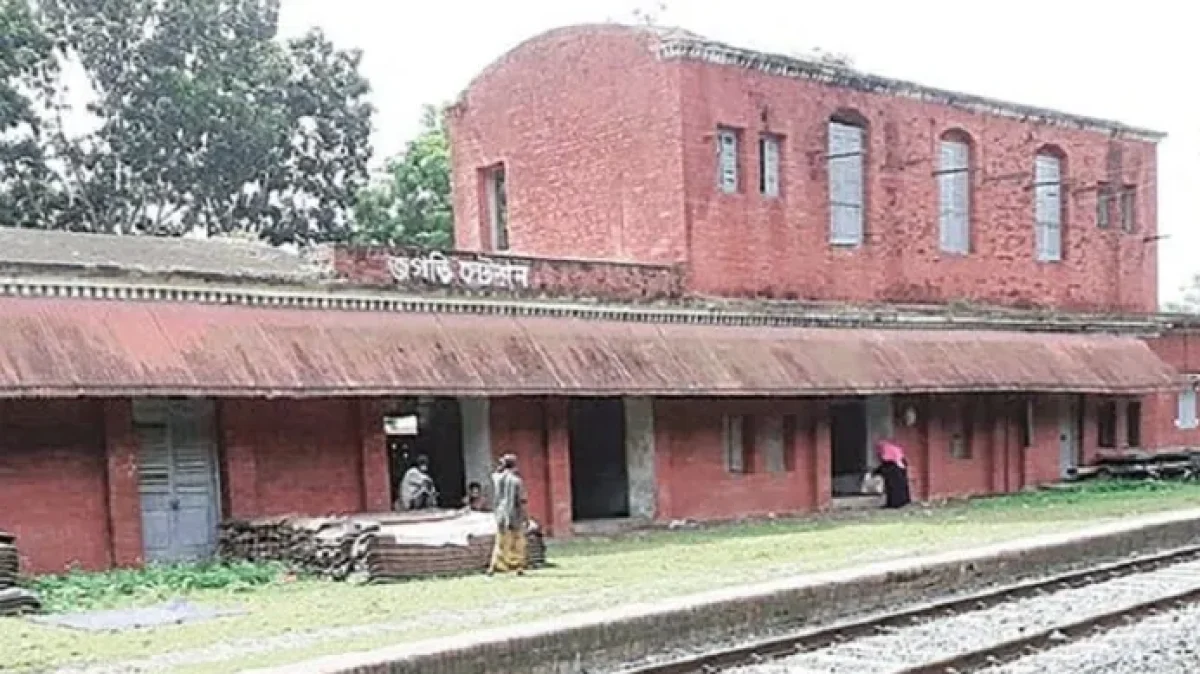
The first railway line in the country, from Sealdah to Kushtia, opened in 1862, and Jagoti railway station is described as the very first railway station in Bangladesh. Yet as an old station it has seen no development. With no repairs, its old buildings are crumbling, and its government land is at risk of being taken over.
According to sources, Jagoti station was established in 1862. That year the Eastern Bengal Railway opened a line from Sealdah to Ranaghat, which was then extended to Jagoti in present-day Kushtia. On the historic day of 15 November 1862, the first train entered the soil of today’s Bangladesh. The train from Sealdah in Kolkata was bound for Jagoti railway station in Kushtia. From that moment, the railway’s journey in the territory of present-day Bangladesh began, opening a new horizon in communications. That is why Jagoti in Kushtia is called Bangladesh’s first railway station.
At that time engines ran on burning coal. Trains pulled into the station whistling in coils of smoke. At Jagoti the British built a two-storey red-brick station building, a waiting room, a water tank, a ticket office and signal lamps.
As the first station, it became the centre where everyone boarded and alighted, and the crowds turned Jagoti into a commercial hub for imports and exports. The station depended on fuel for the engines, and two large wells still stand on either side of it. At one time 26 railway officials and staff were posted here to handle the crowds. Now there are only 3. For lack of staff, the station’s operations have collapsed and passengers face harassment in various ways. Years without repairs have ruined the station’s beauty. Because train passengers get no facilities, hardly anyone uses the station now. Its repair is urgent.
Today Jagoti station lies like a discarded page in the book of history. All around is silence; the platform is broken and the building cracked. Furniture lies scattered in the near-ruined station building. There are no porters’ calls, no train whistles. When night falls it becomes an eerie place.
Thanks to this railway, Asia’s largest textile mill of the time, Mohini Mill, was set up in Kushtia in 1908. Without trains it would have been impossible to bring raw material to such a large mill or send out its goods. In the Pakistan period a sugar mill was also built in Kushtia, and its sugarcane arrived along this line.
While rail travel has become popular, the century-old Kushtia-Bheramara Raita Ghat line is being ruined by neglect. Without repairs, its stations have become dilapidated.
The Raita line, meanwhile, is an old line built under British rule, laid in 1916. The train from Raita-Damukdia even came to be known as the Raita train. Three decades ago the line was still busy, but the railway authority closed it, citing losses. Its closure has held back the living standards of people in the area.
In the 19th century, various railway companies from England began opening small railway sections in different provinces of India. At first railways were opened only for economic purposes. A company called the Eastern Bengal Railway laid the first railway in Bangladesh.
The Eastern Bengal Railway opened the broad-gauge (5 feet 6 inches) section from Kolkata to Ranaghat on 29 September 1862 and the section from Ranaghat to Kushtia on 15 November 1862. The section to Goalanda opened on 1 January 1871. Between 1874 and 1879, to fight famine, the Northern Bengal State Railway opened a metre-gauge (3 feet 3.38 inches) section from Sara to Siliguri. The same company also opened the metre-gauge sections from Parbatipur to Dinajpur and from Parbatipur to Kaunia. On 1 July 1884 the Eastern Bengal Railway came under government management, and on 1 April 1887 it merged with the Northern Bengal State Railway.
On 1 January 1915 the Bheramara-Shakole section opened with the Hardinge Bridge. In 1914 the metre-gauge section from Shakole to Santahar was converted to broad gauge, and in 1924 the roughly 96-kilometre section from Santahar to Parbatipur was converted from metre to broad gauge. In 1926 the roughly 137-kilometre metre-gauge section from Parbatipur to Siliguri was converted to broad gauge.
The Bheramara-Raita broad-gauge section opened in 1916. In 1928-29 the narrow-gauge section from Teesta to Kurigram was converted to metre gauge. The Abdulpur-Amnura broad-gauge section opened in 1930, and the Bahadurabad-Jamalpur Town metre-gauge section in 1941.
In 1897 the Darshana-Poradaha section was upgraded from single to double line. In stages, the Poradaha-Bheramara section followed in 1909, Bheramara-Ishwardi in 1915 and Ishwardi-Abdulpur in 1932. For lack of maintenance, these lines are in poor shape.
A visit finds Jagoti station like a haunt of ghosts. There is no station master, let alone a guard or a ticket counter, and nowhere for passengers to sit. Trees and creepers have grown on the platform. The office rooms have no windows, and the doors there are locked. A train schedule board hangs there, last updated in 2009. Iron rods have come away with the concrete from the ceiling of the two-storey building’s office, and cracks run across the walls. Sunlight can be seen from inside the rooms. Almost everything on the ground floor has been looted. Banyan saplings and weeds growing out of the first-floor windows tell the story of neglect. The pond and water tank at Jagoti once used to supply steam engines are in an even worse state.
Bent with age and close to ruin, the two-storey red-brick building of Jagoti railway station still stands as a witness to time. The red brick is now faded, and the surroundings are covered in moss and dirt. Because of the cracks, nobody has gone upstairs for many years. The waiting room built long ago for passengers has fallen apart, the platform bricks are broken and the masonry has worn away. All the equipment inside the rooms is out of order. None of it is used or repaired.
In those days the British used red on government buildings. Surprisingly, although the British left long ago, and the Pakistanis too, the colour has not changed even under Bangladeshi governments. Many such buildings from the British era can still be seen in red in Bangladesh and India.
Later, to make travel between Dhaka and Kolkata easier, a line from Jagoti station to Goalanda Ghat on the Padma, in what is now Rajbari district, opened on 1 January 1871.
While the country’s railways have developed, Jagoti railway station has not. Passengers and local civil society have strongly demanded the development of this old, historic station.
বাংলায় মূল প্রতিবেদন পড়ুন · Read the original Bengali report