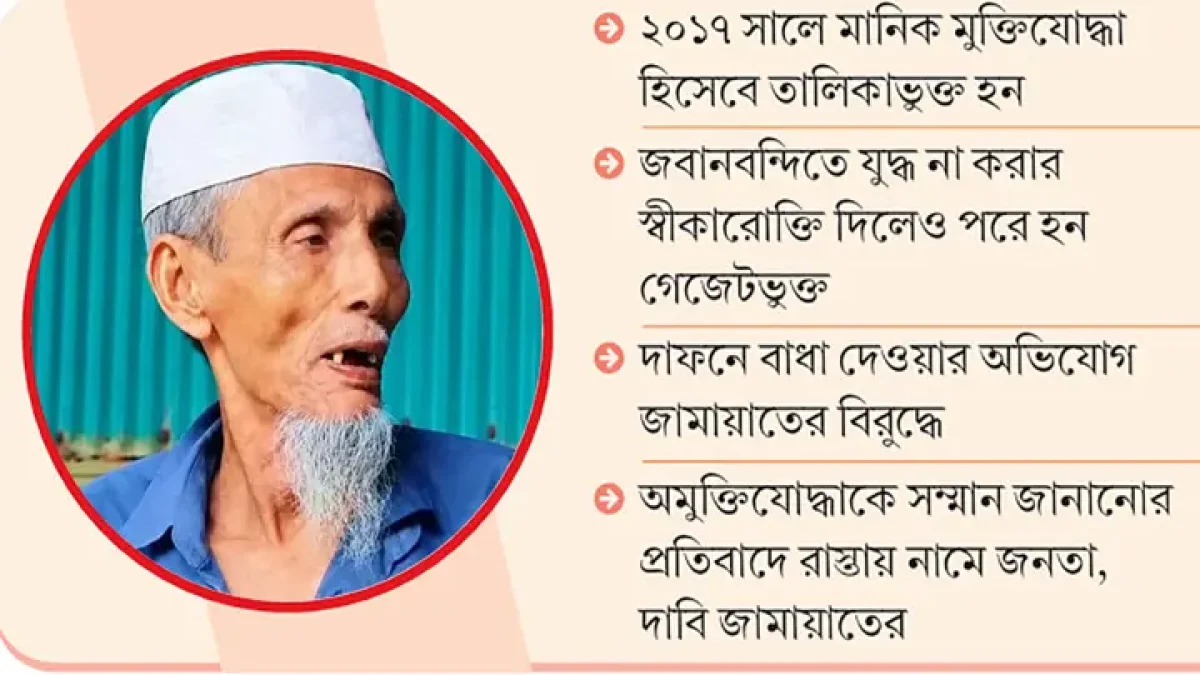
Questions are being asked in political circles about who was behind the events in Pirojpur, and why the body of Manik Pashari was taken to the Upazila Nirbahi Officer’s office and then to the police lines instead of his home. Local BNP leaders and the Muktijoddha Projonmo Dal hold Jamaat-e-Islami and Islami Chhatra Shibir activists responsible for the trouble over his burial and guard of honour.
They say that after the body arrived by ambulance on Saturday afternoon, Jamaat and Shibir activists took up positions in several parts of the town and repeatedly obstructed the burial. Former Shibir district president Mahbubul Alam Nayeem is accused of blocking it, and at Parerhat Bazar a procession demanding that Pashari not be buried was led by Mueen Uddin, a former general secretary of Shibir at Pirojpur Suhrawardy Government College.
Local Jamaat leaders say they did not obstruct the funeral prayer or the burial. They say they joined ordinary people in protesting against a state guard of honour for a man they call a fake freedom fighter, and that people were angered by the gazette listing of a man they accuse of giving false testimony against Delwar Hossain Sayeedi, the late Jamaat nayeb-e-ameer and former MP for Pirojpur-1.
To find out what happened that day, what lay behind the anger and the obstruction, and whether Pashari had fought in the war at all, Amar Desh’s reporter travelled with its Pirojpur correspondent on Wednesday morning to Chithalia village in Shankarpasha union of Sadar upazila. The paper spoke to Pashari’s family, relatives and neighbours, to the local MP, to freedom fighters, to BNP and Jamaat leaders and to officials. Many officials spoke only on condition of anonymity because of how sensitive the issue is.
Pashari, who testified against Sayeedi at the International Crimes Tribunal, had been in hiding since the change of government on 5 August 2024. He was staying at his daughter and son-in-law’s house in Tungipara, Gopalganj, and died there on the morning of 24 October after two months of illness.
On 11 August 2009 Pashari filed a case against Sayeedi at the Chief Judicial Magistrate’s court in Pirojpur. The case was later joined to the main case against Sayeedi at the International Crimes Tribunal, where Pashari testified as the sixth prosecution witness.
Dispute over the gazette listing
His status as a freedom fighter is bitterly disputed locally. Ahmed Shahidul Haque, convener of the Pirojpur district freedom fighters’ command, told Amar Desh on Wednesday that Pashari’s name was not on the list when Haque was the elected commander 40 years ago. Pashari was gazetted as a freedom fighter in 2017, eight years after he filed the case against Sayeedi.
Haque said the updating of the 2017 list is not finished and that the Jatiya Muktijoddha Council is now reviewing it. The new gazette issued after that review will be final, he said.
Any genuine freedom fighter who was left out will be added and anyone listed falsely will be removed, he said. The liberation war affairs minister has said about 85,000 people were wrongly gazetted as freedom fighters; about 6,000 have already been identified and removed and their allowances stopped.
Amar Desh reported that tribunal records show Pashari told the court in his 2011 statement that he did not fight in the war himself but helped freedom fighters. His name was later added to the freedom fighters’ list during Sheikh Hasina’s government on a demi-official letter from the then Awami League MP Saidur Rahman Awal.
Local freedom fighter Abdus Salam Baten said Pashari was never a freedom fighter and was fraudulently made one in return for testifying against Sayeedi, testimony Baten calls false.
Protest over the guard of honour
When Pashari’s body was brought to the Sadar upazila parishad compound on the afternoon of 24 October, angry local people and Jamaat and Shibir activists protested and blocked the guard of honour, saying a man who had not fought should not receive state honours.
His son-in-law Faruk Hossain said Pashari died at 10am and the family went to the Upazila Nirbahi Officer at 12pm. They were told about the guard of honour and the body was kept in an ordinary ambulance until 5pm, without ice or tea leaves, he said, and the local administration took no responsibility for the burial.
To keep order, officials later had the body taken under police guard to the Pirojpur police lines, where journalists were kept out. He was given the guard of honour there quietly at around 5pm.
Burial blocked in his village
When the body was taken from the police lines to his home in Chithalia, Shankarpasha union, local anger boiled over. People who believe Sayeedi was wronged because of Pashari’s testimony filled in the grave dug for him with earth and bamboo.
At Parerhat Bazar, a procession led by former Shibir leader Mueen demanded that Pashari not be buried in Pirojpur.
A night burial, as the village policeman tells it
Village policeman Matiur Rahman said that when he went to fetch digging tools he found Pashari’s sisters, and that they and two local men dug the grave. Asked about photographs and videos shared on social media, he said the women were only moving earth. Pashari was buried at his home in Chithalia between 1am and 2am on Saturday night, under tight security by police, village police and the administration. Amar Desh found no record of local people attending a funeral prayer, and none was held in his own area.
Family members contradict each other
His sister Hena Pashari, who said she was at her in-laws’ house in Khulna at the time, said her brother never told her anything about the case. She had earlier told local media that Sayeedi was, as a person, a friend of God, but she now denies saying so; the paper says it has video of the earlier remarks.
His nephew Azizul said they had dug the grave by about 1:30pm and gone to eat when his father phoned to say people were coming, and they were too afraid to go back.
What the leaders say
Masud Sayeedi, Delwar Hossain Sayeedi’s son and MP for Pirojpur-1, said on Wednesday that Pashari had told the tribunal plainly in 2011 that he did not fight. “Then how did he become a freedom fighter?” he said. He said Pashari became a fake freedom fighter on a demi-official letter through the influence of the then district Awami League president and drew taxpayers’ money for ten years.
He said ordinary people took to the streets in anger at the attempt to give state honours to a man who had not fought, and that Jamaat activists acted responsibly to calm the situation and stop any third party causing trouble. In the end, he said, Jamaat and Shibir activists helped the administration with the burial.
District Jamaat secretary Zahirul Haque and assistant secretary Abdur Razzak said they did not obstruct the burial. Their objection, they said, was to a guard of honour for a man who was not a real freedom fighter, and that objection is being misrepresented as an attempt to block the burial.
Pirojpur district BNP convener Nazrul Islam called the whole affair political and contentious. “It may be a deep conspiracy by an opposition group, especially some Awami League group. The body was sent to the UNO’s office and the police lines as part of a conspiracy,” he said. “I want the administration to investigate how the body came to the upazila headquarters and the UNO, and who was behind it.”
A tense village
Pashari’s house in Chithalia is now locked and empty. Village policeman Matiur Rahman and neighbours Safia Begum and Arif said the mood in the area is tense, and people approached by reporters were too afraid to talk.
Local freedom fighters, politicians and residents said the Pirojpur episode was not a passing flare-up over one burial but a tangle of long-standing anger, rival political accusations and claims that fake freedom fighters were created for political gain.
Jamaat sets up an inquiry
Jamaat-e-Islami formed a two-member committee on Tuesday to investigate the allegation that its activists obstructed Pashari’s funeral prayer and burial, and asked it to report within three days. The members are Jamaat MPs Saiful Alam Khan Milon and Nurul Islam Bulbul.
বাংলায় মূল প্রতিবেদন পড়ুন · Read the original Bengali report