The government has moved to raise domestic gas exploration and production to tackle the country’s growing energy crisis. It plans to drill 52 new gas wells in a second phase. Under its wider programme, the target is to drill 104 new wells and raise output from 46 old wells through workovers. If the plan is carried out, it would ease reliance on imported liquefied natural gas (LNG) and improve gas supply to industry, power and fertiliser production.
But doubts have already arisen over carrying out this large programme. According to sources, drilling has not yet been completed on any of the 52 new wells assigned in the second phase to the state-owned Bangladesh Petroleum Exploration and Production Company (Bapex). That raises the question of whether the wells can be drilled, and commercial gas production started, on schedule.
Energy experts say setting targets for new wells alone will not solve the gas crisis. Exploration, appraisal of discovered fields, development drilling, repair of old wells and gas transmission infrastructure must all be brought under one plan. Bapex’s technical and institutional capacity must also be raised, and offshore exploration pursued effectively.
Import dependence adds to economic strain
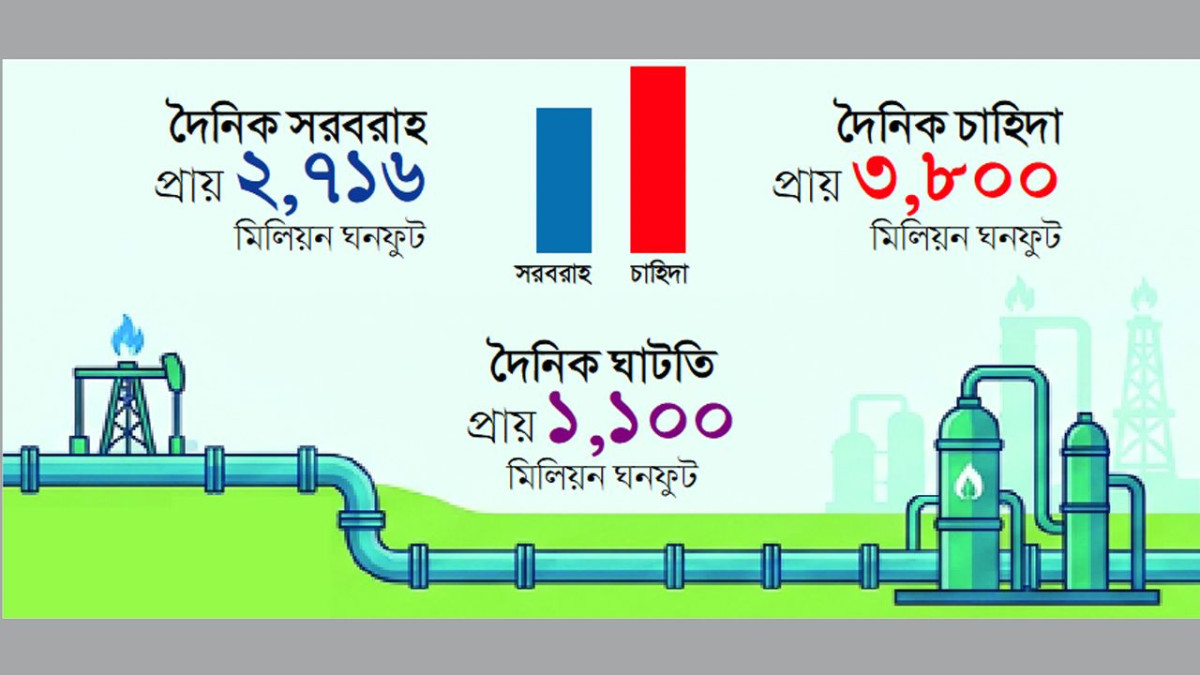
There is a large gap between gas supply and demand. According to the figures, daily supply is now about 2,716 million cubic feet (mmcfd), against daily demand of about 3,800 mmcfd, leaving a shortfall of about 1,100 mmcfd every day.
By source, imported LNG provides about 1,100 mmcfd a day, about 41 percent of total supply. International companies supply 890 mmcfd, about 33 percent, and domestic state companies produce about 726 mmcfd, about 26 percent.
This shows the risk that import dependence poses to energy security. When LNG prices rise on the world market, they drain large amounts of foreign currency and add to the government’s subsidy burden. LNG bought on the spot market is especially exposed to price swings. Shipping, regasification at terminals and related infrastructure push the real cost of imported gas higher still.
Raising domestic output, on the other hand, could ease pressure on imports in the long run. New exploration and extraction need heavy investment, but finding commercial reserves through successful exploration could bring lasting benefits for energy security.
The gas crisis is hitting productive industry directly. Ready-made garments, textiles, fertiliser, cement and other industries are not getting the gas they need. Low pressure in some places and irregular supply in others mean many factories cannot use their full capacity. That raises production costs, weakens competitiveness and hurts exports.
A 150-well programme; delivery is the big challenge
According to information the energy ministry gave parliament on 2 September, the government’s wider programme plans to drill 104 new gas wells and work over 46 old ones. In its second phase, Bapex is responsible for drilling 52 new wells and working over 16.
The first phase runs until January 2028. The second phase is to be carried out from February 2028 to December 2031. But with drilling not yet completed on any of the second phase’s 52 new wells, questions have been raised about progress. Drilling so many wells on time requires advance preparation in financing, rigs, modern technology, skilled staff and equipment. Delays in tendering, procurement and project approval must also be avoided.
Another important point is that drilling a new well does not guarantee the expected amount of gas. Some wells may find commercially recoverable gas; others may not find the expected reserves. Even when gas is discovered, its commercial value depends on volume, pressure, quality and extraction cost.
So the number of wells drilled is not enough to judge the programme. How many wells found gas, the likely size of the reserves found, how much daily output rose and how quickly it was connected to the national grid must be at the centre of any assessment.
Exploration, development and workovers are all needed together
Many of the country’s existing gas fields have been producing for a long time. Long extraction has lowered reservoir pressure, and with it the wells’ output. Production has fallen significantly at some wells, while at others technical and geological problems are hampering extraction.
Experts say that alongside new wells, three kinds of work need particular priority: exploration wells to discover new reserves; appraisal wells to determine the extent, reserves and production potential of discovered fields; and development wells for commercial extraction and supply. Without coordination between the three, production may take a long time to start even after a discovery. Each step from exploration to commercial production needs its own preparation and investment.
At the same time, old wells that have lost capacity need workovers, sidetracks and, where necessary, compressors. In many cases output can be raised faster by technically upgrading existing wells than by drilling new ones. New exploration and restoring output from old wells must therefore get equal priority.
Calls to strengthen Bapex
Raising the capacity of the state-owned Bapex is now one of the most important issues in domestic exploration and production, since much of the onshore work depends on it. Without modern technology, enough rigs, skilled staff and financial capacity, a large programme will be hard to deliver.
Drilling and exploration experts say Bapex needs more and better modern rigs, as well as skills in directional drilling, subsurface data collection, well testing and reservoir engineering. Where needed, it could enter technical partnerships and joint ventures with internationally experienced firms.
Two-dimensional and three-dimensional seismic surveys must also be stepped up in unused and little-explored areas. These surveys give a picture of underground structures and likely gas locations. Choosing exploration well sites on that basis can lower investment risk and raise the chance of success.
Exploration in the Bay of Bengal also needs to be stepped up alongside onshore work. Bringing in internationally experienced companies for deep and shallow waters, creating an investment-friendly contract framework and completing competitive tendering quickly are urgent. If promising offshore blocks stay unexplored or undeveloped for long, a major chance for future energy security may be lost.
Discovery alone will not secure supply
A new discovery is important progress against the energy crisis, but there are several steps between discovery and delivery to consumers. When a new well finds gas, production facilities, processing plants and pipelines to the national grid must be built. Where pressure is low, compressors may also be needed.
Without this infrastructure, discovered gas cannot be connected to the grid quickly. Exploration and drilling projects must therefore be planned together with transmission and distribution infrastructure.
And even if new supply rises, how its benefits reach industry and ordinary customers will depend on the government’s allocation policy. Economic and productivity factors must be weighed in setting priorities between fertiliser factories, power plants, industry and other customers. Reliable gas for export-oriented and productive industries is especially important.
More gas could also help the power sector. If gas-fired power plants get enough fuel, electricity can be generated at relatively low cost. Many plants now cannot run at full capacity for lack of fuel, increasing reliance on costly oil-fired generation and power imports. Raising domestic gas output could ease that pressure.
Delivery matters more than announcements
Energy experts say raising domestic gas exploration and production is a timely and strategically important decision for Bangladesh’s energy security. But its success will depend on the pace of delivery, efficient investment, technical capacity and institutional accountability.
For that, the drilling schedule, likely cost, responsible agency, deadline and production target for each well should be published. Progress should be reviewed regularly, with effective oversight to prevent cost overruns, tender irregularities and delays.
When a well does not find the expected gas, the reasons must be investigated and the lessons used in planning the next one. Progress in restoring output from old wells and in offshore exploration must also be assessed regularly, alongside new drilling.
Raising domestic output would ease the burden of LNG imports, save foreign currency and help control industrial production costs. But announcing or targeting 52 new wells is not success in itself. Real success will depend on how many wells find commercial gas, how much output rises, and how quickly and reliably that gas reaches the national grid.
In the current energy crisis, what is needed is not just a plan for new wells but a time-bound, coordinated and accountable plan from exploration to production and supply. Otherwise, despite heavy investment and ambitious targets, a real solution to the gas crisis may stay out of reach.
বাংলায় মূল প্রতিবেদন পড়ুন · Read the original Bengali report