An unregulated business model is spreading in the housing sector in which land shares are sold on the promise of building and handing over a specific flat. Because land ownership, approved building plans, the capacity to build, the use of buyers’ money, the exact location of each flat and the legal guarantee of handover are all unclear in these schemes, 40,000 citizens have been harmed and many fear losing everything, the Real Estate and Housing Association of Bangladesh (REHAB) said.
REHAB warned that about Tk 50,000 crore could become locked in lawsuits and legal disputes around such projects over the next two to three years.
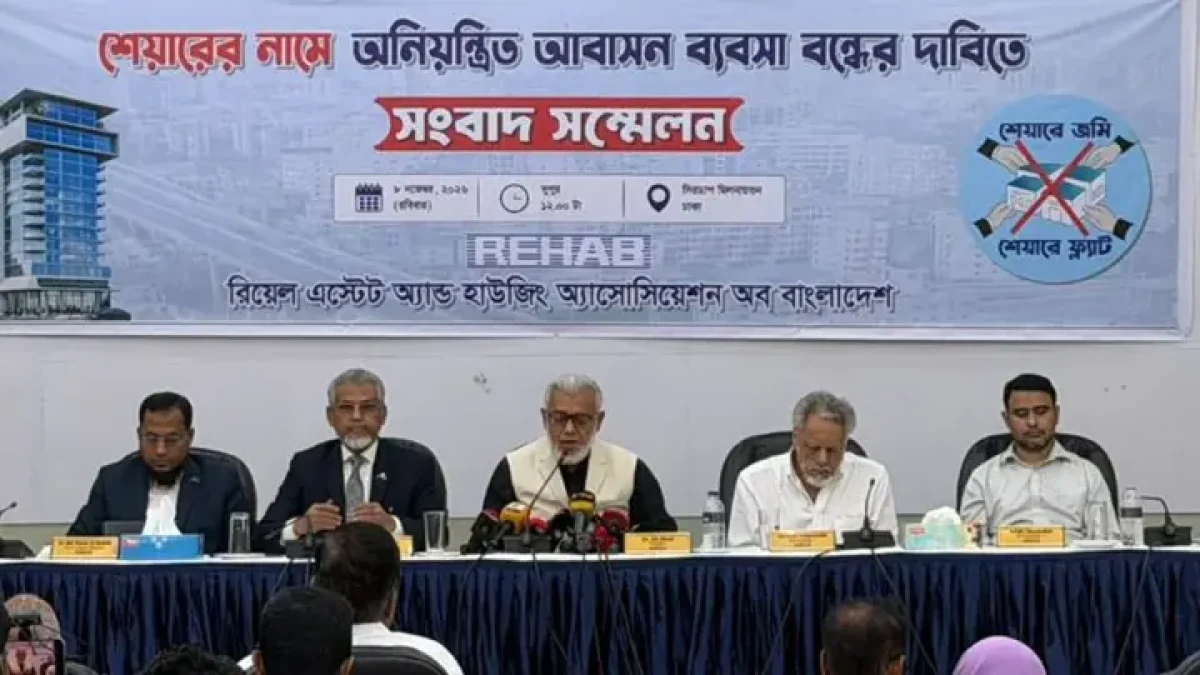
REHAB President Dr Ali Afzal raised the concerns at a press conference at the CIRDAP auditorium in Dhaka on Sunday.
Seeking urgent government intervention, the association said 9,823 cases alleging fraud in land-share housing projects were pending as of 30 September. About 40,000 buyers and Tk 12,000 crore are involved in these cases. With no legal certainty over land ownership, approved plans or a specific flat, many buyers have invested and still not received their flats, leaving them facing social and family hardship on top of financial loss.
The association alleged that shares in the same land or building are being sold to several people, money is being raised without proper approval, construction costs are accounted for opaquely and forged deeds are in use. In many cases the building does not match the approved plan, and building codes and safety conditions are not properly followed.
REHAB leaders said owning an undivided share of land does not guarantee legal ownership of a specific flat. This could cause problems later in selling a flat, mortgaging it with a bank or dividing property among heirs. Disputes among partners over land ownership, flat allocation, construction costs and possession are ending up in court, putting buyers’ money at risk of being tied up for years.
REHAB put forward six demands to end unregulated share-based housing business. They include stopping businesses that rely on promising a specific flat in exchange for land shares; banning such activity or bringing it under strict control after the necessary legal review; stopping the collection of money until land ownership, registration, liabilities and project approvals are secured; independent technical and legal audits of existing projects; and investigation of allegations that the same land has been sold more than once or that deeds were forged. The association also called for transparent accounts of project fundraising and construction costs, and for qualified architects, engineers and professional staff to be hired for every project.
REHAB leaders said about 300 linkage industries are tied to the housing sector. Construction contributes about 15 to 16 percent of gross domestic product (GDP) and employs about five million people. But because of the unregulated model, firms that follow the rules face unfair competition.
REHAB claimed that 99.99 percent of buildings built under the unregulated model have some problem. It said every such building needs an independent, impartial technical inspection by the relevant regulator, and that transparency and accountability should be ensured through REHAB. Sales and fundraising for new projects should be halted until valid approval and land ownership are confirmed, it said; otherwise buyers will keep facing delays in handover and in securing legal ownership even after paying.
Dr Ali Afzal said REHAB does not oppose lawful joint ownership or transparent investment. But business should not be run in the name of land partnership or joint ventures where investors have no guarantee of ownership and handover of a specific flat and government revenue is not properly paid, he said.
He said unregulated share-based housing is not just REHAB’s problem but a national one, involving people’s lifetime savings, housing security, government revenue and the investment climate. If effective action is not taken now, he said, the state will have to bear the financial, social and legal cost later.
REHAB Senior Vice-President Abdur Razzak, Vice-President-2 Md Barkat Ullah, Vice-President-3 AFM Obaidullah, Vice-President (Finance) Dr Harun-or-Rashid and other central leaders were present at the press conference.
বাংলায় মূল প্রতিবেদন পড়ুন · Read the original Bengali report