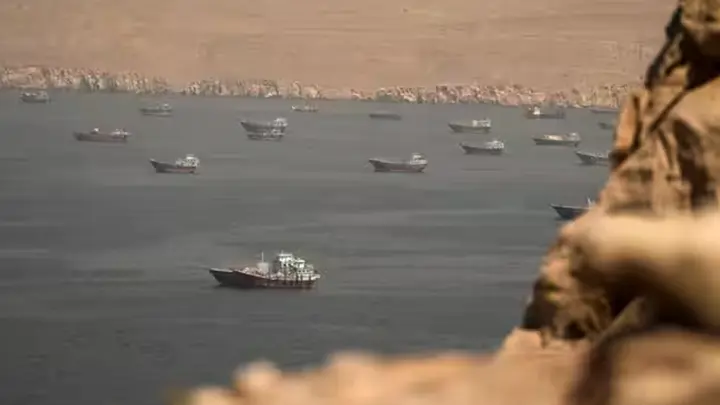
Oman has postponed, at the last minute, a regional meeting between Iran and Gulf states on opening a new shipping lane through the Strait of Hormuz.
The meeting had been due to take place Monday in the country’s southern city of Salalah. It was postponed, officials said, to allow time for a “suitable environment for constructive talks” to develop.
The announcement of the postponement came just a day after Bahrain said it would not take part in any joint ministerial-level meeting with Iran.
Oman announced the postponement Sunday night. The country’s foreign ministry said the meeting would be held at a later date once a suitable environment for constructive talks had developed.
The ministry added that the decision was aimed at creating conditions conducive to reaching an effective understanding that strengthens regional security and stability and fulfils the region’s aspirations for cooperation and peace.
Oman’s foreign minister, Badr Albusaidi, wrote on social media platform X: “In the interest of consensus, the regional meeting scheduled to be held tomorrow in Salalah has been postponed.”
He added: “We remain committed to advancing dialogue conducive to stability and long-term cooperation in our region.”
Albusaidi included the flags of Bahrain, Iran, Iraq, the UAE, Oman, Qatar, Saudi Arabia and Kuwait alongside his post, suggesting representatives from these countries had been due to attend the meeting. He did not, however, announce a new date, nor did he offer details on why the meeting was postponed.
Bahrain withdraws from the meeting
A day before Oman postponed the meeting, Bahrain announced it would not attend the proposed regional ministerial meeting involving Iran.
Bahrain’s foreign ministry said Saturday that Manama would not take part in any joint ministerial-level meeting with Tehran until diplomatic relations with Iran were restored.
Bahrain took this position after reports emerged of a proposed ministerial meeting on the situation in the Strait of Hormuz.
Earlier, Iranian foreign ministry spokesman Esmaeil Baghaei had said last Friday that Tehran would attend the foreign minister-level meeting hosted by Oman. Eight coastal states of the Gulf region had also been expected to attend.
Iranian Foreign Minister Abbas Araghchi told London-based Arabic media outlet Al-Araby Al-Jadeed on Sunday that the “main, and in fact only, agenda item” of the meeting would be a new shipping lane through the Strait of Hormuz.
Araghchi said Iran and Oman had finalised an agreement on the new shipping lane, including a joint statement on the route’s map and its management.
He made clear, however, that this agreement with Oman in no way means reopening the Strait of Hormuz.
Tension between Bahrain and Iran
Bahrain is among the Gulf states that were targeted by Iranian strikes during the conflict with the United States. Tehran previously struck various US facilities in Bahrain, including the Isa Air Base. Tehran claims those strikes were in retaliation for US attacks on Iran.
In February this year, the United States and Israel launched strikes on Iran. In response, Iran struck Israel and US military targets across the region.
In June, the United States and Iran signed the “Islamabad Memorandum of Understanding” through mediation by Pakistan and Qatar. However, its implementation later stalled over disagreements involving the Strait of Hormuz. In August, the United States launched fresh military strikes on Iran. In response, Iran again carried out large-scale strikes on US military installations at several locations in Arab countries allied with Washington.