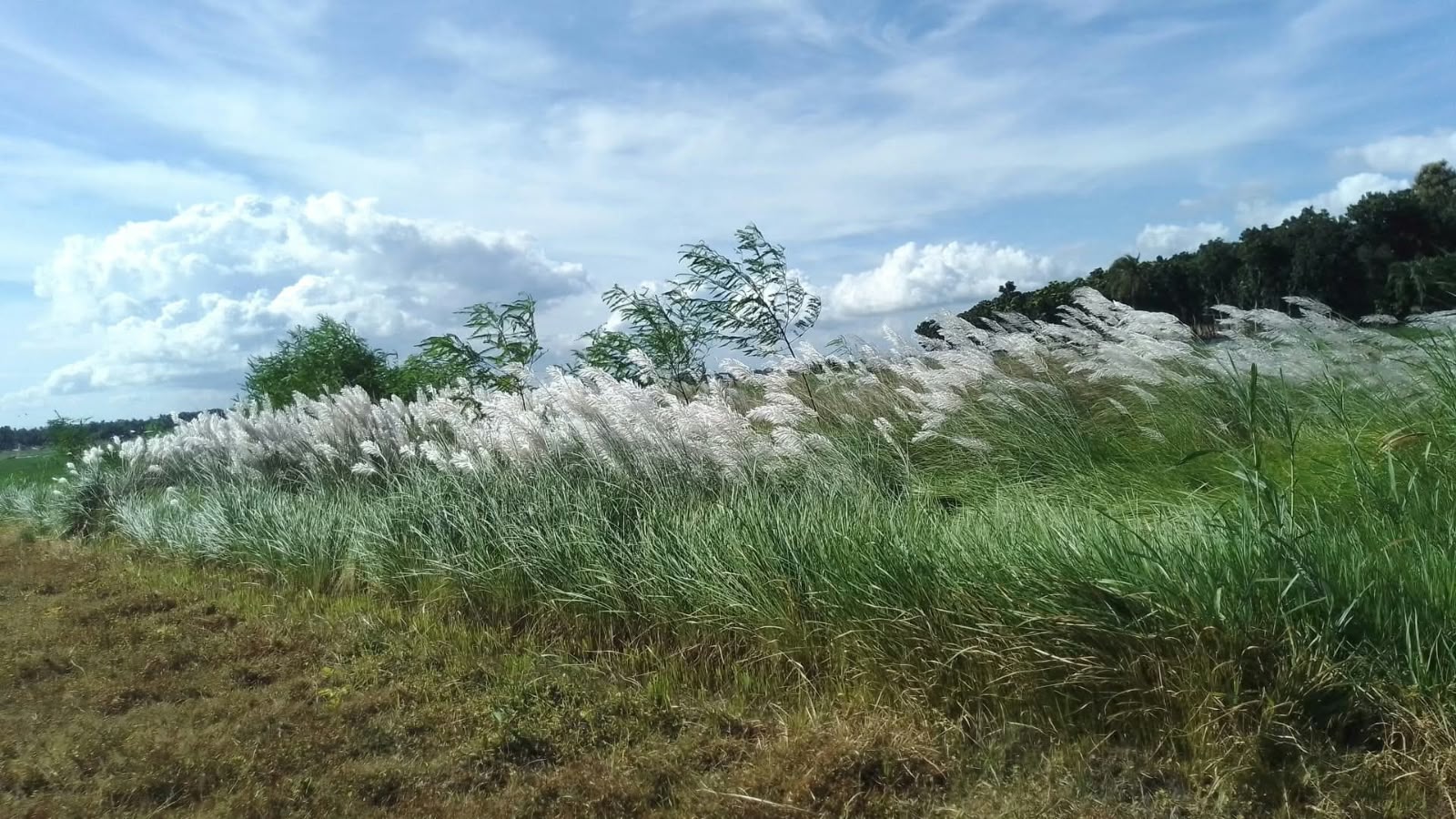
Autumn has quietly arrived in nature. There is a pale blue tint in the Bhadra sky, white kashful reeds nodding at the field’s edge, a soft new touch of autumn in the air. And yet the monsoon hasn’t fully taken its leave — its trace still lingers in the temper of the sky. One moment the world is scorched bright with sunshine; the next, dark clouds appear from nowhere to swallow the sun. The far horizon turns grey first, then a deep blue-black. The air grows heavy. Leaves turn over, showing their silvery undersides. Birds suddenly dip low in flight. Then, without warning, the sky breaks open and rain comes pouring down.
In the month of Bhadra, autumn walks about on soft, quiet footsteps. In the light of dawn, the blue of the sky grows clearer by degrees. In the morning air, the damp smell of monsoon mixes with an unfamiliar freshness. It brings to mind Rabindranath Tagore’s timeless lines about a morning steeped in autumn sunlight, where the heart itself doesn’t quite know what it longs for.
And isn’t it true — doesn’t something in the human mind shift, too, in this autumn light? For no particular reason, the mind turns wistful. It feels as though one ought to go somewhere; but where, exactly, is unclear. The mind wants to chase after some unfamiliar beauty.
Barely has the washing been hung out in a gap between showers before a sudden downpour fills the roof again. Rain drums steadily and hard on the tin roof. Water splashes off the leaves of mango, jackfruit and shirish trees. The dust of the courtyard dissolves into mud in an instant. A curtain of rain falls beyond the window. Through it, the trees blur, the houses dim, and the paths seem to vanish somewhere all at once.
When the rain stops, the scene changes again. Clear droplets of water tremble at the tips of leaves — some drop with a soft patter, others roll onto another leaf below. Soft light falls on the wet grass. In the water pooled in a distant field, a torn patch of blue sky floats. The white flowers of the kash grass sway together in the breeze — as if small waves have risen across the land.
And it is in that very moment that autumn feels closest.
Whether shefali flowers have bloomed anywhere nearby, one cannot say — and yet their scent seems to hide somewhere in the air. In that moment, Tagore’s song about birds calling out from the shefali branch, unsure themselves what it is they sing, feels closer still.
It feels good to sit in an open field and watch the sky. Sitting by the edge of a wetland feels even better. Much of the monsoon’s water still lingers there. Over it, the shadows of clouds drift slowly by. Here, the leaf of a water lily; there, the circular ripple of a small fish breaking the water’s surface. Somewhere in the distance, an embankment of mud, and beyond it, the slender black silhouette of palm trees. When the wind picks up, the wetland’s water trembles, and in that tremor, the sky’s reflection breaks apart.
In that moment, it feels as though gazing at nature is really gazing into one’s own mind. In this cloud, this rain, this sudden sunshine — some shadow of the human mind hides in each. The mind, too, is sometimes like this: filled with a little light one moment, clouded over the next. And then, in some unknown breeze, that cloud parts, and light returns.
The view along the riverbank is even more expansive. Broken shards of sunlight race across the current. Far off, a boat glides slowly forward, leaving a long trail cut into the water behind it. The char on the far bank is hazy, like mist. Some unfamiliar bird calls out. In the air, the scent of kash grass, of mud, of the earthy smell of water all mingle together.
It calls to mind another of Tagore’s lines — of a heart grown restless in the sweet breeze, unable to stay at home, chasing after some unknown flower’s scent into the deep blue sky.
Such is the nature of Bhadra — never still, yet exquisite; carrying at once the departure of monsoon and the arrival of autumn. The sun sets fire to its own body; clouds come and smother that fire; rain soaks the earth, and from the breast of that same wet earth, new green is born.
Autumn, then, is not merely the season of a cloudless blue sky. It sometimes arrives holding the wet hand of the monsoon, sometimes slipping through a gap in dark clouds, sometimes swaying in the white sway of kash flowers. Even through these damp, sun-streaked days of Bhadra, it silently writes its own arrival — in the white script of kash flowers, in the scent of shefali, in the fragrance of wet earth, in the sky trembling on a wetland’s water.
And people stand before that arrival — sometimes at the edge of a field, sometimes on a riverbank, sometimes by a window. They seek no answer. They only watch, and listen. And, for no particular reason, it feels as though when nature changes its season, some invisible season shifts within the human mind as well.