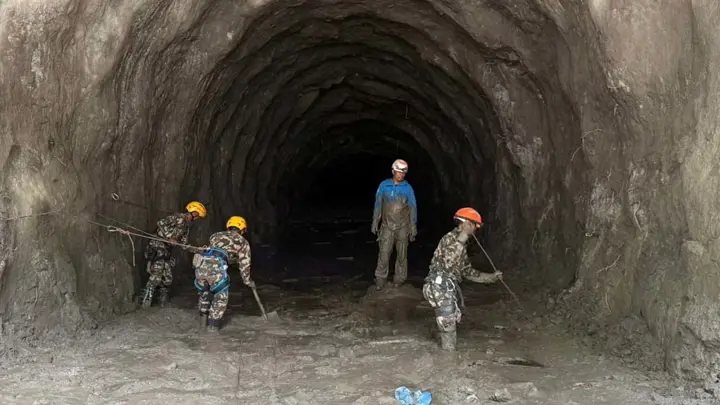
Nepali authorities say dozens of workers trapped in underground tunnels by a devastating flash flood may still be alive. More than a week after the flooding, the army and expert teams from several countries are continuing rescue operations.
A glacial collapse on the Nepal-China-controlled Tibet border last week sent a massive surge of water down the Bhote Koshi and Trishuli river valleys. The torrent of water, mud, rocks and debris destroyed village after village, along with bridges and hydropower plants.
Authorities say at least 639 workers remain missing from various hydropower projects built along the Bhote Koshi and Trishuli rivers. Of them, about 90 are missing from the Rasuwagadhi and Upper Trishuli-3A hydropower projects, where the chances of finding survivors are considered highest.
The Rasuwagadhi hydropower project is located in Rasuwa district, about three miles from the Tibet border. As one of the areas hardest hit by the flooding, reaching the project remains extremely difficult, with helicopters the only practical means of access.
Authorities say there may still be air pockets inside the Rasuwagadhi tunnel, raising hopes that workers trapped there could survive more than a week. A Nepali official identified as Shahi said it is the only project whose tunnel can be entered on foot. The army attempted to enter three days ago but could not locate the trapped chamber; a new rescue effort is now underway.
Meanwhile, it took rescuers nearly six days just to locate the tunnel at the Upper Trishuli-3A hydropower project, with the entrance buried under thick mud and debris. Army spokesman Raja Ram Basnet said an estimated 30 to 40 workers may still be alive inside the tunnel.
He said there are reports of a dry area inside the tunnel, and efforts are underway to build an access route to reach it.
The Nepali Army says operations will continue as long as there is a chance of finding survivors, while the recovery of bodies will also continue. Nepal is using all the technology at its disposal for the rescue effort, along with assistance from India, China and South Korea, and experts from Australia have also joined the operation.
Heavy death toll and destruction
Scientists estimate the floodwaters reached speeds of up to 160 kilometers per hour, carving a path of destruction over more than 60 miles, or 97 kilometers.
At least 1,252 deaths have been confirmed so far, with more than 4,200 people still missing. According to preliminary estimates by the United Nations Development Programme (UNDP), the flood generated at least 2.2 million tonnes of debris, including building rubble, rocks and large amounts of sediment.
The huge rocks and mud carried by the floodwaters blocked the entrances to hydropower project tunnels, in some cases burying them under deep mud. These underground structures have now become the main focus of rescue operations. More than 270 people have been rescued alive from the hydropower projects so far.
Families wait, and frustration grows
Relatives of missing workers have been coming to Nepal’s electricity department for eight straight days awaiting news. Jibanlal Adhikari went missing while inspecting equipment at the Trishuli-3A hydropower project. His sister, Laxmi Adhikari, has alleged that authorities are not giving relatives enough information and that the rescue operation is not moving fast enough.
She said she has had to go from one ministry to another and various government offices searching for her brother, but still cannot say for certain whether he is alive.
A major setback for Nepal’s hydropower sector
The mountainous country has invested more than $9 billion in hydropower over the past several years. But this flood has caused extensive damage to this critical infrastructure.
According to a preliminary survey, at least 11 hydropower plants have been damaged or completely destroyed, knocking out about 10% of Nepal’s total power generation capacity.
Authorities say more than 20,000 homes will need to be rebuilt after the flood. Preliminary estimates put the total cost of recovery at more than $5 billion.
Even amid this enormous damage, the top priority right now is rescuing the workers trapped alive in the tunnels. Authorities are hopeful that some of the missing may still be alive, given the air and dry spaces inside the tunnels.