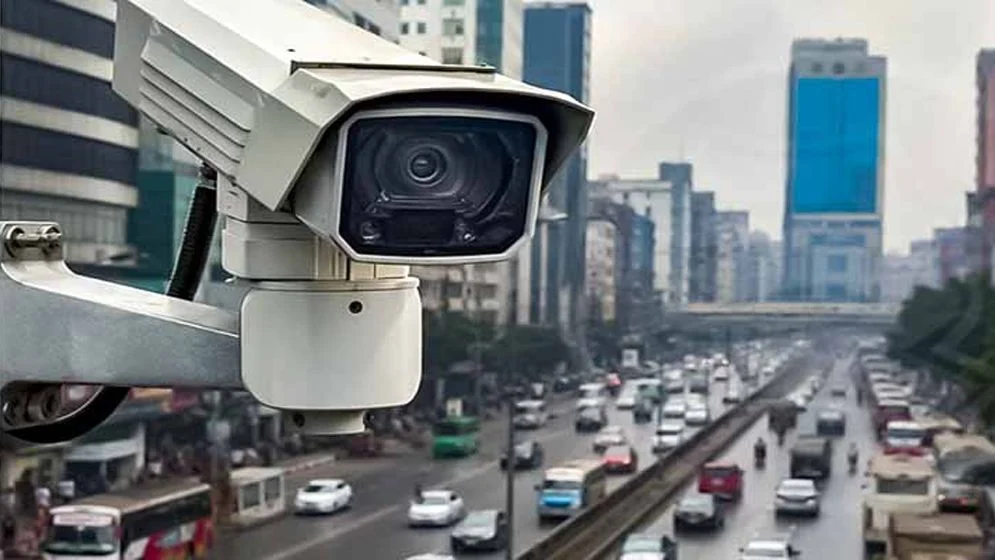
Prime Minister Tareque Rahman has ordered the rapid completion of artificial intelligence (AI) camera installation to modernize traffic management and reduce congestion on the capital’s roads. He has issued seven directives to ease congestion in Dhaka city, modernize the traffic system and restore discipline in the transport sector. Implementation has already begun.
Previously, whether a red or green light was on at Dhaka’s intersections made little real difference. Now, because of camera surveillance, many drivers are stopping at the designated point. At intersections where AI cameras have been installed, motorcycle, private car and CNG-run auto-rickshaw drivers are also showing a noticeably greater tendency to follow the rules than before. Traffic police no longer have to stand at every intersection around the clock, stopping drivers to enforce the law.
Now, information on violations is mainly being gathered through a combination of cameras, software and a centralized surveillance system. Making signals modern and effective depends heavily on drivers’ tendency to obey them. No advanced technology will work if drivers don’t follow the signal. The conventional method of stopping vehicles and filing cases for offenses such as running signals, crossing the stop line, or driving against traffic has its problems. It causes congestion on the road, since stopping one vehicle also traps the vehicles behind it.
As the use of AI cameras has continued to show benefits in reducing congestion and restoring road discipline, the idea of drone surveillance is also gaining momentum. Automatic Number Plate Recognition (ANPR) technology will be added to the drones. Once the technology is operational, it will become easier to take action or file cases based on video footage.
When sudden congestion appears on the capital’s various roads, flyovers and elevated expressways, it is often not possible to quickly identify the cause. If drones can be used, real-time information from the scene will become available. This will make it easier to take swift action depending on the situation.
The drones will also have a system for delivering audio or voice messages. If a vehicle blocks the road and creates congestion, it will be possible to instruct the driver from the sky to move. The main purpose of using the technology isn’t primarily to increase the number of cases filed, but to encourage drivers to follow traffic law.
An organization has already provided the Dhaka Metropolitan Police (DMP) with a drone for trial use. Testing is currently under way. Training of police personnel to operate drones has also begun. In the first phase, members of the Tejgaon division have been trained. DMP has already begun using AI technology in the capital’s traffic management. Starting from Shahbagh, a total of 15 traffic signals across various areas have been brought under AI technology. This has led to a noticeable practice or habit among drivers of following signals.
The most visible change since the AI cameras were introduced has come at traffic signals. Though not sweeping, the familiar picture of signal management in the capital has changed considerably. The once-common sight of vehicles ignoring signals at various spots has decreased with the installation of AI cameras there. Drivers are now following signals out of fear of being fined. DMP said the drone system, too, will be evaluated for effectiveness and potential problems after testing. If the technology proves effective and safe, there are plans to gradually expand its use across the capital and surrounding key areas. Many are already hopeful that AI camera surveillance will reduce extortion on highways.
Whatever extortion occurs on highways — whether by vehicle owners, the workers’ federation, or police — everything will be recorded on camera. That same hope was echoed by Home Minister Salahuddin at the inauguration of the AI-based “Auto Fine System” on the Dhaka-Chattogram highway in the Meghnaghat area of Sonargaon, Narayanganj. He called the Highway Police’s move a landmark step toward restoring discipline on highways.
He said automatic and AI-enabled cameras have been installed on 490 pillars along the Dhaka-Chattogram highway. Offenses such as exceeding the set speed limit, violating traffic law, driving the wrong way, unsafe overtaking, and ignoring signs and signals will be automatically detected via camera. Fines will then be imposed automatically, and the information sent to the Bangladesh Road Transport Authority (BRTA). Vehicle owners will be notified of fines by SMS to their mobile phones. There will be an option to pay the fine through designated mobile financial services.
Whether a vehicle’s registration will be canceled after three fines will be decided under BRTA’s rules. Current data shows that traffic-law violation cases on the Dhaka-Chattogram highway have dropped significantly in the first 10 days since the AI-based “Auto Fine System” launched. Preliminary data shows that on August 18, the first day the highway police’s AI camera surveillance system went live, 446 automatic cases were filed. The very next day, that number dropped to 42. By the tenth day, only 34 cases were filed. That represents a 92.33 percent drop in cases over 10 days.
Drivers see the highway police’s AI camera installation on the Dhaka-Chattogram highway as a positive step to restore discipline and prevent accidents. The Dhaka-Chattogram highway falls under the highway police’s Gazipur and Cumilla regions. The Gazipur region covers the stretch from Dhaka’s Sainboard to the Narayanganj section, while the Cumilla region covers the highway from Cumilla’s Daudkandi to Chattogram City Gate. Under the Road Transport Act of 2018, vehicles are allowed to drive at a maximum of 80 kilometers per hour on highways. According to highway police data, from August 18 through last Thursday, an average of 695 automatic cases were filed per day. Of these, 658 were for speeding and 37 for driving the wrong way.
Of the 446 automatic cases filed on the first day for traffic-law violations, 417 were for speeding and 29 for driving the wrong way. The following day, when the number of cases dropped 90.58 percent from 446, cases for speeding stood at 42. On August 20, there were 20 cases for speeding and one for driving the wrong way. The next day, there were 19 cases for speeding and two for driving the wrong way. On August 22, there were 42 cases, and the following day, 35. On August 24, there was one case for driving the wrong way and 20 for speeding. On August 25, the number of cases was very low, just 14. Last Wednesday and Thursday, cases for driving the wrong way dropped to zero. Wednesday saw 19 cases for speeding, and Thursday, 34.
The data offers plenty of food for thought. It isn’t possible to permanently station traffic police at every point on a highway. In some places, drivers would try to follow the law when they saw traffic police present, but break it when police weren’t around. Because of AI camera surveillance, drivers are developing a habit of following the law on the road, which is why cases are decreasing.
In many cases, when traffic police tried to file cases for traffic-law violations, influential vehicle owners would try to intervene in various ways. But since violations are now detected automatically before a case is filed, people no longer have that opportunity. Cases are filed for driving faster than 80 kilometers per hour. Before the AI cameras were inaugurated on August 18, they were run on a trial basis. At that time, the number of cases was more than 400 a day. Even under the manual method, there were more than 400 cases. Needless to say, the “Auto Fine System” is a project to boost the highway police’s capacity. Since the AI cameras went live, all drivers on their routes have been warned in writing. They have been told they must drive in compliance with traffic law. Otherwise, if a video case is filed, the driver will have to bear the fine. Since video-based cases began, drivers have been staying more alert on the road than before. Once this alertness becomes a matter of ethics rather than fear, it is only a matter of time before the oft-repeated phrase “safe roads” becomes an effective reality — because genuine habit never comes from fear or imposition alone.