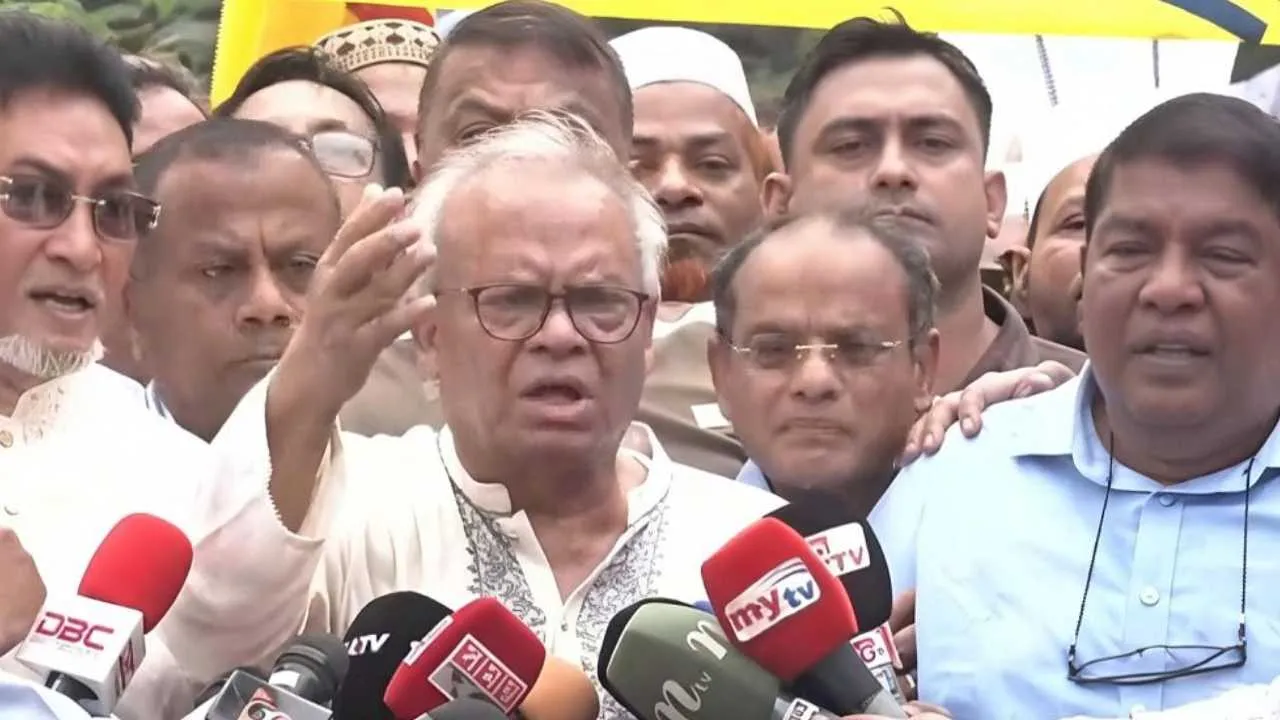
BNP acting secretary general Ruhul Kabir Rizvi has said that after 17 long years of hostile political conditions and movements and struggles, BNP has come to power through the people’s vote. Now, he said, the biggest challenge for the party and the government is to retain the people’s trust and popularity. For that, he said, the government must fulfill people’s expectations, implement its election promises, and stay more closely engaged with the public.
He made these remarks to reporters Tuesday morning, September 1, after paying tribute and offering prayers at the graves of party founder martyred President Ziaur Rahman and former Prime Minister Begum Khaleda Zia at Zia Uddyan in the capital, marking BNP’s 48th founding anniversary.
Ruhul Kabir Rizvi said: “Forty-eight years ago, BNP was founded by the great declarer of independence, martyred President Ziaur Rahman, guided by a set of principles. Alongside protecting independence and sovereignty and ensuring multi-party democracy, he undertook a revolutionary program aimed at the country’s development, production and self-reliance.”
Noting that martyred Ziaur Rahman established Bangladesh with dignity across every field — education, culture, foreign policy, domestic policy and law and order — he said: “Through BNP’s founding, civil liberties were secured and the opportunity for multi-party democratic practice was created. As a result, people of different views and paths gained the opportunity to express their opinions.”
Rizvi further said: “After BAKSAL was established in 1975, newspapers were shut down. Those serving in the press today and freely expressing their views owe an important debt to martyred Ziaur Rahman and Begum Khaleda Zia. Ziaur Rahman also played an important role in exporting labor abroad, creating employment and advancing the country’s economy.”
He said: “Ziaur Rahman founded the Bangladesh Nationalist Party as an ideology-based party. We are moving forward carrying the flag of his policies, ideals and philosophy.”
Referring to the anti-Ershad movement, Rizvi said: “Later, democracy was killed once again through conspiracy and various kinds of scheming. Hussain Muhammad Ershad seized power by imposing martial law and brought the country’s political environment to a standstill. Standing against that autocracy, Begum Khaleda Zia waged an uncompromising struggle for nine years. She did not compromise with anyone to restore democracy, and she kept the promises and commitments she made to the people.”
Calling BNP a “party that keeps its promises,” Rizvi said: “Despite various forms of oppression, persecution and political adversity, Begum Khaleda Zia led the country and the party. Although attempts were made to suppress BNP and Khaleda Zia through various national and international conspiracies, she overcame every obstacle and secured victory for the people and for democracy.”
Recounting Khaleda Zia’s political struggle, Rizvi said: “She herself endured oppression, persecution and torture. She spent years imprisoned. She was denied proper medical treatment and the human rights a prisoner is entitled to; still, she made no compromise. She was the central inspiration in the movement against Sheikh Hasina’s government.”
Rizvi said: “When Khaleda Zia was in prison, her eldest son, Tareque Rahman, carried out the responsibility of running the party. Upholding the ideals of his parents, he led the democratic struggle and organized the entire nation, from the grassroots to the national level.”
He further said: “Under Tareque Rahman’s continued leadership, the mass movement that began in 2018 later grew into the powerful wave of the July revolution. An explosion of people’s power occurred on the streets, and Sheikh Hasina fell on August 5.”
Ruhul Kabir Rizvi said: “Until the last day of her life, Begum Khaleda Zia remained a symbol of democracy for the entire nation. She inspired everyone in the democratic struggle and gave inspiration for the fall of fascism. She is no longer with us today, but she has handed the flag of the ideals, courage, heroism, and independence and sovereignty she left behind to her son, Tareque Rahman.”
On the current government’s activities, the BNP leader said: “BNP came to power through a free and fair election. Having come to power, Tareque Rahman is tirelessly working to fulfill the commitments made to the people. He is working day and night to implement various programs on social protection, development and production.”
Noting that “there are challenges,” Rizvi said: “There may be various kinds of challenges and conspiracies in the country. But Tareque Rahman is leading the government while confronting them. Various promises made to the people, including the Farmer Card, Family Card, and allowances for imams and muezzins, are already being implemented.”
On the power and energy crisis, he said: “This isn’t just a crisis for BNP or the government; it’s a global crisis. International circumstances have created problems in energy supply. The disruption to shipping in the Strait of Hormuz and damage to fuel-carrying vessels have had an impact on Bangladesh as well.”
He said the government is not sitting idle in tackling the crisis. Beyond the allocation for the energy and power sector, an additional roughly 40,000 crore taka has been spent as part of an initiative to resolve the crisis. A technical fault at a terminal in Maheshkhali has been repaired, and gas regasification has resumed. He expressed hope that normal gas supply would be secured by the first or second week of September.
On the relationship between the party and the government, Rizvi said the party and the government are two separate institutions, but there is no contradiction between them. He said the people gave BNP the responsibility of forming the government by voting for it, so it is natural for the government’s ministers to come from among BNP’s leaders and activists.
He said BNP leaders and activists, from the grassroots to the national level, will inform the public about the government’s welfare programs. He said the party will remain in its place, and the government will remain in its place. Those responsible for the party will carry out party responsibilities. And those serving as ministers in the government will, alongside their ministerial duties, also carry out the responsibilities assigned to them by the party, according to their position.
Outlining BNP’s pledge on its 48th founding anniversary, Rizvi said the main goal now is to implement the democratic consciousness built through 17 years of struggle, and the commitments to the public’s social protection and the country’s development and production made in the 31-point charter, the election manifesto and Begum Khaleda Zia’s “Vision 2030.”
He concluded by saying: “After 17 long years of hostile political conditions, BNP has won the people’s vote today. The biggest challenge now is to retain this trust and popularity from the people. For that, the government must fulfill people’s expectations, implement its promises, and stay more closely engaged with the public.”