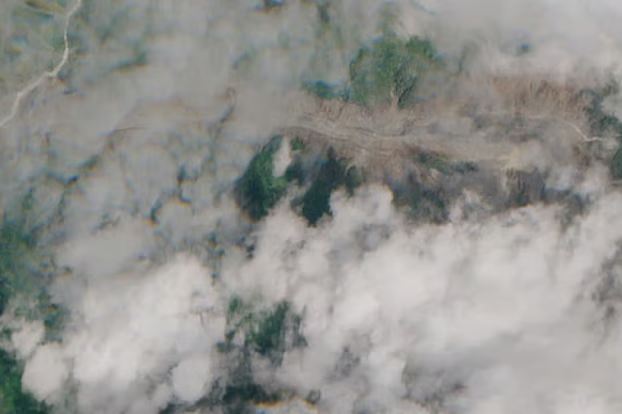
A lake formed by a glacial collapse on the Nepal-China border began overflowing again on Friday, spreading intense panic across the region. Areas already devastated by the catastrophic flash flood two days earlier now face renewed risk of disaster. Rescue operations had to be temporarily suspended as a result.
Last Wednesday’s catastrophic flood, triggered by the glacial collapse, killed 489 people in Nepal and 5 in Tibet, China. More than 1,000 people remain missing across the two countries.
After the glacier collapsed, a powerful surge of massive boulders, ice, mud and debris swept down through the Himalayan mountain river system. A lake also formed at the time. Water there kept accumulating, and the water level kept rising.
Nepali authorities and witnesses said that by Friday, before the lake’s water overflowed into the Bhotekoshi River, its reservoir held more than 2.5 million cubic meters of water — a significant increase from an estimated 1.5 to 2 million cubic meters the previous day.
Narendra Pariyar, the top official in Nepal’s flood-hit Rasuwa district, told the news agency Reuters: “We received a notice that the lake’s bank has broken and water is flowing out. But we don’t know exactly how large it is or how high the water level is. What we can see is that the water level in the river is rising.”
Several people climbed to higher ground on a hillside to watch the situation in Kot district after a warning that the lake’s dam had broken and water was overflowing.
Reuters witnesses said that as loudspeakers warned everyone to stay away from the river, people grabbed their belongings and began running toward higher ground. Police stood ready in formation with ropes and stretchers.
Shanti Tamang, 40, told Reuters: “When everyone started shouting warnings to flee, I ran too. The siren in Bidur town also went off. I was terrified.” Rescue workers were also told to move their equipment to safety.
Chinese president orders search for the missing
Chinese state broadcaster CCTV said Friday that when the risk of the lake’s dam breaking emerged, all Chinese rescue personnel and vehicles were told to retreat to safe areas. Rescue work later resumed, however, after it appeared the lake’s risk could be managed through the upstream river.
A Nepali army official said Nepali authorities suspended rescue operations for 90 minutes before resuming them. Wednesday’s flood obliterated villages and valleys, destroying power stations, roads and bridges. A road connecting Kathmandu with Lhasa, Tibet, and a highway extremely popular among pilgrims, was destroyed. Among the missing are at least 800 foreign nationals, many of them Hindu pilgrims from India who had set out for the sacred Mount Kailash and Lake Manasarovar in Tibet.
State media said China’s Politburo held a meeting in Beijing on Friday to discuss rescue strategy.
According to a report by the state news agency Xinhua, the meeting, chaired by President Xi Jinping, said authorities must “develop a scientific search-and-rescue plan and make an all-out effort to find missing individuals, both Chinese and foreign.”
The meeting said rescue operations face “extremely difficult challenges.” It also called for stepped-up monitoring of glacial lakes, landslide risks and natural dams, emergency assistance for Nepal’s affected areas, and stronger international disaster cooperation.
Earlier, Nepali rescue teams used helicopters to search for survivors, airlifting emergency relief to thousands of people cut off in various towns and valleys. Meanwhile, emergency service teams recovered many bodies that had washed up on flat ground. Dogs are also being used in search teams.
Digbga Tamang was among the last people rescued from Rasuwa on Thursday, airlifted along with three others to an army camp in Nuwakot.
Tamang said: “All our people are gone. Everyone died. There’s no one left for me to wait for. Everything and everyone is finished. It’s all over.”
Nepal declines foreign rescue assistance
Despite offers of help pouring in from all sides, Nepal has said it does not need assistance from other countries in its search-and-rescue operations.
Foreign Ministry spokesperson Lok Bahadur Chhetri said Friday: “It’s natural that offers of help are coming in, but our security agencies are already conducting the search-and-rescue operation. We don’t need this kind of assistance at the moment.”
According to Seoul’s foreign ministry, a South Korean rapid response team is already stationed in Kathmandu. But since the Nepali government has not yet planned to accept help from foreign rescuers, the team has not been deployed.
The Kathmandu Post reported that India, China, the United States, the United Kingdom, Japan, South Korea, Sri Lanka and Bangladesh had all requested government permission for their search-and-rescue teams to assist in the operation.
A state media report suggested Chinese rescuers had not yet reached the Gyirong border crossing, the worst-affected area on the China side, as of Thursday evening, because workers were still clearing debris from the main access road to that area.
Video footage from Wednesday showed a massive surge of muddy water and debris crushing one structure after another at the border crossing within seconds, sweeping away people fleeing in search of safety.
China’s state broadcaster CCTV said Thursday that the number of missing in Tibet’s Gyirong county stood at 558, including 260 foreign nationals. Only five deaths have been confirmed so far on the Chinese side.
China’s state-owned news agency Xinhua said the country’s second-highest-ranking official, Premier Li Qiang, arrived in the disaster-hit area of Gyirong on Thursday afternoon. His visit underscores how seriously China is treating the disaster.
Buildings ‘wiped out like toothpicks’
Relatives of missing people around the world are desperate for news of their loved ones.
Sneha Sudhir was one of 10 women whose husbands had set out from Nepal toward Mount Kailash in Tibet, right when the region was struck by this disaster. They are residents of northern Virginia in the United States.
Speaking tearfully from her home in Chantilly, Virginia, Sneha Sudhir said Thursday: “Where are they?”
Sudhir said the women are supporting each other emotionally, staying in touch with U.S. and Indian officials, politicians, friends and family in hopes of news.
President Donald Trump said the United States has assured Nepal of its support.
Trump said: “No one has ever seen anything like this, where extremely strong, sturdy, well-built buildings were wiped out like toothpicks. It’s a horrific event. We’re sending help, and we’ve spoken with the leadership there. We’ve told them they’ll get whatever they need.”