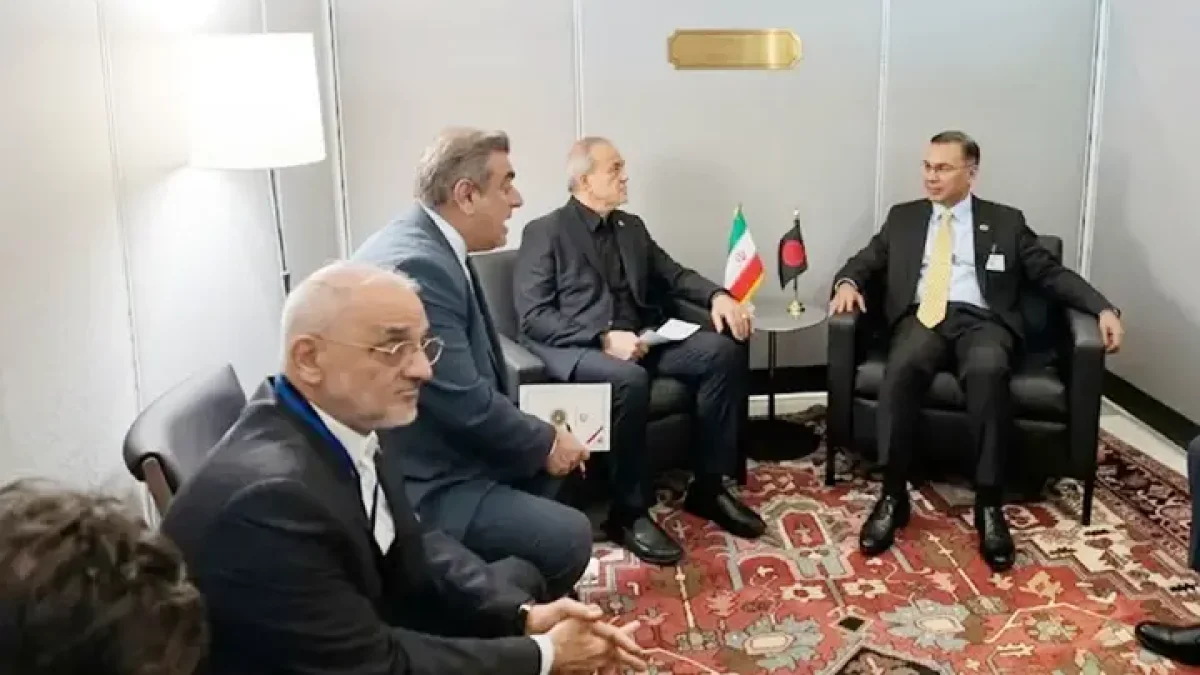
Bangladesh has called on Iran to resolve the ongoing conflict in the Middle East quickly and peacefully. Dhaka also stressed the safety of Bangladeshi workers and professionals in the region and the safe passage of Bangladeshi ships and containers through the Strait of Hormuz.
Prime minister Tarique Rahman raised these issues on Wednesday at a meeting with Iranian president Masoud Pezeshkian on the sidelines of the 81st session of the UN General Assembly.
After the meeting, state minister for foreign affairs Humayun Kabir and the prime minister’s adviser Mahdi Amin set out the details at a press briefing the same day at the Hyatt Grand Central New York hotel.
Humayun Kabir said the prime minister called for a quick resolution of the Middle East conflict through diplomatic initiatives.
A prolonged conflict could affect Bangladesh too, he said, with particular concern for the safety of the large number of Bangladeshi expatriates and professionals working in the Middle East and for Bangladesh’s energy security.
Noting that a significant number of Bangladeshi workers and professionals are in the Middle East, the state minister said that if the conflict in the region drags on, its effects could reach Bangladesh.
The meeting also raised the issue of Bangladeshi containers and ships held up by the tension around the Strait of Hormuz. Iran’s cooperation was sought so that these ships and containers can move safely once the situation improves.
“We have called for a swift diplomatic solution to this conflict,” Humayun Kabir said.
The Iranian president listened carefully to Bangladesh’s concerns and took note of them, he said.
Humayun Kabir said Bangladesh is maintaining a neutral position on the conflict and is ready to play a constructive role if an opportunity arises to help establish regional peace and stability.
Bangladesh can play a role as a country with “soft-medium influence” — the capacity to exert positive influence — for peace and stability in the world, he said.
Bangladesh has important partnerships with various countries in the Middle East, he said, and some of those partners have encouraged Bangladesh to use its neutral position in communicating with the parties to the conflict.
It is not essential, however, for Bangladesh to take on a direct, visible role as mediator, he said. In his view, Bangladesh can contribute to peace and stability through diplomatic contacts as a friend of the region.
Humayun Kabir described the meeting with the Iranian president at UN headquarters as a neutral diplomatic space for Bangladesh. “The UN is a neutral venue,” he said.
The prime minister used the opportunity not only to discuss the Middle East conflict but also to raise Bangladesh’s national interests, the state minister said, including the possible effect of the situation in the Strait of Hormuz on Bangladesh’s energy supply and trade.
Bangladesh wants a quick, peaceful, diplomatic resolution of the conflict, Humayun Kabir said. If the crisis drags on, its effects will not be confined to the countries involved but could spread to the wider region and the world.
The prime minister’s adviser Mahdi Amin said the meeting also discussed regional stability, the safety of Bangladeshis working across the wider Middle East, and questions of regional and international peace.
The prime minister gave priority to Bangladesh’s national interests in the talks, he said, and in particular stressed the safety and welfare of Bangladeshi expatriates living and working in the Middle East.
The meeting with Iranian president Masoud Pezeshkian was part of the prime minister’s bilateral and diplomatic engagements on the sidelines of the 81st session of the UN General Assembly.
বাংলায় মূল প্রতিবেদন পড়ুন · Read the original Bengali report