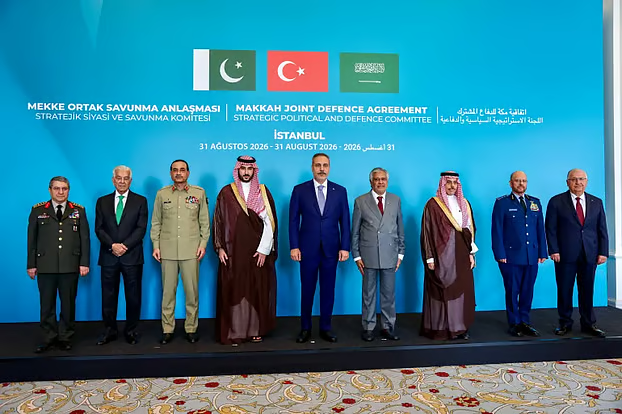
Pakistan, Saudi Arabia and Turkey have given their new mutual defense treaty a formal name: the “Mecca Defense Alliance.” The name was announced in Istanbul, Turkey, following a meeting of senior officials from the three countries.
At a news conference after Monday’s talks in Istanbul, Turkish Foreign Minister Hakan Fidan said a secretariat for the alliance has been established in the Saudi capital, Riyadh, and its first secretary-general will be appointed from Pakistan.
Fidan said the alliance is built on international principles such as respect for other states’ sovereignty and territorial integrity and non-interference in internal affairs. It will remain open to partnership and participation from any other country in the region.
The meeting came hours after the first exchange of attacks between the US and Iran in a month. The war that began when the US and Israel jointly struck Iran on February 28 has now run for more than six months, following a brief lull before attacks resumed.
Pakistan’s army chief, Field Marshal Asim Munir, and the country’s deputy prime minister, Ishaq Dar, arrived in Turkey last Sunday. Dar traveled there from London, after completing a separate visit to the UK.
Pakistani officials had signaled in recent weeks that Egypt might also join Monday’s talks — not to discuss the defense pact, but as part of the four-country group that has been mediating to end the US-Israel war with Iran. These four countries have played an important role in that mediation effort.
The four last met in Amman, Jordan, on August 5. Before that, they met in Cairo, Egypt, in June. That meeting welcomed Pakistan’s mediated Islamabad memorandum of understanding between the US and Iran. Monday’s talks, however, focused mainly on the three countries that signed the mutual defense pact.
Under the joint defense treaty signed by Pakistan, Saudi Arabia and Turkey in Mecca on August 7, a strategic political and defense committee has been formed. The committee has begun work turning the pact’s political commitments into a workable framework. Under that commitment, an attack on any one of the three countries is to be treated as an attack on all three.
It remains unclear, however, how the alliance’s institutional structure will actually function, or under what circumstances the mutual-defense clause would be triggered.
Efforts to operationalize the pact
Pakistan’s delegation at the Istanbul meeting was led by Deputy Prime Minister Ishaq Dar, along with Army Chief Asim Munir and Defense Minister Khawaja Asif.
Turkey’s delegation included Foreign Minister Hakan Fidan, Defense Minister Yasar Guler and Chief of General Staff Selçuk Bayraktağlu.
Saudi Arabia’s delegation included Foreign Minister Faisal bin Farhan Al Saud, Defense Minister Khalid bin Salman and Chief of General Staff Fayyad Al-Ruwaili.
According to Pakistan’s foreign ministry and Turkish officials, the agenda included boosting coordination and interoperability among the three militaries, joint military exercises, defense-industry cooperation including joint production and research, and counterterrorism coordination.
In an August 8 interview with Anadolu Agency, Fidan had said the alliance would have a permanent secretariat in Saudi Arabia, though its structure and responsibilities were still to be worked out among the three member states.
Some have compared the alliance’s mutual-defense clause to NATO’s Article 5, though several independent analysts reject that comparison. In their view, the alliance lacks a NATO-style integrated command, standing ready forces or joint military structure.
Tughral Yamin, a retired brigadier and senior associate at Islamabad’s Institute of Policy Studies, said having a dedicated office or secretariat is essential to making the pact functional.
Yamin told Al Jazeera the secretariat could be based in any one country, or could rotate among the member states. He cited the example of NATO’s Supreme Headquarters Allied Powers Europe, based in Belgium.
Yamin said Saudi Arabia has already established a headquarters this year after forming a separate maritime alliance under its leadership.
Sinem Cengiz, a researcher at Qatar University’s Gulf Studies Center, told Al Jazeera these questions need to be settled before the treaty goes to Turkey’s parliament for ratification. It appears the treaty’s full terms won’t be disclosed until the ratification process is complete.
Testing the pact
The Istanbul meeting came days after Asim Munir’s fourth visit to Iran this year. On August 24, Munir traveled to Tehran and met Iranian President Masoud Pezeshkian, Foreign Minister Abbas Araghchi and Supreme National Security Council Secretary Mohsen Rezaei. According to Pakistan’s army, the visit was part of the country’s effort to help end the war.
Pakistani officials say the visit made significant progress on reviving the Pakistan-brokered Islamabad memorandum and on reopening the Strait of Hormuz.
Pezeshkian, for his part, said Washington needs to change its tone.
But little optimism was evident in Washington. Two days later, US President Donald Trump said the US was in no hurry over talks with Tehran.
Monday morning, US Central Command (CENTCOM) struck two rocket-launch sites belonging to Iran’s Islamic Revolutionary Guard Corps (IRGC) on Larak Island in the Strait of Hormuz — the first US strike on Iran it has acknowledged in a month.
Within hours, the IRGC responded. It claimed to have struck Jordan’s King Hussein and Al-Azraq air bases with ballistic missiles, and the UAE’s Al Minhad air base with drones.
Jordan and the UAE denied Iran’s claim. US troops are stationed at both bases.
Tughral Yamin of Islamabad’s Institute of Policy Studies told Al Jazeera that if the proposed trilateral alliance turns explicitly into an anti-Iran bloc, it would become difficult for Pakistan to maintain credibility in its dual role as a Saudi security partner and a trusted mediator with Tehran.
Gokhan Ereli, an international relations expert at Istanbul’s Ibn Khaldun University, said the Pakistan-Saudi Arabia-Turkey relationship wasn’t newly created by the war — ties and cooperation among the three existed before the war began as well.
He noted decades of Pakistan-Saudi security ties and Turkey’s own drive toward strategic self-reliance. The alliance’s real test, Ereli said, will come after the war ends.
Ereli told Al Jazeera that if joint management, an institutional secretariat and joint defense-industry initiatives survive beyond the current period of tension, it would signal that the pact points toward a fundamental realignment of the regional security architecture.
Sinem Cengiz of Qatar University’s Gulf Studies Center has taken a more cautious position on the pact. But she does not fully agree with describing the Mecca Defense Pact as merely “symbolic” or as something that amounts to major change.