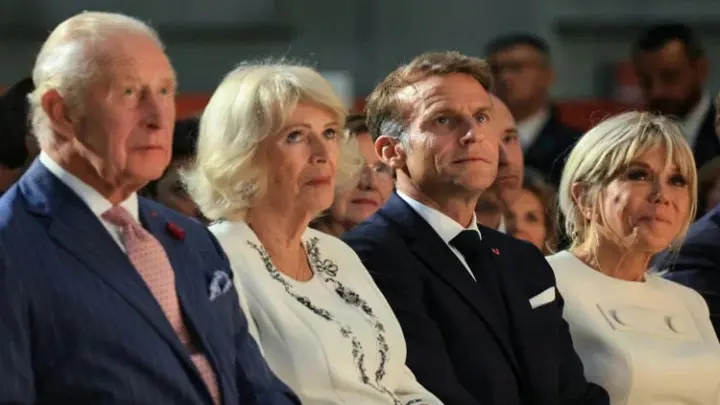
After viewing the Bayeux Tapestry, the historic French artifact on loan for exhibition in London, U.K. Prime Minister Andy Burnham and French President Emmanuel Macron held their first formal meeting Thursday. The talks focused on migrant boat crossings and the war in Ukraine.
The Bayeux Tapestry is an embroidered cloth roughly 70 meters (230 feet) long and 50 centimeters (20 inches) high, depicting events leading up to the Norman conquest of England in 1066.
The two leaders met for the first time at Wednesday evening’s preview event for the tapestry’s opening at the British Museum. King Charles III also attended.
Both sides described the event as a symbol of the positive relationship between the two countries.
The French president said he hopes future generations will remember “the centuries of shared history between two nations that decided to weave bonds as close as the threads of this thousand-year-old embroidery.”
Macron has played a key role for nearly a decade in the effort to loan the tapestry to the U.K. The exhibition is seen as another step in overcoming the bitterness that built up during the Brexit years.
The 11th-century artwork depicts William the Conqueror’s conquest of England. It arrived in London in July. The exhibition is sold out.
In his remarks, Burnham described it as an opportunity to build “a new future full of hope and expectation.”
Macron is set to become the first European Union leader invited to Downing Street under Burnham. Ukrainian President Volodymyr Zelensky, however, visited in July.
The visit is significant for Macron, as his term as president is drawing to a close; his term is due to end in May 2027.
‘No room for complacency’
Thursday’s talks were set to include discussion of joint efforts to stop migrants crossing the English Channel in small boats.
Burnham told French journalists Wednesday: “We are working with the French government on migration. There is scope to do much more together.”
Downing Street said the leaders would give significant attention to stopping the use of “mega-dinghies” — larger, more robust boats.
Downing Street said a 45-member French “surge team” of officials would be deployed on beaches in the coming weeks to help stop migrant crossings using such boats.
The government said Monday that the number of small boats carrying migrants across the English Channel this summer was the lowest since 2019. The government has held that up as a success of its enforcement agreement with France.
But in a statement issued at Downing Street ahead of the meeting, Burnham said: “We cannot afford to be complacent. Smuggling gangs are constantly changing their tactics. The U.K. and France must respond quickly.”
Burnham has continued London’s support for Ukraine in its war with Russia. His first overseas trip as prime minister was to Kyiv.
Speaking at the British Museum event, Macron told Burnham: “This was important. Our coalition of the willing for Ukraine is just as important.”
He specifically noted the U.K.’s supply of information related to components of the long-range SCALP missile. The French-made SCALP is the French version of the U.K.’s Storm Shadow missile.
Macron had a strong relationship with former British Prime Minister Keir Starmer. Both played leading roles in the coalition of countries supporting Ukraine.
Burnham told French journalists Wednesday: “Britain may have changed prime ministers, but our policy on Ukraine has not changed.”
Downing Street said the talks could also touch on ensuring stability in the Middle East and reopening the Strait of Hormuz.
Mutual respect
Macron remains interested in establishing a concept of European sovereignty independent of the United States. Even after the U.K.’s exit from the European Union, Britain is seen as a country capable of playing an important role in that effort.
The French president said Wednesday that Paris and London “don’t always agree on everything,” but added: “We respect each other and are ready to discuss everything, including progress on rebuilding the U.K.’s relationship with the European Union.”
Burnham is keen to build on former Prime Minister Keir Starmer’s post-Brexit push for closer cooperation with the European Union aimed at boosting the U.K.’s economic growth.
He told reporters Wednesday: “I think it’s important to build on what my predecessor achieved. He took steps toward closer ties.”
Burnham said: “Ten years after Brexit, people here are frustrated by the lack of direction. They understand that we need to work more closely together.”
But Anand Menon, a politics professor at King’s College London, cautioned that the meeting risks “giving more weight to style than substance.”
He told AFP: “You can create as warm an atmosphere as you like. But we need progress in talks with the European Union. And I don’t think there will be any.”