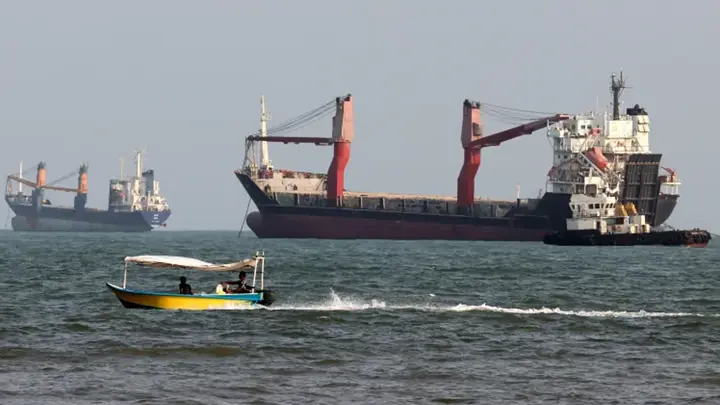
The conflict between the United States and Iran over the Strait of Hormuz, one of the world’s most important energy transit routes, is moving toward new risk. Tehran has announced plans to create a new “no-go zone” near the strait. It has threatened that any ship entering the area will be placed on Iran’s sanctions list.
Meanwhile, attacks and counterattacks between the two countries continue in Hormuz. Facing a U.S. naval blockade, Iran is taking an even harder line on controlling shipping. As a result, there is growing concern that conflict could spread further around this critical global energy corridor. Some experts view the situation as a “dangerous escalation.”
Mohsen Rezaei, secretary of Iran’s Supreme National Security Council, said the new no-go zone would be announced within the coming days.
He told Iranian state media the zone would begin at the boundary of the U.S. naval blockade, then extend toward the Strait of Hormuz and into parts of the Persian Gulf.
He warned that any ship entering this new zone would be placed on Iran’s sanctions list. However, Tehran has not yet detailed the zone’s exact boundaries, what the sanctions would mean, or how they would be enforced.
Iran sets conditions for reopening Hormuz
Alongside announcing the no-go zone, Rezaei also delivered a stern message on the Strait of Hormuz itself. He said Iran will not guarantee keeping the strait open until the United States stops its “sabotage, threats and attacks” against Iran.
He also said Iran is working with Oman to draw up a map for a new international shipping route through Hormuz.
According to him, Iran would be responsible for managing this corridor, which runs through Iranian and Omani waters. The two countries have agreed on this, and the agreement is expected to be signed within the coming days.
Earlier, Iranian Deputy Foreign Minister Kazem Gharibabadi had said a temporary shipping-route agreement had been reached with Oman for vessels passing through Hormuz, with the entry and exit portions of that route running through Iranian waters.
Attacks and counterattacks on ships
Tensions around Hormuz have already spilled into direct military conflict. The United States has struck several Iranian oil tankers. In response, Iran has struck tankers as well. Tehran has also fired ballistic missiles at U.S. warships patrolling near Hormuz.
Iranian local media had claimed that a U.S. ship tried to enter Tehran’s designated no-go zone and was struck as a result. But U.S. Central Command spokesperson Capt. Tim Hawkins rejected the claim as “completely false.”
Whose shipping route will run through Hormuz?
The dispute between the U.S. and Iran over control of shipping routes through Hormuz is not new. Back in April, Iran published a map of its own approved shipping route, running much closer to the Iranian coast than before.
Oman took a counter-initiative against Iran’s attempt at control. Working with the U.N.’s International Maritime Organization (IMO) in June, Oman designated an alternative shipping corridor in the southern part of Hormuz, aiming to restore safe passage through the strait.
The Liberian-flagged tanker “Stoic Warrior” used that alternative route, passing along the coasts of the United Arab Emirates and Oman, near the Musandam Peninsula.
This angered Iran’s Islamic Revolutionary Guard Corps (IRGC), which declared Iran’s approved route the “only authorized shipping lane” through Hormuz. It warned that any ship using another route without permission would face “unacceptable and highly dangerous” consequences.
Hormuz stalls again as agreement collapses
On June 17, the United States and Iran signed a 14-point memorandum of understanding (MOU) in Geneva, after which shipping through Hormuz increased.
Under the agreement, the U.S. was to lift its naval blockade within 30 days. Iran, for its part, was responsible for clearing mines from Hormuz and allowing 60 days of toll-free shipping.
But after the 60-day period ended, attacks between the two countries resumed, sharply reducing commercial shipping through this critical waterway.
From 130 ships a day to just 10
Hormuz has not been completely shut down. Shipping continues. But it is far below pre-war levels.
Before the conflict began, about 20 million barrels of crude oil passed through Hormuz daily. U.S. Energy Secretary Chris Wright said more than 9 million barrels a day are now passing through this route. Including alternative pipelines, he claims total flow is two-thirds or more of pre-war levels.
The U.K. Maritime Trade Operations (UKMTO) said 59 ships crossed Hormuz in the 48 hours ending Sunday.
But data from other organizations that monitor maritime traffic paint a bleaker picture. Only six ships crossed the strait last Wednesday, 11 on Tuesday and five on Monday. Over 10 days, an average of 13 ships crossed daily.
According to maritime analytics firm Kpler, over the past 10 days, an average of just 10 cargo ships have crossed Hormuz daily — the lowest since May.
Before the war began, more than 130 ships passed through Hormuz daily. That route has now effectively become one of the war’s main pressure points.
Can Iran actually enforce a no-go zone?
This is now the biggest question. Iran has already shown it can make Hormuz risky. Since March, numerous ships have been attacked there. At least 19 sailors have been killed.
But militarily enforcing a much broader no-go zone is an entirely different matter. In particular, there are questions over how much resistance Iran could mount if ships under U.S. Navy protection enter the zone.
Stephen Zunes, founding chair of Middle Eastern studies at the University of San Francisco, believes it will be difficult for Iran to enforce such a zone.
He says enforcing the zone would require Iranian warships and warplanes to be deployed — but those would become extremely vulnerable to U.S. attack.
Still, Zunes thinks this could also be a warning from Iran. Shipping companies are being told that passing through Hormuz without Tehran’s permission carries risk.
Is Tehran trying to draw the US into a bigger conflict?
According to Zunes, Iran may be trying to push the United States toward a bigger military response. This could create a pretext for attacks on neighboring Gulf states and U.S. military installations in the region.
Tehran could also gain politically from this. There is public opposition in the U.S. to continuing the war. Meanwhile, Iran is facing a growing economic crisis at home. In such a situation, external military pressure could rally the public further behind the government.
However, it remains unclear whether the new no-go zone in Hormuz is purely a military threat. Zunes believes it could also be connected to Iran’s ongoing talks with Oman over shipping routes.
If the agreement with Oman takes effect and the U.S. accepts it, Iran might step back from enforcing the no-go zone. But if the U.S. doesn’t accept that agreement, Tehran will have a new tool in hand to increase pressure on Washington.
As a result, Hormuz is no longer just a route for oil transport. It has become one of the primary stages of the U.S.-Iran military conflict. And how effectively Iran’s new no-go zone is actually enforced could determine the conflict’s next trajectory.