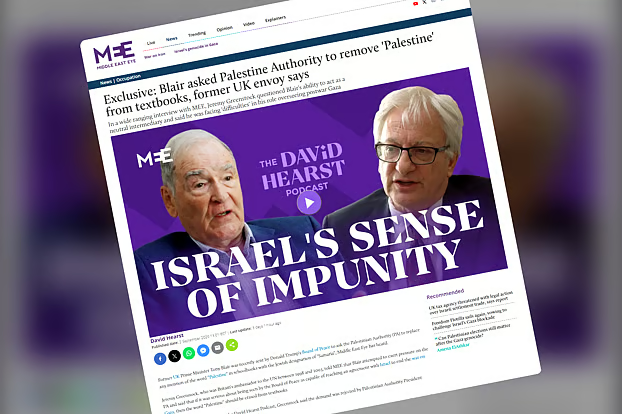
The “Board of Peace” set up by U.S. President Donald Trump to bring “peace” to Gaza, the Palestinian territory devastated by Israel’s brutal and indiscriminate attacks, recently sent former U.K. Prime Minister Tony Blair to the Palestinian territories. There, he proposed that the Palestinian Authority (PA) remove the word “Palestine” from textbooks and replace it with “Samaria,” the name given by Israelis. Middle East Eye (MEE) has learned of the development.
Jeremy Greenstock, who served as the U.K.’s ambassador to the United Nations from 1998 to 2003, told Middle East Eye that Blair attempted to pressure the Palestinian Authority. He said that if the Palestinian Authority genuinely wanted to build an image with the peace board that it was capable of reaching a settlement with Israel to end the war on Gaza, Blair had suggested it should remove the word “Palestine” from textbooks.
In a detailed interview on the “David Hearst Podcast,” Greenstock said Palestinian President Mahmoud Abbas directly rejected the unjust demand.
Greenstock also said his former boss, Blair, has now run into considerable “trouble and complications” while overseeing postwar Gaza management on behalf of the board.
“As far as I understand, the peace board recently sent Blair to Ramallah. The purpose was to ask the Palestinian Authority to remove the word Palestine from the Palestinian curriculum, in order to demonstrate the qualifications needed to strike a deal with Israel to end the Gaza war that began after Oct. 7, 2023,” Greenstock said. He said he received this information from a reliable ministerial-level source.
“President Mahmoud Abbas made clear he would never do such a thing,” Greenstock said. “I’m astonished the peace board was even able to raise such a demand about the Palestinian curriculum. What principle are they operating on? I doubt whether they have any real understanding of justice, honesty, or the history of this crisis at all.”
A spokesperson for Tony Blair denied the claim, calling it “completely untrue and entirely fabricated.”
It has been reported that in mid-August, Blair traveled to Israel along with Trump’s son-in-law Jared Kushner and Gaza high representative Nickolay Mladenov. There, they met with Israeli Prime Minister Benjamin Netanyahu, even though Netanyahu had earlier rejected Trump’s so-called Gaza “peace plan.”
The three-member delegation then traveled to Cairo, where they met with the Palestinian technocratic team awaiting responsibility for Gaza, as well as members of Hamas, the Palestinian liberation movement.
In the interview, Greenstock also discussed Blair’s role in the Iraq war. He said that before the invasion of Iraq, Blair persuaded then-U.S. President George W. Bush to seek United Nations authorization. But he sharply criticized Blair’s current role on the “Board of Peace” formed by the current U.S. president for Gaza’s reconstruction.
Greenstock said Blair is not in a neutral position from which he could negotiate while giving equal weight to both sides. “Because of the Iraq war and his conduct on the Palestine question after leaving office in the U.K., everyone will consider him biased. So I think he is facing, and will continue to face, a serious credibility crisis in this role,” he said.
Greenstock retired from government service in March 2004. He described the Board of Peace as an “unrealistic and whimsical committee,” saying a body structured this way cannot meaningfully influence either Israel or the Arab world on the ground on the Palestine question.
“This peace board doesn’t have a solid enough foundation to bear the weight of the difficult decisions that need to be made about the future of the Palestinian territories,” Greenstock said.
Washington brokered a ceasefire to end the Gaza war last October. President Donald Trump then formed the so-called peace board. Under Trump’s plan, Hamas and other Palestinian factions had agreed to disarm. But Israel has refused to withdraw its troops from Gaza until that process is complete.
Even after the ceasefire took effect, Israel has continued repeated air and drone strikes across Gaza. These strikes have killed at least 1,300 Palestinians and wounded more than 4,000.
Last Tuesday, Israel carried out at least seven airstrikes within just 10 minutes in the western part of Gaza City. The area was then surrounded with quadcopter drones, which indiscriminately fired on and dropped explosives on anyone moving in the area.
An effort to erase the name of Palestine
Israel and its supporters have intensified a worldwide effort to erase the word “Palestine” from history books and museums.
Israeli authorities have already tightened control over the education system in occupied East Jerusalem. As part of this, starting Tuesday, they began imposing their own curriculum on more than 45,000 Palestinian students at public schools there.
Middle East Eye has learned that a revised curriculum has been quietly circulated for review in the occupied Palestinian territories.
Earlier this year, the curriculum of UNRWA, the U.N. refugee agency, sparked controversy in Lebanon as well. Israel has already banned the agency.
On some sixth-grade regional geography maps used in UNRWA-run schools in Lebanon, the word “Palestine” was replaced with “West Bank” and “Gaza Strip.” The move triggered widespread protests there.
An investigative team led by former French Foreign Minister Catherine Colonna, formed to examine Israel’s allegations that UNRWA staff were involved with a terrorist organization, found no evidence to support the claim. However, the team put forward 50 recommendations to further strengthen the agency’s neutrality.
Meanwhile, a cross-party alliance of British MPs has called for an investigation into the removal of the words “Palestine” and “Israeli occupation” from an exhibition at the British Museum in London.
A Middle East Eye investigation found that museum authorities decided to remove those words between October and December 2024 under pressure from pro-Israel lobbyists.
Greenstock is among the former ambassadors who have called for a boycott of products made in illegal Israeli settlements. In the interview, he warned the U.K.’s new prime minister, Andy Burnham, and urged him to take a tougher stance against Israel.
“If the Burnham government doesn’t stand firm on basic principles, how can it talk about principle anywhere else?” Greenstock said. “How does it work that Burnham will go to Kyiv to support President Zelensky over Russia’s aggression in Ukraine, which violates the U.N. Charter, but won’t stand for justice on the Arab-Israeli question in the Middle East?”
Greenstock said the U.K. must consider arms transfers to Israel with extreme caution. He said that if Netanyahu or former Defense Minister Yoav Gallant travel to Britain, they should be arrested immediately, since the International Criminal Court (ICC) has issued arrest warrants for both men.
“The U.K. is legally bound by having signed the U.N. treaties and the ICC statute. Anyone charged under a warrant issued by ICC judges should be arrested,” Greenstock said.
Greenstock believes bringing the West Bank under Israeli authority is Netanyahu’s ambition — a way of fulfilling a commitment he made to his father, Benzion Netanyahu, a scholar of Jewish history.
“I’m certain that fulfilling his father’s dream — bringing ‘Judea and Samaria’ (the West Bank) under Israeli sovereignty — is Netanyahu’s aim. He has treated the Oct. 7, 2023 attack as a major opportunity to achieve that goal,” Greenstock said.
Greenstock said the U.K. could be a great admirer of Israel’s achievements as a democratic, technologically advanced society. “But what Israel is doing in Palestine and the region is a flagrant violation of international law, and most of the British public does not support it either. Israel has adopted a policy of eliminating every enemy through military force and killing rather than pursuing a political solution — should we continue our trade relationship with such a country?” he said.
A warning
Greenstock also had a warning for ordinary Israeli citizens. “If I were an Israeli citizen, I would be deeply worried about the country losing its image around the world. A negotiated settlement is essential for long-term peace and security in the Middle East. Once the fighting ends, a security understanding must be reached with the Arab countries and with Iran,” he said.
Greenstock added, “A solution has to be found somewhere. The idea that you can send troops into Iran, change the government, leave, and expect Iran to be completely transformed is unrealistic. That will never happen. Sending a few hundred thousand troops to occupy a country of more than 90 million people is not a realistic idea.”
Greenstock noted that neither the U.K. nor the U.S. has won a war since Kosovo. He said the root cause of repeated failures in Afghanistan, Iraq, Yemen, Libya, Syria and now Iran is Washington’s excessive reliance on military power. He said this mindset of using force to impose one’s will has steadily eroded U.S. credibility in global politics.
“We live in a world where power has become far more diffuse. A positive image matters enormously now. The ability to persuade matters far more than the use of force. The world is far more open now, and many actors beyond governments now play a role in decision-making. The legitimacy of using force has diminished significantly in the eyes of world opinion,” Greenstock said.
Greenstock had direct experience working with the Bush administration during the Iraq war and with Paul Bremer, head of the Coalition Provisional Authority formed in Iraq.
Drawing on that experience, Greenstock said, “I think Britain had influence at that time. In the autumn of 2002, Tony Blair and the British team persuaded the American team to bring in the United Nations. Then-U.S. Secretary of State Colin Powell also played a major role in that.”
“But when the final military operation in Iraq began in March 2003, Blair wanted to delay it. He asked to wait until there was clear evidence of weapons of mass destruction. But the Americans dismissed his request as stalling,” Greenstock said.
Greenstock said Britain’s influence over the U.S. on tough decisions like the Iraq war was not “first class,” but “second class.”
He added, “George W. Bush’s two main advisers were then-Vice President Dick Cheney and Defense Secretary Donald Rumsfeld. They gave no weight at all to the realities Secretary of State Colin Powell tried to raise. They relied only on military strength. On decisions of that magnitude, Britain’s role was purely second class.”
The Iran war and the ‘Mecca agreement’
Greenstock said Donald Trump misjudged Iran’s character from the start. “I don’t believe Washington had any real plan for what the consequences of striking Iran might be,” he said.
“Washington did not properly account for Iran’s ability to strike across the Persian Gulf or to close the Strait of Hormuz. Nor did it consider the asymmetric power of drone warfare. Drones don’t just strike military targets — they also pose a major threat to commercial shipping, oil transport and ordinary maritime trade. Washington never thought through, before making its decision, the risk of mines being laid in Hormuz alongside drone attacks on ships,” Greenstock said.
Greenstock said the timing of the strike on Iran did not rely solely on Israeli intelligence. The strike came at a time when speculation over the notorious sex offender Jeffrey Epstein’s files and legal action against the Trump administration was at its peak. That, he said, was no coincidence.
“The timing of the Iran strike may well have been chosen to divert attention from events unfolding at home in the United States,” Greenstock said.
Greenstock also said the recently signed “Mecca Agreement” between Turkey, Saudi Arabia and Pakistan in Riyadh essentially reflects their loss of confidence in American power. “This Mecca Agreement is a clear signal that they intend to secure their own self-reliance. But it may not meet every need for self-reliance on its own. There is much more to be done on this front, and it will be done,” he said.
Greenstock identified two main reasons behind the erosion of trust in the United States in the Middle East. “First, American military power has failed to bring about the positive political change in the Middle East that Arab countries expected. As a result, the U.S. is unable to deliver in practice on what it claims,” he said.
“Second,” Greenstock added, “the United States is clearly prioritizing its own ‘Make America Great Again’ agenda over the interests of its allies. As a result, its credibility in the eyes of its Arab allies has fallen considerably.”