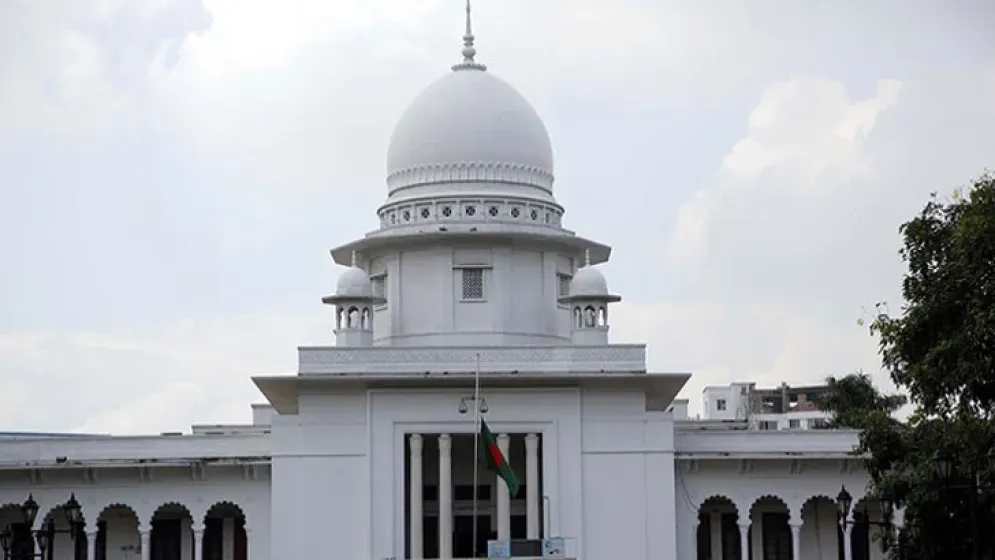
Two Supreme Court lawyers have sent a legal notice to relevant government officials demanding adequate and rational budget allocation for the Supreme Court and judiciary, the appointment of judges, and necessary steps to ensure faster, fairer justice.
The notice was sent in the public interest Sunday (Sept. 6) by Barrister Mohammad Humayun Kabir Pallab and Barrister Mohammad Kawsar, acting as ordinary citizens and Supreme Court lawyers, via registered mail and email.
The notice names the secretary of the Law and Justice Division, the cabinet secretary, the Finance Division secretary, the registrar general of the Supreme Court, and the attorney general as respondents.
According to the notice, as of Dec. 31, 2024, about 31,120 cases were pending in the Appellate Division and about 580,000 in the High Court Division.
Currently, six judges serve in the Appellate Division and 103 in the High Court Division. The notice claims this number of judges is inadequate compared to the huge volume of pending cases.
It also cites recommendations from the Judiciary Reform Commission, which has recommended increasing the number of judges in subordinate courts from about 2,000 to at least 6,000, and maintaining a minimum of seven judges in the Appellate Division.
The notice further states that Bangladesh has roughly one judge for every 94,444 people, a ratio it claims is lower than in neighboring countries.
Demand for more benches in High Court, Appellate Division
The notice states that only two benches are currently functioning to settle commercial cases in the High Court Division, meaning a huge volume of commercial disputes has remained pending for a long time, lawyers say.
Meanwhile, although the Appellate Division had as many as 11 judges at its peak in 2009, the number of judges has dropped significantly since then, the notice says, making it difficult to run multiple benches and settle the large volume of cases quickly.
The notice also states that only 35% of cases filed in the High Court Division and 18% in the Appellate Division were settled during October-December 2024.
Hardship for lawyers and litigants
The notice highlights the shortage of adequate chambers, seating, toilets, clean drinking water, library facilities and digital amenities for Supreme Court lawyers.
It states that infrastructural limitations force litigants to wait for long periods in court corridors, while a shortage of courtrooms and limitations in digital case management are also disrupting judicial proceedings.
The notice further claims that the lack of necessary equipment and infrastructure in the judiciary is creating various administrative complications in judicial proceedings.
The remaining demands
– Ensuring the minimum necessary facilities for lawyers;
– Drawing up a rational budget structure for the judiciary in consultation with the chief justice;
– Appointing an adequate number of judges to the Appellate and High Court divisions and forming the necessary benches;
– Determining the necessary number of judges and benches by analyzing case volume, disposal rates and the trend of newly filed cases;
– Publishing a specific assessment report on the matter;
– Publishing a separate, transparent annual account of revenue collected through the judiciary.
The notice also states that, under Article 21 of the constitution, citizens have a duty to uphold the constitution, and lawyers, as officers of the court, are obligated to help prevent constitutional violations. It says that while Article 22 of the constitution establishes a constitutional obligation to keep the judiciary separate from the executive, judicial independence cannot be effectively realized without adequate funding and infrastructural support.
Lawyers say the national budget for fiscal 2026-27 proposes 291 crore taka for the Supreme Court, up from 270 crore taka in the revised budget of the previous fiscal year. The notice claims this allocation is extremely small compared with the country’s overall budget.
The notice also questions the overall allocation for the judiciary. Citing remarks by Law Minister Md. Asaduzzaman, it says the allocation for the entire judiciary is about 2,200 crore taka, while Bangladesh Television receives 2,500 crore taka and the Ministry of Youth and Sports receives more than 4,000 crore taka.
According to the lawyers, such an allocation for a judiciary responsible for ensuring justice for a huge number of citizens reflects state neglect.
The notice states that inadequate allocation for the judiciary is not a new issue. Over the past two decades, an average of only 0.41% of the national budget has been allocated to the judiciary. In some years, the notice says, there was no allocation at all for the Supreme Court’s development sector.
Lawyers say that despite the huge number of pending cases in the higher and subordinate courts, funding and infrastructure have not been increased as needed, creating a major imbalance between the number of judges and cases, alongside shortcomings in modern case management, digital infrastructure and other necessary facilities.
The notice further states that the judiciary is not merely an expenditure sector for the state. Through court fees, non-judicial stamp duties, process fees and fines, the judiciary also contributes significant revenue to the state treasury. However, it alleges that a separate, transparent government account of total revenue collected through the judiciary is not published.
The notice states that those concerned must inform the notice-senders in writing, within three days of receiving it, of what steps have been taken.
Otherwise, the notice warns, a writ petition will be filed in the High Court Division in the public interest, alleging violation of various articles of the constitution.