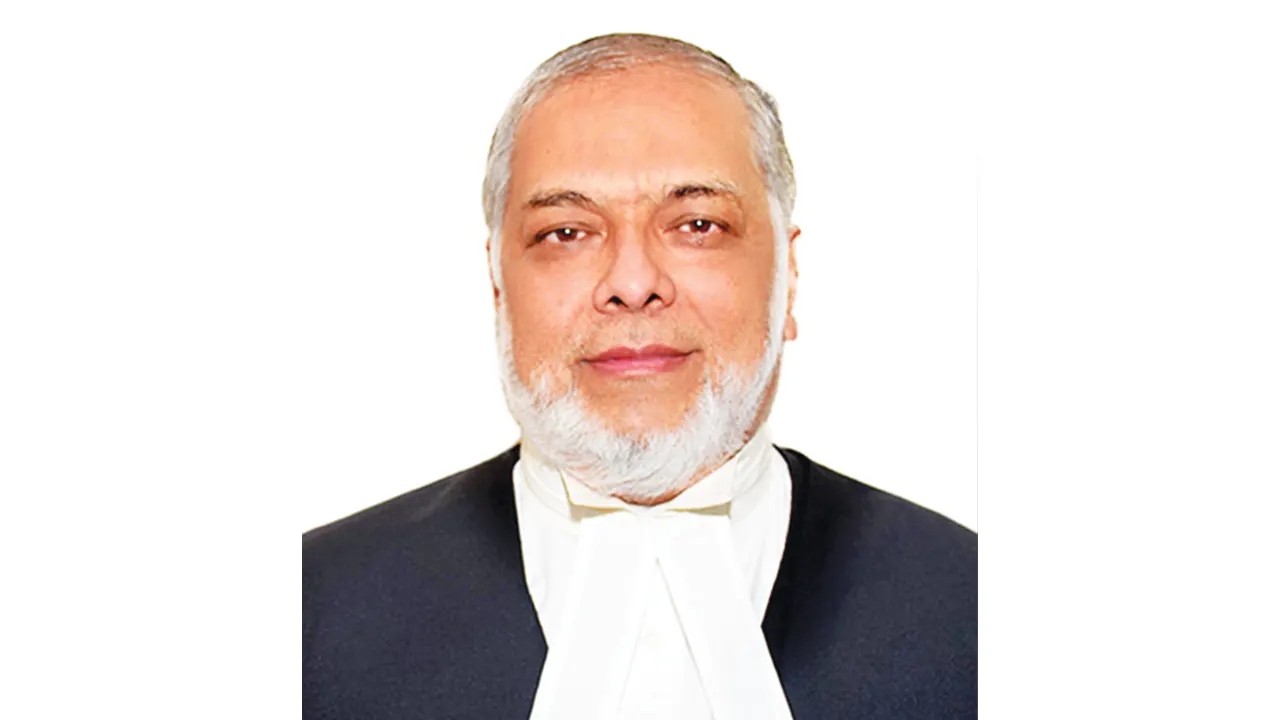
Chief Justice Zubayer Rahman Chowdhury has said that whatever else artificial intelligence (AI) may be used for, it cannot be used to write judicial rulings. Doing so, he said, would be improper.
He made the remarks Saturday, August 29, as chief guest at the inaugural session of “AI Governance Summer School 2026,” held at the Asiatic Society of Bangladesh auditorium in the capital.
Describing AI’s future as boundless, the chief justice said its use is something we need to understand. He said that in trying to understand how far AI can be applied, what he considers essential is recognizing that it has both a positive and a negative side.
Citing an example from a case in Britain, the chief justice said: “I read in the newspaper that in a case in Britain, a reference was made to another case. The judge accepted that reference and ruled in the litigant’s favor. That ruling was then followed in three or four subsequent courts. Some time later, research found that no such case had ever existed. The judge was left deeply embarrassed. But by then, the ruling had already been delivered.”
He said the risk with AI is that it is very difficult to use without verification.
Noting that August 27 marked 23 years since he began his judicial career, the chief justice said: “There is one thing I have learned in my modest career — whatever else you do with AI, you cannot use it to write a judgment. That would be improper.”
He said: “A judgment has to be written using three things — I say this from my own experience. The first is ‘on the facts’ — what is the case actually about? Then you apply the law relevant to those facts. You have to determine which law applies to the case, and which section or subsection of that law is relevant. The law is very broad.”
“First comes the facts, then the law. Lastly, when you make your decision, alongside the facts and the law, what I use — what every judge uses — is your conscience. Is this right? That is ethics. Conscience.”
Noting that this conscience cannot be governed by AI, the chief justice said conscience comes from within a person — it is their own self-driven capacity for thought. When a person loses that capacity for thought, he said, he believes they become much diminished.
Also speaking at the inaugural event were Additional Attorney General Barrister Anik R Haque, currently serving in the Attorney General’s role, and Dhaka University Law Faculty Dean Prof Dr Mohammad Ikramul Haque. The welcome address was delivered by Deputy Attorney General Barrister Tasnova Shelly.