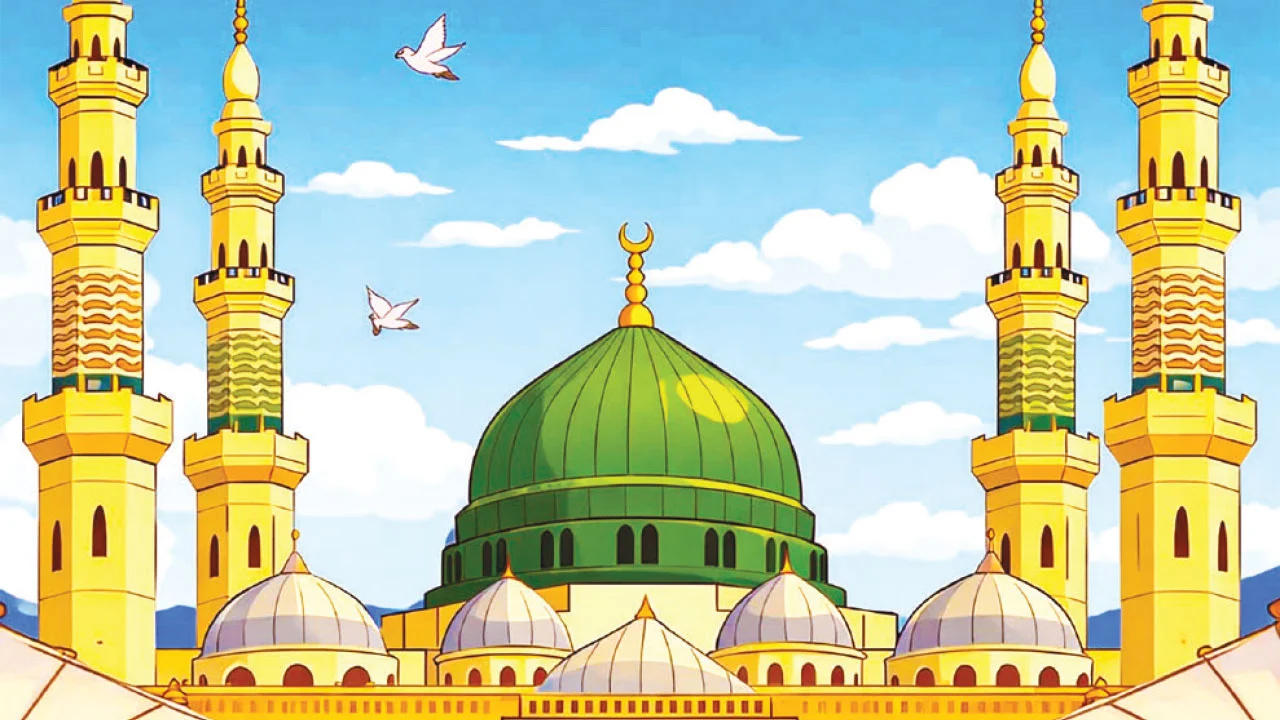
All the people of the world had, one by one, fallen asleep, heads resting in the lap of silence. Even the restless birds were quiet, still. A deep tranquility surrounded everything. And yet the nature of Arabia was awake. The desert plains of Arabia had adorned themselves. The sky spread its wings overhead, taking on some strange new form that night. The moon seemed caught up in some secret conversation with the heavens. Even the stars, hundreds of thousands of miles away, seemed to shine with joy, forgetting the sorrow of their solitude. It felt as though they could not witness today’s joy without leaning a little closer toward the earth. Some entrancing melody rode the air, drifting from plain to plain. Something was about to happen. Some sign of it played like an unseen song in the pulse of the earth’s every living thing. Mecca did not yet know what momentous hour of history stood at its door. The world did not yet know that such a man was coming, whose name would be spoken century after century. Whose life would change the course of human thought, society, civilization and history. He was coming. The Prophet of Mercy. The Teacher of Humanity. The final Messenger of Allah, Muhammad (peace be upon him).
Wrapped up in the birth of the infant Muhammad (peace be upon him) is an extraordinary account of light. One narration connected to his mother, Amina bint Wahb, describes her seeing a light whose glow illuminated the palaces of Sham. A hadith narrated in Musnad Ahmad states that at the time of the Messenger of Allah’s (peace be upon him) birth, his mother saw a light by which the palaces of Sham were illuminated. In another narration, the Messenger of Allah (peace be upon him) himself is said to have recounted his mother’s dream, saying that while she carried him, she saw a light whose glow illuminated the palaces of Busra in Sham. How remarkable — a child still in his mother’s womb, and yet the light heralding his arrival seemed to point far beyond the boundaries of Mecca, toward distant Sham. It was as though the first news of light had reached a world still steeped in darkness. Not just one household, not just one city — a single light seemed to carry an announcement that would illuminate a vast horizon yet to come. In the imagination of the poet Kazi Nazrul Islam, that scene grows even more enchanting: “As if the crimson sun sways in the lap of dawn, come and see, in Amina’s lap.” And indeed — what lay in Amina’s lap then was not merely a child. In that lap, a new chapter of history itself lay sleeping.
Toward the end of the night, the knot of mystery came undone. A new dawn rose in the history of the world. Amina’s lap was lit up by the birth of a wondrously beautiful human child. His face seemed to shine brighter than the full moon. His small body was as soft and pure as a freshly bloomed flower. He was Muhammad (peace be upon him). A child was born to light up a mother’s lap — a child whose arrival would go on to change the course of human history. At a time when Arabian society was steeped in the darkness of ignorance, idol worship, tribalism, oppression and moral decay, this was the moment such a man was born through whom Allah would open the door of guidance for humanity. The Quran calls him “a mercy to all the worlds.” His arrival, then, was not simply the birth of a child. It was the beginning of a new chapter of mercy.
A new rhythm seemed to return to the flagging life of mother Amina. The dimmed light of her tear-blurred eyes seemed to brighten once more. Though alive, she had, until then, seemed wrapped in death’s dark shroud. Her husband’s death had stolen away many of her dreams, much of the color from her life. But today, with this child lighting up her lap, a new bond with life seemed to form. Days that had been full of grief now carried a touch of joy. Nights that had been long and mournful were now settled by peace. With thirsty eyes, mother Amina looked at her child again and again. The more she looked, the more her longing to look grew. The child’s wonder-filled gaze stirred so many dreams in his mother’s heart. It felt as though she wanted to devote her entire life to this messenger of peace, pouring out all the tenderness gathered in her chest onto her gentle child. Neighboring women began arriving in groups to see the child. Their astonished eyes fixed on the infant’s face. They were captivated by his beauty. My child, treasure beyond seven kingdoms! The moisture on his lips seemed sweet as honey. His wondering gaze held such an allure that it drew the heart toward him on its own. This was the infant Ahmad! Whose arrival carried with it that astonishing news of light.
Various books of Seerah and Dala’il record other extraordinary events said to be connected with the Prophet’s (peace be upon him) birth. Among the most well known is the trembling of the palace, or iwan, of the Persian emperor Khosrow, and the collapse of its fourteen balconies, or sharafat. The same accounts say that a fire which had burned for a long time in a Persian fire temple went out that night. They also mention the drying up of Lake Sawa. And they describe a strange dream seen at Khosrow’s court, in which Arab camels and horses were seen crossing the Tigris river. One by one, these events seemed to carry the message of a new age arriving. The fire of the Persian fire temple, the trembling of Khosrow’s palace, the drying of Lake Sawa, and a child born on the plains of Arabia — together, they seemed to raise the curtain on a new chapter on history’s stage. According to the commonly told account, a fire in a Persian fire temple went out on the night of the Prophet’s (peace be upon him) birth. In the Zoroastrian tradition of fire worship, fire held a place of special reverence. Many, therefore, have seen in this event a symbolic sign — the light of monotheism rising over the world, past an age of darkness. The story of Lake Sawa is likewise tied to the Prophet’s (peace be upon him) birth. It is said that the lake’s water dried up that night. And the collapse of fourteen balconies of Khosrow’s palace also appears in various historical accounts. It was as if the old world trembled at the arrival of a new one.
But what, exactly, was this light? Was it merely light that lit up the sky? Merely light that lit up a palace? No. The greatest light of his arrival was the light of guidance. The Quran states: “There has come to you from Allah a light and a clear Book.” This light is not for the eyes, but for the heart. This light does not illuminate a dark room, but a dark heart. This light is not confined within a palace’s walls. It spreads into people’s faith, character and lives. The journey of light that began in that small house in Mecca spread from Mecca to Medina, from Medina across Arabia, and from Arabia to the far corners of the earth. A people who once buried their infant daughters alive, through his teaching, grew so tender-hearted that they learned to worry over the suffering of a baby bird. Tribes that had warred for years over trivial causes became, through his teaching, brothers to one another. In a society where might alone was the measure of justice, he established human dignity. Into a world submerged in darkness, he brought the light of monotheism. So the greatest miraculous sign of his birth was not merely a trembling palace. The greatest sign was that one man came, and through him, a nation was transformed. A nation was transformed, and history changed. History changed, and the hearts of countless millions changed course.
The poet has compared the Prophet’s (peace be upon him) arrival to a flower. A wondrous flower blooming in the heart of the Sahara. A flower whose color did not beautify just one garden. Whose fragrance did not spread through just one town. Instead, its fragrance has carried on from age to age. In the words of Kazi Nazrul Islam, that feeling becomes: “In the Sahara bloomed a crimson tulip, and with that flower’s fragrance the world today is intoxicated. Moon and sun, planet and star, all vie for that flower, the quiet blue sky bends low to kiss it. By that flower’s radiance the Throne and its footstool shine, touched by that flower’s color the three worlds today are illumined.” The poet’s language is the language of love. And the language of history tells us that this newborn child would one day unite Arabia’s scattered tribes in the bond of faith. He would call people drowning in the darkness of ignorance toward monotheism. He would stand against oppression. He would establish human dignity. And through his hands would come Allah’s final revelation. So the greatest light of that birth night was not simply some light seen in the sky. The greatest light was the guidance that spread across the world through him. That light has not gone out even today. The light whose journey began in that small house in Mecca still burns in the hearts of countless millions today. That light is not confined within any palace’s walls. Nor is it confined to the sands of any desert. It belongs to no single nation. It is the light of the human heart. And the bearer of that light was Muhammad, the Messenger of Allah (peace be upon him). A flower bloomed in the desert of Arabia. But its fragrance intoxicated the world. That flower’s name is Muhammad (peace be upon him).